
15+ Standard Criteria for Employee Evaluation in HR Management | Wotech Electronics
Vũ Khôi
Tác giả tại Wotech Electronics Blog
15+ Standard Criteria for Employee Evaluation in HR Management
Vũ Khôi
Author at Wotech Electronics Blog
Employee evaluation is an indispensable activity in the HR management process of any company. Employees are the core of the business, so evaluation is the basis for managers to review and reassess the company's structure and make appropriate reward and disciplinary decisions to build an ever stronger workforce.
What is employee evaluation?
Employee evaluation is management's work of reviewing employees' contributions and work performance over a given period at the company. Almost all businesses, large or small, have their own personnel evaluation system. However, to have a complete evaluation process, a business needs not only a comprehensive set of criteria but also a management system to store and track evaluation results across each working period.

Employee evaluation can be said to be one of the most important steps in HR management. Based on competency assessments, management can grasp the work performance of each individual, each team, each department, and the whole business. From there, they can make decisions — promotions, raises, reminders, or reprimands — fairly and reasonably. As a result, each employee becomes aware of the strengths they should develop and the shortcomings they face at work, and gains more motivation to keep striving and improve performance.
Typically, businesses can conduct employee competency evaluations at the following times:
-
Periodic evaluation: includes monthly, quarterly, or annual HR review cycles; it allows assessment of how employee performance changes across multiple periods.
-
Situational evaluation: includes evaluating employees after probation, after completing each project, or when a contract expires for renewal consideration; it assesses employee capability in the short term against specific expectations, enabling timely decisions and adjustments that fit the company's direction.
How do you evaluate personnel effectively?
Evaluating employee capability objectively and accurately is no easy task. First, different staff levels need different competency evaluation frameworks. For example, the evaluation criteria for the Sales department differ from those for Administrative and HR staff in terms of skills and expertise; or the criteria for a Manager position differ from those for Staff in terms of job responsibility. Second, evaluation criteria must be clearly measurable, avoiding vague, generic criteria. Specifically, each criterion needs a relative rating scale — for example a 1–4 scale, or pass/fail. Third, managers also need to stay close to employees' work to understand not only the results but also each individual's working process. That gives a more comprehensive view and the fairest, most fitting assessments.

Furthermore, to correctly gauge employee capability, leaders must consider the factors from a more multidimensional, objective perspective. Based on defined evaluation goals, each company can combine suitable evaluation formats, including:
-
Self-evaluation: employees rate their own ability to meet job requirements and their work attitude on the company's evaluation form, then submit it to superiors for review and approval.
-
Hierarchical evaluation: managers directly evaluate their subordinates, then consolidate the comments and talk directly with employees to plan suitable direction and adjustments.
-
Peer evaluation: also called "cross-evaluation", where employees at the same level evaluate one another.
-
360-degree evaluation: an evaluation based on comments and feedback about the employee from customers, colleagues, and the direct manager, providing the most complete, well-rounded view of the person being evaluated.
Basic criteria for evaluating employees
Every job has its own specifics and needs a different set of evaluation criteria. However, any job should be assessed on 2 basic criteria: job-related criteria and human-related criteria; each of these in turn encompasses the following sub-criteria:
Job-related evaluation

1.1. Discipline and attendance evaluation
-
Punctuality and working the required hours.
-
Compliance with the company's labor rules.
-
Compliance with the department's working regulations and rules.
1.2. Skills evaluation
-
Negotiation and persuasion skills
-
Problem-solving and incident-handling skills
-
Planning and work management skills
-
Professional skills
1.3. Target completion evaluation
Employees are assessed based on their KPI system or OKR figures monthly, quarterly, or annually. These metrics are the basis for superiors to promote, raise salaries, or remind and reprimand employees.
1.4. Work progress evaluation
-
Average work performance
-
Average time to complete work
-
Average volume of work completed within a given period
-
Ability to finish work on time; number of missed deadlines.
1.5. Work quality evaluation
-
Level of job absorption
-
Level of care and thoroughness at work
-
Degree of compliance with work standards
1.6. Teamwork evaluation
-
Communication skills with colleagues
-
Spirit of cooperation
-
Ability to manage projects and assign work
1.7. Critical thinking evaluation
-
Problem-solving ability
-
Ability to research, analyze, and synthesize information
-
Ability to form and defend an opinion
1.8. Creativity evaluation
-
Ability to contribute to company projects
-
Ability to propose feasible initiatives to develop projects
-
Ability to propose workflow improvements
1.9. Crisis handling evaluation
-
Ability to adapt to work pressure
-
Ability to improvise and stay flexible at work
-
Ability to manage and anticipate risks
Human-related evaluation

2.1. Deportment evaluation
-
Neat, clean clothing in line with regulations
-
Awareness of maintaining general hygiene and workplace cleanliness
-
Agile, brisk demeanor
2.2. Fit with company culture
-
Ability to integrate into the company
-
Friendly, open personality
-
Level of satisfaction with the working environment
2.3. Work attitude evaluation
-
Proactiveness and enthusiasm at work
-
Carefulness and thoroughness at work
-
Discipline at work
2.4. Honesty evaluation
-
Trustworthiness at work
-
Trust placed in colleagues
2.5. Learning spirit evaluation
-
Ability to learn proactively
-
Level of updating new knowledge in the field
-
Willingness to join the company's training courses
2.6. Workplace relations evaluation
-
Attitude toward superiors, colleagues, and customers
-
Ability to proactively cooperate and coordinate with other departments
2.7. Career drive evaluation
-
Short-term/long-term development goals
-
Attitude and actions toward those goals
Evaluating employees with SimERP software and the Appraisals app
SimERP is one of the pre-programmed ERP solutions businesses can download and use. Developed with more than 1,000 features covering the full range of business needs — sales, customer care, project management, financial management, HR management, logistics, and more — SimERP has been and is being chosen by many businesses as a comprehensive enterprise management solution.
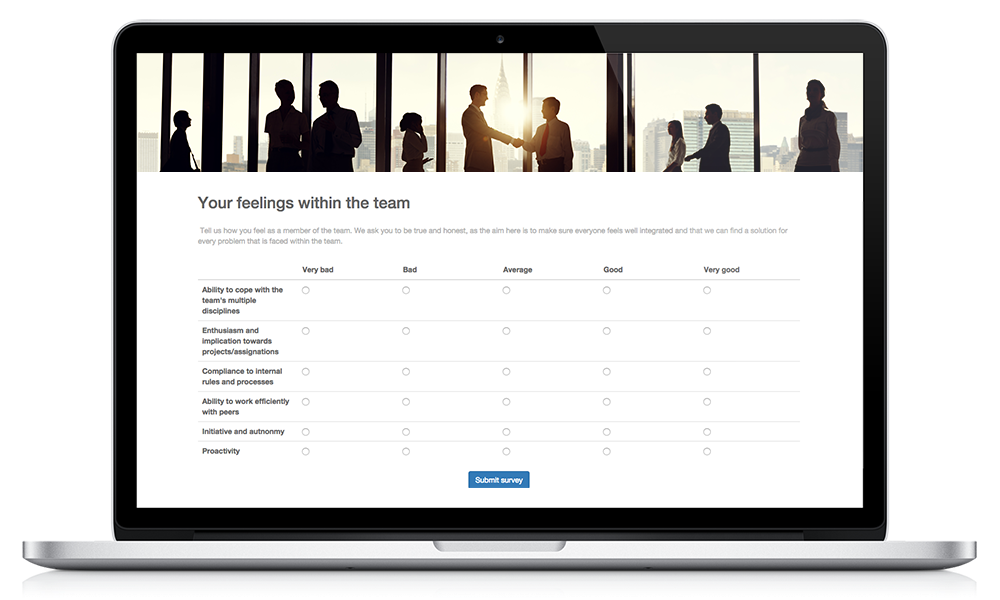
Among these, the SimERP Appraisals HR evaluation app is also widely adopted, allowing businesses to create evaluations and assess employee work performance in just a few minutes. With the Appraisals feature, whether the business is large or small, setting up periodic personnel evaluations has never been simpler.
Advantages of evaluating employees with the Appraisals app on SimERP
-
Easy tracking: View the evaluation status of each employee or the entire company.
-
Clear scheduling: Schedule and send reminder emails about upcoming review periods.
-
Employee feedback export: Convert evaluations into printable PDF files.
-
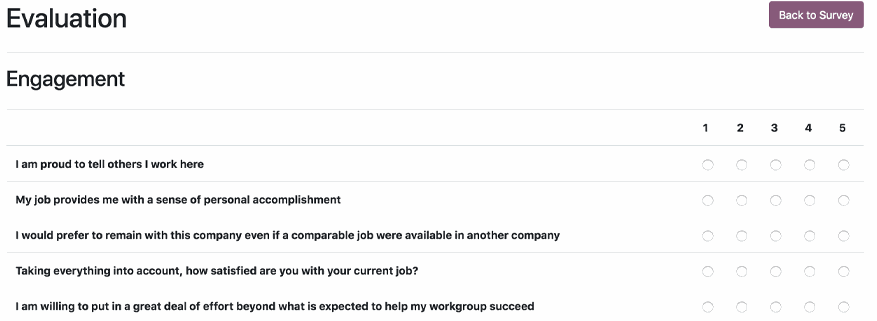
Build an effective evaluation process: Supports creating suitable survey templates to collect employee answers using built-in or custom forms. Easily manage evaluation formats: hierarchical evaluation (bottom-up, top-down), self-evaluation, and the manager's final evaluation. Allows employees to create evaluations themselves to send to subordinates, new hires, and managers.
-
Automated evaluation process: Ensures the process runs on schedule with full details on employees, levels, and departments, making evaluation content easy to review and manage.
-
Fully integrated with other SimERP apps such as Employees, Expenses, Recruitment, and Survey.
Summary
So, to build an excellent employee evaluation process, a business first needs a quality set of criteria to assess each individual's work performance as objectively and accurately as possible. On top of that, applying software such as SimERP's Appraisals app to the HR management system also helps drive the company's digital transformation, making the evaluation process automated, faster, and easier.
SimERP currently lets users try the SimCRM package free for 30 days. Sign up for a trial by clicking the button below!
Related articles
Bài viết liên quan

25 tháng 10, 2026 · 3 phut doc
2024年网页设计趋势预测如何? | Wotech Electronics
关于 2024 年网页设计趋势——步入 2024 年,年初正是我们为新事物预留时间的时刻。这也非常适合设计师群体唤醒我们内心的"艺术之魂"。闲话不多说,快来和 Markdao 一起浏览 2024 年的 UX/UI 设计趋势吧,说不定您就能为自己接下来的网页设计项目"迸发"出一个绝妙的点子呢!

25 tháng 10, 2026 · 1 phut doc
什么是网站(Website)?网站的详细定义及其带来的商业价值
什么是网站(https://www.markdao.com.vn/blog/website-la-gi)——这个问题或许已经无需定义,因为在如今这个信息时代,网站对每一家企业而言都是不可或缺的组成部分。正是网站帮助用户更近距离地接触企业所提供的产品和服务,从而提升经营效益。此外,要在当今竞争如此激烈的环境中求发展,网站是一个重要因素,它将带你走向品牌与销量上的双重成功。

25 tháng 10, 2026 · 1 phut doc
什么是SEO标准网站?一场"打赢"Google SEO标准的战役 | Wotech Electronics
99%的用户在购买前会先搜索信息,73%的用户只会访问排名前10的网站,并认定它们是值得信赖的品牌……在数字营销爆发的时代,这些数字有力地印证了SEO标准网站的重要性。然而,许多人对什么是SEO标准网站(https://www.markdao.com.vn/blog/huong-dan-toi-uu-seo-website-chuan-seo-on-page)仍然相当模糊,并未真正理解。达到SE…