7 Ways to Persuade Easy-Going and Difficult Customers to Buy | Wotech Electronics
Vũ Khôi
Tác giả tại Wotech Electronics Blog
7 Ways to Persuade Easy-Going and Difficult Customers to Buy
Vũ Khôi
Author at Wotech Electronics Blog
The 21st century offers businesses countless opportunities to find potential customers, run operations, and optimize products. However, the challenge facing businesses right now is how to maintain a stable customer base: attracting new customers while retaining existing ones. In the article below, let's explore how to persuade customers — the optimal method for solving both problems! This article focuses on the importance of customer persuasion and how to do it for your business.
What is customer persuasion?

Customer persuasion is a crucial activity in marketing and sales. It mainly uses direct communication (the buying process or seminars) or communication through advertising programs (image or text formats). Customer persuasion focuses on building the belief in the product – business – value that the customer will receive. This kind of persuasion usually happens before purchase, in these stages:
-
The customer has no need for the product yet: persuade the customer of the value they will receive from consuming/using the product/service. At this stage, the business needs a gain–loss strategy that plays on the customer's buying psychology.
-
The customer has a need for the product but is hesitating between providers: at this stage, the business must go beyond providing basic product information and features, focusing instead on the differentiators — the reasons why the customer should choose your product over a competitor's.
-
The customer has used/tried the product for only a short time: some customers are in the habit of changing their consumption habits by trying new brands' products. We can absolutely take advantage of this by persuading customers to strengthen their belief in the product and the business, retaining them so they become loyal customers.
Why do you need to persuade customers?

Before answering this question, put yourself in the position of a customer shopping for a product. Think about it: does belief in the product's quality and origin matter? Do you weigh whether the business is trustworthy and whether many people use that product?
Customers think the same way. They will always have doubts when considering a purchase — especially Vietnamese consumers. Moreover, with relentless competition from rival brands, the product alone is no longer the only factor deciding whether customers come to your business. Customer persuasion is essential, because only when they believe will customers decide to come — and to stay. By persuading customers, a business can:
-
Attract new customers who had no prior need for the product.
-
Attract customers who are still hesitating.
-
Retain the "trial" group of customers.
7 ways to persuade customers
Learn to "mirror" your customers

"Mirroring" customers simply means imitating their behavior — their manner, gestures, and speech. It may sound absurd, but according to a recent study, your customers will feel a sense of familiarity with your business if the salesperson speaks and communicates the way they do — it can be as simple as family circumstances or education level, etc.
In the first study, conducted in 2009, mirroring helped close sales in 67% of cases. A second study in 2011 showed that purchase likelihood increased by 18.1% — and notably, customers bought the products recommended by salespeople who appeared "like them." Observe your target customer group closely and develop persuasion approaches based on these traits:
-
Posture and movement. If your customer gestures with their arms while talking, move your arms too. If they cross their legs, cross yours the same way.
-
Speed and volume of speech: if the customer speaks slowly and softly, speak slowly and softly — and vice versa.
-
Manner: if the customer speaks simply, do the same; if their speech contains many difficult and rare words, make your phrasing more elaborate, so you always project the most familiar image possible.
-
Keywords: if the customer uses certain keywords in conversation, try to work those words into your communication.
Focus and listen to what customers share

Research conducted at Harvard in 2013 demonstrated that humans love talking about themselves. In the past, the questions doctors asked us triggered pleasure at the neurological level — we were listened to about our own problems, got to share how we could feel better, and everything revolved around us.
So if you want customers to follow your advice, first act like a doctor — focus more on the customer than on your product, listen to them, make them the center of attention, share relevant stories, and don't rush to talk about your product. In reality, most customers who come to your business have no intention of buying yet; they are looking for a "solution" to their problem. By listening to that problem, you lead the customer to the solution/product you provide. At that point, their trust in your business and product rises significantly.
Avoid unnecessary conflicts

The saying "the customer is king" may be outdated in the new era, but you and your sales staff should certainly minimize conflicts as much as possible. Follow these rules when persuading customers to buy: don't interrupt the other person, don't lie to them or hide important information, don't boast, don't speak rudely or mock customers, and above all never threaten them or go against their wishes. As you know, it is very easy for a dissatisfied customer to walk away from your brand.
Always offer more than one option

There is a misconception that you should give buyers only one option so they won't be tempted by "the grass on the other side of the fence." However, a study published in the academic journal Journal of Consumer Research in 2013 showed this is not an effective way to persuade customers.
In the study, buyers were offered only one DVD player to buy. The result: 9–10% of customers bought it. That is not a bad number, but when customers were given a second option, the rate suddenly jumped from 10 to 66%. The reason is that our brains want to choose the option with the least risk. When there is no choice, the lowest-risk option is usually simply not to buy. When there are two options, a comparison appears in the customer's mind — should I buy A or B, rather than should I buy A at all.
Become a friend to the customer

In the process of persuading customers, the salesperson bears the greatest responsibility for compromising with the customer and deciding whether they buy. When choosing sales staff, consider personality and pay attention to how employees communicate.
An introverted person may not appear friendly and may find it hard to talk with your customers; however, choosing someone too extroverted can make customers feel they have no personal space. Choose staff with a balanced personality so that talking with customers feels like chatting with a friend. Customers will then feel more at ease, leading to higher sales effectiveness.
But what if you have already hired both introverts and extroverts? HR expert Meredith Persily Lamel has pointed out ways to work with them:
-
With extroverts: let them handle direct customer communication. They excel at nonverbal cues and reading body language. Extroverts also tend to form their thoughts and logical chains by talking everything out loud. With this tendency, customers easily absorb the information and are easier to persuade.
-
With introverts: give them time to prepare. Introverts are not good at improvising; let them work behind the scenes to devise suitable customer persuasion strategies. They are observant and psychologically perceptive, so they easily read customers' mindset. If you want them to interact with customers, have them try persuading customers over the phone. That way, your customer persuasion effectiveness will soar!
Never "trash" your competitors
Many people believe the best way to elevate themselves is to "smear and badmouth" competitors. Human psychology is peculiar: our brains associate negativity with the person speaking it, not the subject being mentioned. If you keep berating a competitor's service, customers will feel you are untrustworthy and walk away, subconsciously concluding that the service you are hawking is not good either. Point out how you differ from competitors instead of dwelling on their shortcomings. Only then will you easily score points with your customers.
Simplify the persuasion process by applying technology
Today, the digital era has almost entirely changed consumers' habits, especially as customers use phones and the Internet to shop and access information. Beyond persuading customers over the phone, why not leverage the Internet to persuade them?
Persuading customers via email

Many businesses already use email marketing to capture customers' attention and build their trust in products through this channel. However, businesses should note the following points:
-
An engaging, persuasive opening: create a relatable email that zeroes in on the customer's problem and focuses on solving it. You can start with open-ended questions to make customers feel familiar, making it easier to draw them to click through to the content.
-
Keep content minimal: up to 80% of today's users tend to avoid long reads and will only read short, focused content.
-
Respond quickly: most businesses lose potential customers because of slow replies. Be ready for every scenario and answer customers as fast as possible.
-
Provide accurate information: once you have created a comfortable space that draws the customer into the content, accurate and necessary information is the best way to persuade them to care about and buy your product.
Use CRM tools to control information and automate customer care and persuasion
As mentioned above, the goals of customer persuasion include new potential customers, customers weighing brands against one another, and customers who don't yet know about the product. Grasping each group's information and understanding their needs allows salespeople to adjust their persuasion methods accordingly. To streamline information management and automate online persuasion activities, a CRM application is a tool many businesses have adopted on their digital transformation journey.
CRM modules let users grasp customer information, from personal details to consumption preferences; compile purchasing activity to analyze consumer behavior; and from there build personalized persuasion strategies, such as: delivering exactly the information the customer needs; answering questions for each customer segment; and — instead of spending hours writing emails one by one — automating online customer persuasion processes.
Introducing below an effective CRM lead management application — SimCRM:
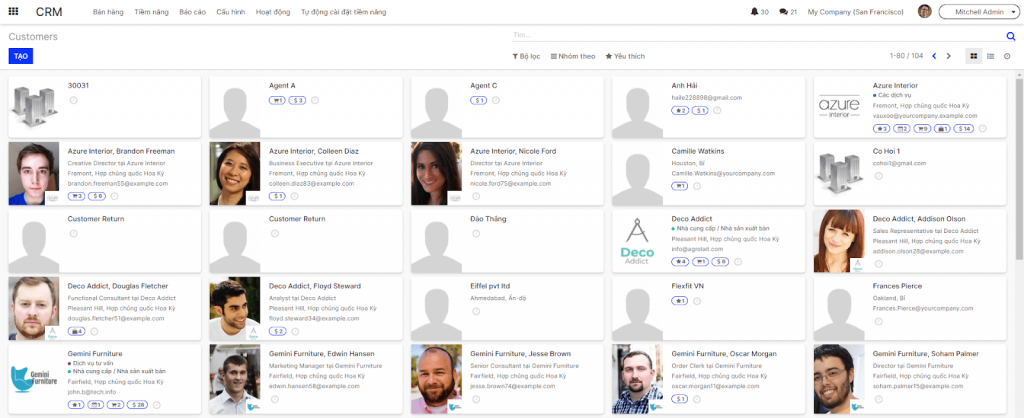
The application was refined into its most complete version in 2021, with many features that make the entire management process more convenient for businesses. Particularly worth mentioning
is the Email Marketing support tool — it makes persuading customers simple yet equally effective. The application can create email templates for specific products to provide information to buyers, helping the business stay in regular contact and persuade customers to purchase. SimCRM is offering this application to businesses free of charge.
How to persuade difficult customers
Difficult customers are those with high demands on the product and the advisory service, not easily satisfied, and sometimes prone to making unreasonable requests. Beyond the persuasion steps above, businesses should pay attention to the following when dealing with difficult customers:
-
Always be honest: honesty is the key to success in every business deal. Be especially careful with difficult customers, because they will always sense what you are hiding.
-
Proactively investigate the cause of this group's dissatisfaction. If you have delivered once or twice and the product still falls short of the customer's expectations, conduct deeper research with the people around that customer to find out what their real problem is. If you discover why your customer is dissatisfied in advance, you can carry out "under-the-radar" customer care by targeting their pain points.
-
Arm yourself with solid knowledge: one reason customers keep complaining about your product/service is that staff lack the knowledge to fully answer their questions. This creates the impression that the business lacks expertise and professionalism.
-
Create a sense of intimacy: certainly, find ways to remove the psychological barrier and distance between you and the customer. Listening to their stories and problems, sharing, and trying to understand their feelings will surely score points with this hot-tempered group of customers.
Conclusion
Clearly, we can hardly deny that customers are the most important part of any business. Attracting new customers and retaining existing ones can absolutely be achieved with the persuasion methods described above. In addition, make use of software like SimCRM to make each persuasion step more effective!
Related Articles
Bài viết liên quan

25 tháng 10, 2026 · 3 phut doc
2024年网页设计趋势预测如何? | Wotech Electronics
关于 2024 年网页设计趋势——步入 2024 年,年初正是我们为新事物预留时间的时刻。这也非常适合设计师群体唤醒我们内心的"艺术之魂"。闲话不多说,快来和 Markdao 一起浏览 2024 年的 UX/UI 设计趋势吧,说不定您就能为自己接下来的网页设计项目"迸发"出一个绝妙的点子呢!

25 tháng 10, 2026 · 1 phut doc
什么是网站(Website)?网站的详细定义及其带来的商业价值
什么是网站(https://www.markdao.com.vn/blog/website-la-gi)——这个问题或许已经无需定义,因为在如今这个信息时代,网站对每一家企业而言都是不可或缺的组成部分。正是网站帮助用户更近距离地接触企业所提供的产品和服务,从而提升经营效益。此外,要在当今竞争如此激烈的环境中求发展,网站是一个重要因素,它将带你走向品牌与销量上的双重成功。

25 tháng 10, 2026 · 1 phut doc
什么是SEO标准网站?一场"打赢"Google SEO标准的战役 | Wotech Electronics
99%的用户在购买前会先搜索信息,73%的用户只会访问排名前10的网站,并认定它们是值得信赖的品牌……在数字营销爆发的时代,这些数字有力地印证了SEO标准网站的重要性。然而,许多人对什么是SEO标准网站(https://www.markdao.com.vn/blog/huong-dan-toi-uu-seo-website-chuan-seo-on-page)仍然相当模糊,并未真正理解。达到SE…