AI Is Shrinking Job Opportunities for Young US Software Developers: Down 20% Since ChatGPT's Launch, by Age Group
Vũ Khôi
Tác giả tại Wotech Electronics Blog
AI Is Shrinking Job Opportunities for Young US Software Developers: Down 20% Since ChatGPT's Launch, by Age Group
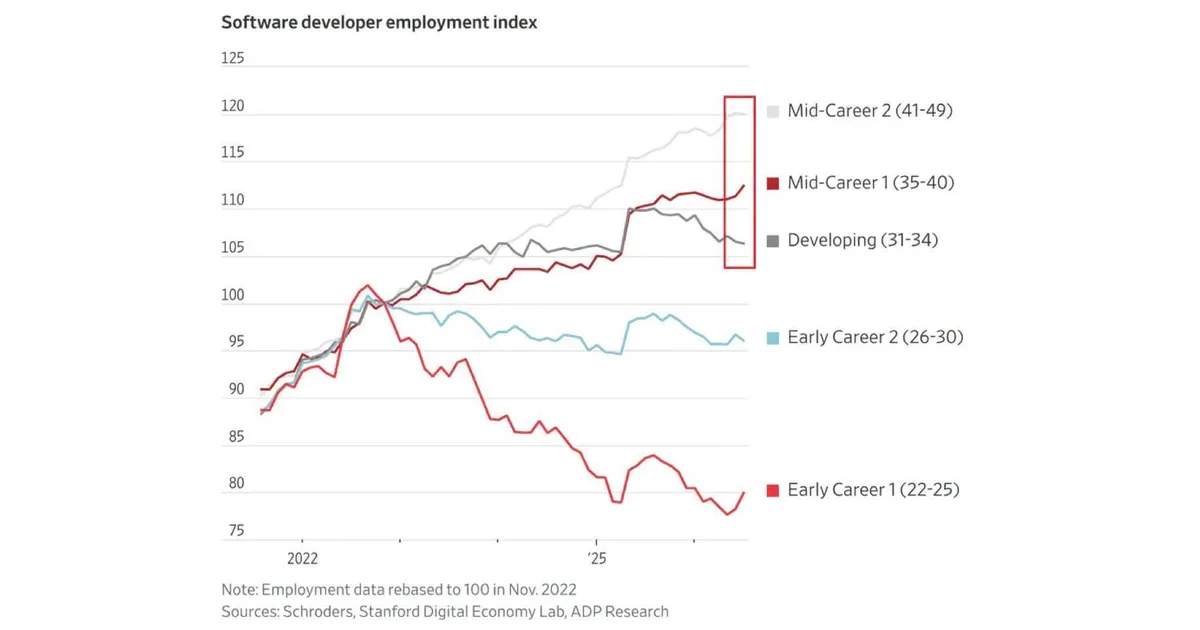
A paradox is emerging in the US tech labor market: while the AI industry booms, job opportunities for young software developers keep shrinking. A post by the page Học lập trình cho người mới bắt đầu, citing data published by The Kobeissi Letter, shows the 22–25 age group losing 20% of employment since November 2022, while the 41–49 group gained 20%.
Quick answer: US software developer employment for ages 22–25 fell 20% since November 2022, when ChatGPT launched. Ages 26–30 fell 4%, while older groups all grew: ages 31–34 up 6%, ages 35–40 up 11%, and ages 41–49 up 20%. The gap between the youngest and oldest groups is 40 percentage points. The post argues AI is changing how companies hire, narrowing the entry path for newcomers, rather than necessarily eliminating jobs across the whole industry.
The software developer employment index in the chart is employment data rebased to 100 in November 2022, so that age groups can be compared from the same starting point. The chart credits Schroders, Stanford Digital Economy Lab, and ADP Research as its data sources.
What does the employment data by age group say?
According to the post, data published by The Kobeissi Letter shows that since November 2022, US software developer employment has split sharply by age: the younger the group, the steeper the decline; the more experienced the group, the stronger the growth. November 2022 is when ChatGPT launched, the baseline the post uses to measure the change.

The line for ages 22–25 (red) falls almost continuously after its early-2023 peak, while the line for ages 41–49 rises steadily past 115. Ages 26–30 move sideways with a slight decline, and the two middle groups grow slowly but steadily.
| Age group | Employment change since Nov 2022 | How the post reads the number |
|---|---|---|
| Ages 22–25 | Down 20% | The hardest-hit group; entry-level Junior positions are shrinking |
| Ages 26–30 | Down 4% | Still falling, but far less than the youngest group |
| Ages 31–34 | Up 6% | The experience advantage starts to show |
| Ages 35–40 | Up 11% | More experience, more employment growth |
| Ages 41–49 | Up 20% | The strongest growth, the mirror image of the youngest group |
The 40-percentage-point gap between the two ends is the point the post emphasizes most: the same market, the same AI wave, but almost opposite effects on newcomers and experienced developers.
Why are young developers hit hardest?
The post offers an explanation: as AI takes over more coding, testing, and basic task work, the positions that used to be the starting point for Junior staff come under greater pressure. In other words, the very tasks newcomers are usually given to learn the job are the tasks AI learned to do first.
This is the post's interpretation, not an independently verified conclusion. The data shows the age split, but the chart alone does not prove the exact cause — AI, the post-pandemic hiring cycle, or a combination of factors. The post presents the AI link as a plausible explanation, anchored to the ChatGPT launch.
Will AI eliminate jobs across the whole tech industry?
Not necessarily, the post answers. According to the post's author, AI does not necessarily eliminate jobs across the whole tech industry, but it is changing how companies hire: fewer opportunities for newcomers, while experienced staff keep their edge through three capabilities — problem-solving, system design, and quality control.
That is also the post's core viewpoint: the issue is not "AI replaces developers" but "AI shifts the hiring balance." Companies still hire, but they favor people who can do what AI does not yet do well: understand the problem, design the system, and take responsibility for the quality of the output.
If companies hire fewer Juniors, where will future Seniors come from?
The post ends with a big question: if this trend continues, the question is not only where IT students will find jobs, but also — if companies hire fewer and fewer Juniors, where will the Seniors of the future be trained?
The question touches the industry's talent pipeline: today's Seniors were all Juniors once. As the entry path narrows, the supply of experienced staff five to ten years from now is threatened too. The post offers no answer to this question; it leaves it open as a signal worth thinking about for learners, employers, and training programs alike.
What can newcomers take away from the post?
From the very points the post emphasizes, newcomers can draw three directions for self-development, matching the three advantages the post attributes to experienced developers:
- Problem-solving: focus on understanding the problem before writing code, instead of only practicing writing code from templates.
- System design: learn how a system is organized and how its components communicate, instead of working only inside one file or one function.
- Quality control: build the habit of testing, reviewing, and taking responsibility for output — including output generated by AI.
These three directions are not new advice invented by Wotech; they are the three capabilities the post names when explaining why experienced developers keep their advantage.
Frequently asked questions
1. Where and when was the 20% figure measured? It measures US software developer employment, from November 2022 — when ChatGPT launched — to the time the data was published. It is US market data, not Vietnam data.
2. Where does the chart get its data? The chart credits Schroders, Stanford Digital Economy Lab, and ADP Research; the post cites it via The Kobeissi Letter. Wotech has not independently verified these figures.
3. Does a 20% drop for ages 22–25 mean 20% of young developers lost their jobs? Not exactly. The figure is the decline of that age group's employment index against the 100 baseline of November 2022, meaning the group's total employment shrank 20%. It does not mean every individual in the group lost their job, and it does not separate how much is due to AI versus the hiring cycle.
4. Is AI the only cause of the decline? The post presents AI as the main explanation, anchored to the ChatGPT launch, but the chart alone does not prove causation. Other factors, such as the post-pandemic hiring cycle, may also play a role.
5. Should someone new to programming quit the field because of this trend? The post does not conclude that. Its argument is that AI changes hiring rather than wiping out the industry, and the advantage belongs to those with problem-solving, system design, and quality-control skills — capabilities newcomers can build early.
Source: post by the page Học lập trình cho người mới bắt đầu (17/11/2026), citing data published by The Kobeissi Letter; the chart credits Schroders, Stanford Digital Economy Lab, and ADP Research. The figures and interpretations in this article belong to the original source and have not been independently verified by Wotech.
Bài viết liên quan

18 tháng 11, 2026 · 6 phut doc
FPT Software Chairwoman: US Clients No Longer Want to Pay by the Hour, Company Shifts to Outcome-Based Pricing
Artificial intelligence is forcing FPT Software to transform its traditional software outsourcing model: large clients in the US now apply 100% outcome-based payment, and the company expects the Time…

18 tháng 11, 2026 · 6 phut doc
Meta Expands Muse to Australia: The 6th Country, Real-Time Voice, and Local App Integrations
On 17/11/2026, Meta expanded Muse to Australia — the 6th officially supported country, just over 2 months after its US launch. According to a post by Hồ Hoàng Tiến (18/11/2026), the notable point is …

18 tháng 11, 2026 · 7 phut doc
AI Agent Costs Grow With the Square of Steps: 4 Layers to Cut Token Spend Before Switching to a Cheaper Model
You don't pay for answers — you pay for how many times you re-ask the same thing. That is the central argument of Hoang Viet AI in a post in the comailo group (18/11/2026): an agent running 40 steps,…