Alexandr Wang: Superintelligence Is Arriving, and Humanity May Have Only One Year to Decide the Future
Vũ Khôi
Tác giả tại Wotech Electronics Blog
Alexandr Wang: Superintelligence Is Arriving, and Humanity May Have Only One Year to Decide the Future
A problem born in 1859 has just become the catalyst for the boldest AI warning of the year: superintelligence is arriving, and how humanity acts over the next year will decide what the future world looks like.
Quick answer: Alexandr Wang, Meta's Chief AI Officer, declared "Superintelligence is coming." He argues that if AI can help solve a problem at the level of the Riemann Hypothesis, humanity is entering a completely different era. What he truly fears is the self-improvement loop: AI accelerating AI research at a pace that could outrun human oversight. And the greatest irony: the person building the smartest machines is publicly asking whether humanity can control them.
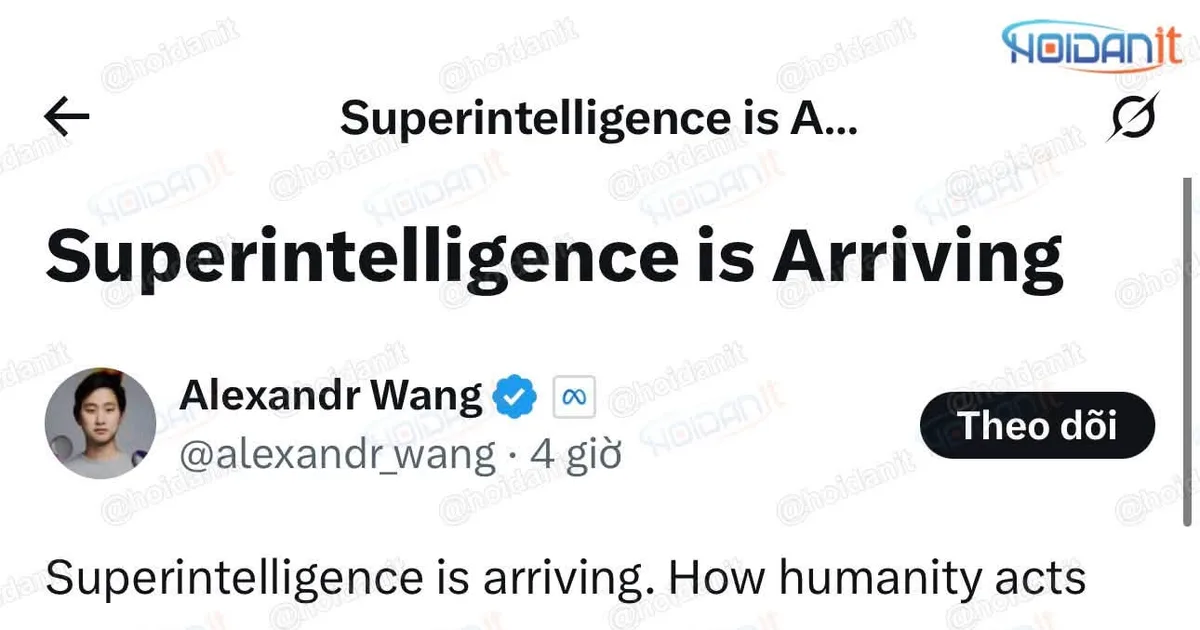
Alexandr Wang is the young man who dropped out of MIT to found Scale AI and now sits as Meta's Chief AI Officer, leading the company's superintelligence division. In a post on X, he opened with exactly one statement: "Superintelligence is coming."
Why did the Riemann Hypothesis proof become the catalyst?
It all starts with a problem born in 1859: the Riemann Hypothesis, one of the seven Millennium Prize Problems, carrying a $1 million prize for a valid solution. For over a century and a half, the world's best mathematicians tried to conquer it without success.
Then on November 20, Levent Alpöge, a mathematician working at Anthropic, announced he had found a proof with Claude's support, even extending it to the Generalized Riemann Hypothesis for Dirichlet L-functions. Instead of a manuscript of a few dozen pages, the story arrived with numbers that sound like statistics from a giant software project: about 175,187 Lean files, nearly 17 million lines of code, and 239 MB in size.
Lean is a system for expressing and machine-checking mathematical proofs. Put simply, instead of asking people to trust a chain of reasoning written on paper, the author turns it into logical steps that software can verify.
But there is a crucial boundary, and the post stresses exactly this: a claimed proof, a verification codebase, and a result recognized by the mathematical community are three different things. A scale of 17 million lines does not automatically make a proof correct. (Per the independent verification done for an earlier article on this topic: Lean and Mathlib issued a joint statement certifying the work, but the Clay Mathematics Institute has not officially recognized it.)
That announcement became the catalyst for Wang's even bolder argument.
Being smart and being able to do the job are two different things
Wang is not the kind of CEO who sees AI solve a few math problems and immediately declares humanity's time is up. He grew up in Los Alamos, a place tied to the history of US atomic bomb research, has a background in math competitions, and studied at MIT.
In his X post, Wang argues that if AI can genuinely contribute to solving a problem at the level of Riemann, that is a signal we are entering a completely different era. He even makes a very strong comparison: in terms of pure intellectual difficulty alone, the Riemann Hypothesis may far exceed the scientific achievements ordinary people regard as the pinnacle.
Does that sound like an overstatement? That is precisely the controversial point. The difficulty of a mathematical proof cannot be directly used as a yardstick for all of physics, engineering, or weapons research.
But Wang's next argument is the one that truly matters. In December 2024, when OpenAI introduced o3 with impressive AIME math-solving ability, the AI world witnessed a major leap. AIME is a math exam for outstanding US high school students, whose hardest questions demand reasoning ability that many adults, including experienced engineers, struggle with. Yet AI started handling them.
From there, Wang asks a question: if AI has passed extremely hard reasoning tests, why hasn't it replaced all programmers, researchers, or business experts?
Because being smart and being able to do the job are two different things. A model can write algorithms brilliantly yet not know how a banking system actually operates. It can spot a security vulnerability yet not fully understand a business's constraints. It can propose a new drug yet still need laboratories, data, and real trials to determine whether the drug works.
Wang calls those gaps domain knowledge, connected infrastructure, and experimentation. And in his view, as those gaps gradually close, AI's capabilities will be unleashed on an unprecedented scale.
The self-improvement loop: what Wang truly fears
This is where the story turns from interesting to alarming. Because the next field AI may accelerate is… AI research itself.
Imagine a company with thousands of excellent researchers. They must read papers, write code, design experiments, run models, analyze results, and keep improving. Now replace much of that process with AI agents that can operate continuously. Those systems are then used to research and create the next generation of AI. The smarter new generation further accelerates the research process. A self-improvement loop begins to form.
This is the scenario Wang fears could lead to development speed far beyond human oversight. To be clear: it remains a forecast about the future, not a demonstrated capability of unlimited self-improvement.
But the greatest irony lies in who is issuing the warning. Alexandr Wang now leads Meta's superintelligence division, one of the corporations pouring enormous resources into the AI race. In other words, the person helping build the smartest machines is publicly asking whether humanity can control them.
Wang argues that a superintelligence exceeding humans thousands of times over in capability would pose enormous control challenges. He also rejects a mindset spreading through the industry: build superintelligence first, then figure out how to make it safe afterward. In Wang's view, the more important question is what kind of society humans actually want to build, and how AI will serve that goal.
Apply it now: as code gets cheaper, what value is left for programmers?
For people working in tech, Wang's argument reveals a very practical shift. For years, programmers were judged by their ability to turn requirements into code. Now AI is making that step ever cheaper. A feature can be created in minutes.
But understanding why a feature needs to exist, which systems it affects, whether the data is safe, whether it runs reliably in production, and who is responsible when it causes an error remain hard problems. An AI can generate thousands of lines of code in the blink of an eye. When production goes down at 2 a.m., a company still needs a system that can identify the cause, restore service, and take responsibility for the consequences.
That is also why the story of 17 million lines of Lean is worth thinking about, even before discussing whether the Riemann proof is recognized. Creating a solution and establishing that the solution is trustworthy are two different capabilities. The stronger technology gets, the more the gap between those two capabilities can become a matter of survival.
If AI can take part in scientific research, drug development, military technology design, economic optimization, and ultimately improve its own capabilities, who will decide the direction of all those activities? Governments? Tech corporations? Researchers? Or increasingly autonomous AI systems?
For thousands of years, humans invented tools to compensate for the limits of the body. Now we are trying to build something that can surpass the very intellectual ability of its makers. And for the first time, the big question may no longer be whether humans are smart enough to create such technology. It may be whether, once the technology is smarter than us, humans still have enough power to decide what it will do.
1. Who is Alexandr Wang? Alexandr Wang is the founder of Scale AI (he left MIT to start it) and is now Meta's Chief AI Officer, leading the company's superintelligence division. He grew up in Los Alamos and has a background in math competitions.
2. Why does the Riemann Hypothesis proof matter for superintelligence? According to Wang, if AI can help solve a problem at the level of Riemann — one of the seven Millennium Prize Problems, standing since 1859 — that signals humanity is entering a completely different era, because its pure intellectual difficulty may exceed many other scientific achievements.
3. Has Alpöge's Riemann proof been recognized? Not fully. A claimed proof, a verification codebase, and a result recognized by the community are three different things. Lean and Mathlib issued a joint statement certifying the work, but the Clay Mathematics Institute has not officially recognized it.
4. What is the self-improvement loop Wang fears? It is the scenario in which AI is used to accelerate AI research: AI agents replace humans in much of the research process, create a smarter generation of AI, and that generation accelerates research further — at a pace that could outrun human oversight. It is a forecast about the future, not a demonstrated capability.
5. What should programmers do as AI writes code ever more cheaply? According to the argument in the post, the remaining value lies in what AI cannot yet do: understanding why a feature needs to exist, which systems it affects, whether data is safe, whether it runs reliably, and who is responsible when something fails. Creating code and establishing that the code is trustworthy are two different capabilities.
Source: post by the page "Học lập trình cho người mới bắt đầu" (source: Alexandr Wang @alexandr_wang on X). Cover image: screenshot of Alexandr Wang's post on X.
Bài viết liên quan

23 tháng 11, 2026 · 7 phut doc
AgentScope: Alibaba DAMO Academy's Open-Source Python Framework for Building AI Agents — 100% Apache 2.0
China has just released a Python framework for building AI agents. 100% open source, Apache 2.0 license. It is called AgentScope — and the difference, according to the post introducing it, is that it…

23 tháng 11, 2026 · 11 phut doc
Almost 2027 — Do You Have a Real System for Running Agents Yet? A Linux Mini PC, Backups Twice a Day, and the Cost Question
Last week, sick at home, Vương Nguyên Bình started upgrading the machine running his agents. His post is a blunt reminder: if you really intend to use agents for work, prepare the foundation for your…

23 tháng 11, 2026 · 9 phut doc
OpenAI Discloses Internal Numbers: GPT-6.2 Astra Solved a Millennium Prize Problem, an Unnamed Internal Model Is Already at 0.732
On November 22, Jakub Pachocki, OpenAI's Chief Scientist, published "Perplexity and Intelligence" and did something no lab has done: he disclosed the internal pretraining log-perplexity of each model…