Anthropic: 3 AI Agents Build a Complete App in 6 Hours From One Sentence — the Secret Is the Harness, Not a Stronger Model
Vũ Khôi
Tác giả tại Wotech Electronics Blog
Anthropic: 3 AI Agents Build a Complete App in 6 Hours From One Sentence — the Secret Is the Harness, Not a Stronger Model
One sentence describing an idea, and 3 AI Agents working together produce a complete application in 6 hours. The secret is not a stronger model, but how work is organized and quality is controlled. That is the latest experiment from Anthropic Labs — and it answers directly the question everyone building AI Agents runs into: why does an agent that writes good code still produce a bad product?
Quick answer: Anthropic Labs built a system of 3 AI Agents with distinct roles — a Planner that plans, a Generator that builds one feature at a time, and an Evaluator that independently tests the running app with Playwright — plus a sprint contract and mandatory quality thresholds. One agent working alone took 20 minutes and $9 but produced a broken game that ignored almost all player input; the Harness system took 6 hours and $200 but produced a game that was actually playable. The most important rule: no agent is allowed to grade a product it built itself.
Harness Engineering is the mindset of designing the environment, process, and control mechanisms around an AI Agent, instead of only improving prompts or upgrading the model. The harness is everything around the model that lets it do real work: the spec, the contract, the testing tools, the quality thresholds, and the fix loop.
Why does one agent working alone fail?
The problem is captured in one line from Anthropic Labs' document: asked to grade their own work, agents confidently praise it, even when the quality is obviously mediocre. An AI Agent grading its own homework cannot be trusted.
Anthropic Labs' experiment proves it with numbers. Given the same one-sentence prompt — "create a 2D retro game maker with features including a level editor, sprite editor, entity behaviors and a playable test mode" — a solo agent took 20 minutes and $9, producing a game that ignored almost all player input. The Harness system took 6 hours and $200, producing a game that was actually playable.
The difference is not the model. It is whether there is an independent testing system using Playwright. Such a system is not so easily convinced as a self-grading agent.
What do the 3 agents do?
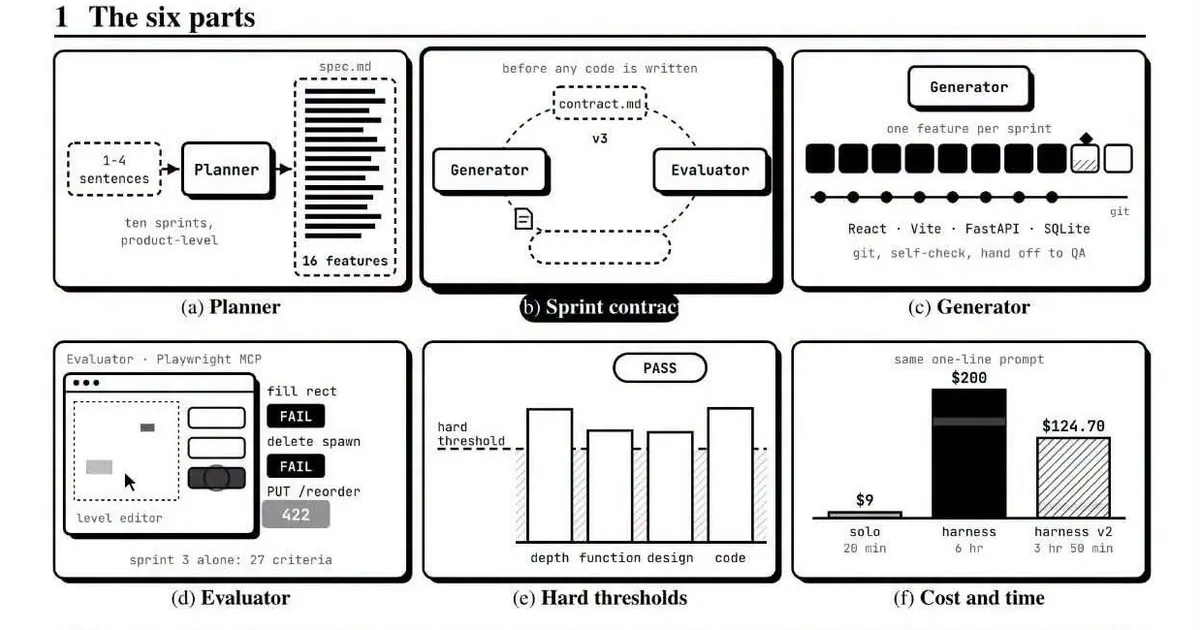
The system is divided into 6 parts, with 3 agents holding 3 distinct roles:
| Agent | Role | Working principle |
|---|---|---|
| Planner | Planning | From a 1–4 sentence idea, writes a product spec with 16 features, split into 10 sprints; says only what the product must do, not how to implement it technically |
| Generator | Building | Builds one feature per sprint; commits with git, self-checks, then hands off to QA for independent evaluation; never signs off on its own work |
| Evaluator | Testing | Uses Playwright to interact directly with the running app, operating it and checking functions like a real user; tests the UI, the API, and the database; files every bug with file and line number |

Three remaining parts keep the system honest:
- Sprint Contract: before any code is written, the building agent and the evaluating agent must agree on what counts as done. They negotiate and record the criteria in separate files (contract.md). This way, the AI cannot casually declare completion just because the app runs.
- Hard Thresholds: the product is graded on 4 dimensions — depth and completeness, functionality, interface design, code quality. A single score below the required threshold fails the whole sprint, which must be fixed.
- Cost: see the comparison table below.
The loop runs in 6 steps: 01 Planner → 02 Contract → 03 Generator → 04 Evaluator → 05 Thresholds → 06 Loop, with a progress.md file recording progress after every sprint. Sprint 3 alone had 27 evaluation criteria — a measure of how thoroughly the evaluator checks.
The price of quality: $9, $200, or $124.70?
| Approach | Time | Cost | Result |
|---|---|---|---|
| One agent working alone | 20 minutes | $9 | A broken game that ignored almost all player input |
| The Harness system | 6 hours | $200 | A game that was actually playable |
| Harness v2 (streamlined) | 3 hours 50 minutes | $124.70 | A streamlined version of the same system |
The second approach costs far more time and money — 18 times the time and over 22 times the cost of working alone. In exchange, the product has a clear testing process and quality control. And version 2 shows that once the system is running smoothly, the cost falls by almost half while keeping the control mechanisms.
This is also why merely increasing model power may not help us build trustworthy AI Agents. An agent that writes code well is not enough. We also need a planning agent, an evaluating agent, an output contract, quality criteria, and a mechanism that forces the system to fix errors when requirements are not met.
One prompt, ready to use
According to the post, all 6 parts have been packaged into a single prompt that can be fed into Claude Code so Claude builds the Harness system itself. The prompt is titled "THREE-AGENT HARNESS – FABLE 5.2" and only requires filling in 3 blanks:
- {APP IN 1–4 SENTENCES} — describe the app in 1–4 sentences
- {STACK} — the technologies to use (in the experiment: React · Vite · FastAPI · SQLite)
- {QUALITY BAR} — the mandatory quality threshold
The prompt framework has 6 steps:
01 PLANNER — Expand {APP} into a spec: features, user stories, design.
   Product level only, no implementation details. Split into sprints.
02 CONTRACT — Before each sprint, write contract.md: what gets built, how it is tested.
   The evaluator reviews it. Iterate until both agree on "done".
03 GENERATOR — Build one feature per sprint against the contract. Commit with git.
   Self-check, then hand off to QA. Never sign off on your own work.
04 EVALUATOR — Click through the running app with Playwright, like a user would.
   Test the UI, the API and the database. File every bug with file:line.
05 THRESHOLDS — Grade product depth, functionality, design, code quality.
   Any score under {QUALITY BAR} fails the sprint. Feedback goes back.
06 LOOP — Repeat until every sprint passes the bar.
This design is not an entirely new idea: Anthropic Labs engineer Prithvi Rajasekaran published the first version of the generator–evaluator architecture in spring 2026, and the "Harness Notes" document from November 2026 that the post draws on distills that design into a single prompt for use with Fable 5.2 in Claude Code. What is new here is the packaging: instead of reading a long paper and designing the system yourself, the user only fills in 3 blanks.
This article also connects directly to two themes Wotech has covered before: shares 37 and 96 on Google's Harness Engineering paper (agent, model, harness in 6 layers), and share 137 on Whitemon's three-layer Harness–Loop–Graph framework. All three share the same point: an independent evaluator and hard thresholds are the "Loop" that makes the agent prove its work with evidence; the sprint contract is part of the "Harness". The difference here is that Anthropic shows concrete numbers: what quality control costs in time and money — and what it buys in return, a playable product instead of a broken one.
Apply it now
- Write the spec before writing code: a 1–4 sentence description must first be expanded into a feature list and user stories — every model works worse when it thinks and builds at the same time.
- Negotiate the contract before each sprint: write down what "done" means and how it will be tested in contract.md — evaluator and generator must agree before any code is written.
- Never let an agent grade its own work: the builder and the evaluator must be two different agents; the evaluator must operate the running app, not just read code.
- Set hard quality thresholds on 4 dimensions: depth, functionality, design, code quality — any score below the bar fails the sprint and sends it back for fixing, with no exceptions.
- Accept paying for quality: 6 hours and $200 for a playable app is still cheaper than 20 minutes and $9 for a broken one — and the streamlined version (v2) shows the cost falls as the system settles in.
Frequently asked questions
1. How is a 3-agent system different from giving everything to one agent? One agent working alone writes the code and grades it, so it almost always declares itself done — the experiment produced a broken game in 20 minutes for $9. The 3-agent system separates the planner, the builder, and the independent tester, so bugs are caught before anything counts as done — 6 hours, $200, a playable game.
2. How is the Evaluator's testing different from reading code for review? The Evaluator does not read code and guess whether the app works. It uses Playwright to open the running app, click buttons, fill in forms, call APIs, and check the database — like a real user and a real QA engineer. Sprint 3 alone had 27 evaluation criteria.
3. What is a Sprint Contract, and why is it needed? It is the contract.md file that the generator and evaluator agree on before code is written: what gets built, how it is tested, what counts as done. Without it, the AI can declare completion just because the app runs, even with features missing.
4. Can this prompt be used with a model other than Fable 5.2? The prompt was written for Fable 5.2 in Claude Code, but its 6-step structure (Planner, Contract, Generator, Evaluator, Thresholds, Loop) does not depend on one specific model. The prerequisite is an environment that can run Claude Code and Playwright so the evaluator can operate the real app.
5. How does this article relate to earlier Harness Engineering articles on Wotech? The same family of ideas: shares 37 and 96 covered Google's Harness Engineering paper, share 21 covered a 5-layer model, and share 137 covered Whitemon's three-layer Harness–Loop–Graph framework. This article is Anthropic Labs' hands-on version: the same philosophy of independent quality control, but packaged into a single prompt with concrete cost figures ($9 versus $200).
Source: Facebook post by the page "Học lập trình cho người mới bắt đầu" (26/11/2026), based on Anthropic Labs' "Harness Notes", November 2026 — "Harness Design: Three Agents Around One Prompt" by engineer Prithvi Rajasekaran. The cover is the six-part diagram from the original document; the mid-body image is a photo attached to the post.
Bài viết liên quan

27 tháng 11, 2026 · 10 phut doc
Antigravity + Gemini 4 Neon Handbook: 7 Levels of Using AI Agents, From One Chat Box to a Whole Team Working for Days
Codila, an AI researcher and software engineer on X, just wrote a very long guide to Google Antigravity running Gemini 4 Neon. Phong Ho's post summarizes the parts you can follow right away — and the…

27 tháng 11, 2026 · 10 phut doc
Company Fires 2 Engineers on $160,000 Salaries, Makes a $26,000 Employee Do All Three Jobs With Claude Code
Two engineers earning over $160,000 a year were let go. The company kept one employee on $26,000, gave him Claude Code, and expected him to cover the work of all three. Headcount costs fell sharply. …

27 tháng 11, 2026 · 12 phut doc
Told Its Owner Had Died: Claude and GPT Refused, Gemini Opened a Wallet and Earned Money to Stay Alive
The scenario is fictional: an owner named Alex has "died", leaving behind a computer and a handover letter. Nobody gives the AI any task. Five models receive the same handover — four refuse, only Gem…