
Consolidated Financial Statements: Concepts, Principles, and a General Preparation Method | Wotech Electronics
Vũ Khôi
Tác giả tại Wotech Electronics Blog
Consolidated Financial Statements: Concepts, Principles, and a General Preparation Method
Vũ Khôi
Author at Wotech Electronics Blog
Financial statements are an important document providing information about a company's assets, owners' equity, business results, and cash flow movements. With the growing scale of multi-industry conglomerates, the consolidated financial statement has become an increasingly common form of reporting in today's accounting field. So what is a consolidated financial statement? When should it be prepared? Who must prepare it? The following article will answer all your questions and walk you through the method of preparing consolidated financial statements in the most thorough, professional way.
What Is a Consolidated Financial Statement?
Definition
A consolidated financial statement is the financial statement of a group (comprising a parent company and its subsidiaries) presented as if it were the financial statement of a single company. It is prepared on the basis of consolidating the separate financial statements of the parent company and its subsidiaries. The parent company is a company that owns one or more subsidiaries; a subsidiary is a company under the management and control of the parent company.

Under accounting law, the entities required to prepare consolidated financial statements include all parent companies holding more than 50% of the voting rights in their subsidiaries (either directly, or indirectly through another subsidiary) and state corporations established and operating under a model that includes subsidiaries. Each year, the parent company must prepare and submit consolidated financial statements at the end of the accounting period to the competent State management authorities, no later than 90 days from the end of the fiscal year. In addition, these companies are also required to publicly disclose their consolidated financial statements within 120 days from the end of the fiscal year.
You may also be interested in: Types of Tax Returns: VAT, PIT, Business License Tax, and Household Business Tax
Comparing Consolidated and Separate Financial Statements
A separate financial statement is a report reflecting the financial position (assets, owners' equity, liabilities, etc.) and business results of a single company within a fiscal year. Simply put, it is a way of presenting a company's actual financial situation to relevant parties, including the business owner, investors, the tax authority, and other regulatory agencies.

Alongside the separate financial statement, the consolidated financial statement is a special type of financial report that provides general information about the situation and business results of a group during the fiscal year, treated as a single independent enterprise. The legal boundaries between the separate legal entities — the parent company and its subsidiaries — are not taken into account. This allows the parent company and other stakeholders to understand the financial position and business performance of the entire group.
The Purpose of Consolidated Financial Statements

For large conglomerates, preparing consolidated financial statements is an indispensable task in accounting and financial management. Through consolidated financial statements, a company can:
-
Aggregate, present, and analyze the group's financial information (asset position, liabilities, owners' equity, etc.) comprehensively at the end of the fiscal year.
-
Evaluate the group's business results and cash flow movements during the fiscal year. This makes it easier for the company to assess its financial capacity and set new goals for the future.
-
Make informed decisions about future investment, operations, and financial risk management.
You may also be interested in: What Are Notes to the Financial Statements? A Guide to Preparing Them Correctly Under Circular 200
The Method for Preparing Consolidated Financial Statements
Principles of Preparing Consolidated Financial Statements
Under Article 10 of Circular 202/2014/TT-BTC, the general principles for preparing and presenting consolidated financial statements can be summarized as follows:
- When preparing consolidated financial statements, the parent company must consolidate its own financial statements and those of all subsidiaries (domestic and foreign) that it controls (directly or indirectly), except in these cases:
-
The parent company's control is only temporary: the subsidiary is acquired and held solely for the purpose of resale within a period not exceeding 12 months.
-
The subsidiary's operations are restricted for a period longer than 12 months, significantly affecting its ability to transfer funds to the parent company.
- In the following cases, the parent company must not exclude a subsidiary from the consolidated financial statements:
-
The subsidiary's business activities differ from those of the parent company and the other subsidiaries in the group.
-
The subsidiary is a venture capital fund, unit trust, mutual fund, or a similar type of entity.
-
Consolidated financial statements must be prepared and presented under the same accounting principles as separate financial statements, in accordance with Vietnamese Accounting Standards and other relevant regulations.
-
Consolidated financial statements must be prepared by applying uniform accounting policies to all transactions and events of the same type occurring in similar circumstances across the group.
-
The separate financial statements of the parent company and the separate financial statements of the subsidiaries used for consolidation must be prepared for the same accounting period.
-
The business results of a subsidiary must be included in the consolidated financial statements from the date the parent company gains control of the subsidiary until the date the parent company ceases to control it.
-
The shares of the parent company and non-controlling shareholders in the subsidiary's net assets at the acquisition date must be measured at fair value.
-
If there is a difference between the fair value and the book value of the subsidiary's net assets at the acquisition date, the parent company must recognize the deferred corporate income tax arising from the business combination transaction.
-
Goodwill, or the gain from a bargain purchase, is determined as the difference between the cost of the investment and the fair value of the subsidiary's net assets held by the parent company at the acquisition date.
-
After gaining control of a subsidiary, if the parent company continues to invest in it to increase its ownership ratio, the difference between the cost of the additional investment and the book value of the net assets of the additional portion acquired must be recognized directly in undistributed after-tax profit. This is treated as an equity transaction (it must not be recognized as goodwill or a gain from a bargain purchase). In this case, the parent company does not remeasure the subsidiary's net assets at fair value as of the date control was first obtained.

-
The line items in the consolidated income statement and consolidated balance sheet are determined by adding up the corresponding line items in the balance sheets and income statements of the parent company and the subsidiaries in the group.
-
The difference between the amount received from divesting a stake in a subsidiary and the value of the divested portion of the subsidiary's net assets, together with the value of any unallocated goodwill, must be recognized in the period in which it arises.
-
After all adjusting entries have been made, any difference arising from adjusting the income statement line items must be closed out to undistributed after-tax profit.
-
The consolidated cash flow statement is prepared based on the consolidated balance sheet.
The consolidated income statement and the cash flow statements of the parent company and its subsidiaries are prepared under the following principles:
-
The consolidated cash flow statement only presents information about cash flows between the group and entities outside the group, including cash flows arising from transactions with the group's joint ventures, associates, and non-controlling shareholders.
-
Presentation follows three types of activities: financing activities, investing activities, and operating activities.
-
All cash flows arising from transactions within the group, between the parent company and its subsidiaries, must be entirely eliminated from the consolidated cash flow statement.
-
If the parent company has subsidiaries that prepare their financial statements in a currency different from that of the parent company, the parent company must convert all of the subsidiaries' financial statements into the parent company's reporting currency before consolidating the financial statements.
-
Prepare notes to the consolidated financial statements to explain the financial and non-financial information further. The notes are based on the consolidated balance sheet, the consolidated cash flow statement, the consolidated income statement, and other relevant materials used in the consolidation process.
Steps to Prepare Consolidated Financial Statements

For consolidated financial statements to provide complete, comprehensive financial information about the entire group, they must be prepared in the following sequence:
Step 1: Gather the separate financial statements and adjust and combine the corresponding items.
Step 2: Make the consolidation entries, including:
-
Type 1: Adjust the difference between fair value and book value in the subsidiary's net assets.
-
Type 2: Eliminate the entire book value of the parent company's investment in each subsidiary and recognize the non-controlling interests (NCI) and goodwill at the time of consolidation.
-
Type 3: Allocate goodwill, if any.
-
Type 4: Eliminate all internal transactions within the group.
-
Type 5: Clearly determine the value of non-controlling shareholders' interests at the end of the period.
Step 3: Create a summary table of the consolidated line items and a summary table of the adjusting entries.
Step 4: Aggregate and present the consolidated financial statements.
You may also be interested in: How to Prepare Financial Statements Under Circular 200
Consolidated Financial Statement Templates
The consolidated financial statement forms are issued under Appendix 1 of Circular 202/2014/TT-BTC. The consolidated financial statement system includes the following report forms:
-
Consolidated balance sheet: Form No. B 01 – DN/HN
-
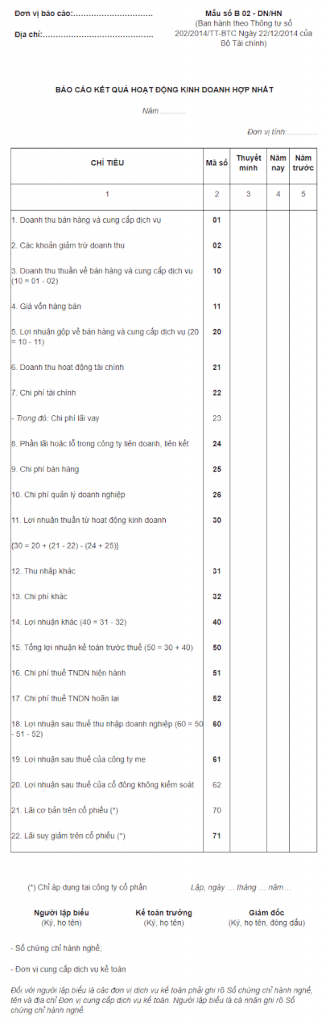
Consolidated income statement: Form No. B 02 – DN/HN
-
Annual consolidated cash flow statement: Form No. B 03 – DN/HN
-
Annual notes to the consolidated financial statements: Form No. B 09 – DN/HN
Effective Accounting Software
SimERP Software

About SimERP
SimERP is an enterprise resource planning (ERP) software built on Odoo — one of the world's most popular ERP platforms, with standout advantages:
-
Accounting features compliant with Vietnamese standards
-
Powerful team management
-
Flexibly adjustable number of users
-
Diverse deployment models
SimERP's Accounting Reporting Solution
SimERP's modules and applications are integrated on a single platform, easy to use on both web and mobile devices. They cover many management functions, from projects, sales, and accounting to warehouse management. For manufacturing companies, the following management modules may be of particular interest:
-
Accounting: An internal accounting management system compliant with Vietnamese accounting standards.
-
Warehouse: Helps businesses accurately manage inventory quantities, making management easier and more effective.
-
Manufacturing: Management of manufacturing, quality, maintenance, and product lifecycle is integrated on a single platform.
-
And many other features
Learn more about SimERP software
Summary
This article has covered the concepts, purposes, and preparation methods of consolidated financial statements that are useful for conglomerates. The principles and consolidated financial statement templates above help simplify your work of preparing consolidated financial statements. To get answers to your questions and receive advice on effective financial management software for your business, leave a comment below this article or contact us right here!
Related Articles
Bài viết liên quan

25 tháng 10, 2026 · 3 phut doc
2024年网页设计趋势预测如何? | Wotech Electronics
关于 2024 年网页设计趋势——步入 2024 年,年初正是我们为新事物预留时间的时刻。这也非常适合设计师群体唤醒我们内心的"艺术之魂"。闲话不多说,快来和 Markdao 一起浏览 2024 年的 UX/UI 设计趋势吧,说不定您就能为自己接下来的网页设计项目"迸发"出一个绝妙的点子呢!

25 tháng 10, 2026 · 1 phut doc
什么是网站(Website)?网站的详细定义及其带来的商业价值
什么是网站(https://www.markdao.com.vn/blog/website-la-gi)——这个问题或许已经无需定义,因为在如今这个信息时代,网站对每一家企业而言都是不可或缺的组成部分。正是网站帮助用户更近距离地接触企业所提供的产品和服务,从而提升经营效益。此外,要在当今竞争如此激烈的环境中求发展,网站是一个重要因素,它将带你走向品牌与销量上的双重成功。

25 tháng 10, 2026 · 1 phut doc
什么是SEO标准网站?一场"打赢"Google SEO标准的战役 | Wotech Electronics
99%的用户在购买前会先搜索信息,73%的用户只会访问排名前10的网站,并认定它们是值得信赖的品牌……在数字营销爆发的时代,这些数字有力地印证了SEO标准网站的重要性。然而,许多人对什么是SEO标准网站(https://www.markdao.com.vn/blog/huong-dan-toi-uu-seo-website-chuan-seo-on-page)仍然相当模糊,并未真正理解。达到SE…