
What Is a Business Performance Report? Contents and How to Prepare One
Vũ Khôi
Tác giả tại Wotech Electronics Blog
What Is a Business Performance Report? Contents and How to Prepare One
Vũ Khôi
Author at Wotech Electronics Blog
The business performance report is one of a company's most important reports. Preparing an accurate corporate report brings enormous benefits. It not only helps you clearly understand your company's profits, but also gives investors a clear picture of your company's finances. This helps you raise your company's capital value on the stock exchanges. In addition, preparing the report also makes tax filing easier. Let's take a closer look at the business performance report!
What Is a Business Performance Report?
A business performance report is a statement of the company's business situation over an accounting period. Its contents cover the main business activities and other activities of the enterprise. From it, investors can grasp the company's business situation as well as its tax and insurance status. In addition, profitable business operations are very important. This is one of the top priorities not only for the business but also for its stakeholders. The higher the profit, the more effective the business operations are. And this helps the company attract large amounts of capital from investors.
What Does the Report Contain?
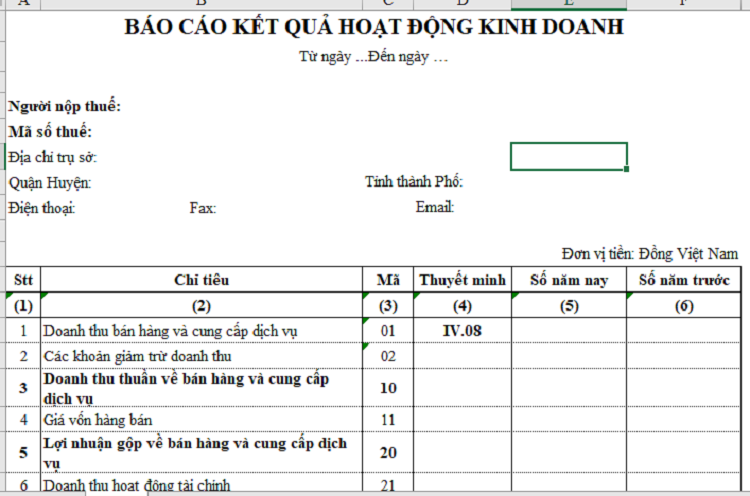
The Company's Business Results
The business performance report (BPR) is prepared on the principle of balancing revenue and expenses. For example, a company is profitable when revenue exceeds expenses. In the report, the company's activities are divided into business operations and other activities. The above principle also applies to preparing the BPR estimate. The company will combine prior-period reports with plans for the current period to produce the estimate. For foreign partners, the BPR needs to be translated into English. In essence, the report in English or Vietnamese follows the same accounting balancing principles. The company should take care to use the correct terminology in the English version.
Consolidated and Separate Business Results
A company without subsidiaries will only have one type of BPR. However, for large companies and corporations, the separate BPR reflects only the parent company's business situation, while the consolidated BPR aggregates information from the parent company and its subsidiaries. Therefore, the consolidated business performance report will contain information related to earnings per share, whereas the separate report does not.
Internal Business Results
In addition to the company's BPR, the company should also prepare an internal performance report. This is intended to provide financial information to the company's executive leadership. An internal business performance report has the same structure as a regular report. However, the difference is that the internal report may include other types of expenses. A typical example is expenses without supporting documents.
The BPR can be prepared periodically depending on each company's needs. Typically, companies prepare a monthly BPR for internal purposes. Preparing the business performance report should be done monthly. Regular reporting helps managers keep a closer grasp of the company's situation
>> See more: Consolidated Financial Statements: Concepts, Principles, and How to Prepare General-Purpose Reports
Guide to Preparing a Business Performance Report

Structure of the Business Performance Report
A business performance report has 4 main sections. The first section reflects the revenue and expenses of operations during the period. Then comes section 2, reflecting revenue and expenses from the company's other activities. Section 3 presents the company's profit and tax obligations. Finally, basic and diluted earnings per share are presented. However, this section is only presented in the consolidated business performance report.
Layout of the Business Performance Report
A company's BPR consists of 5 columns:
-
Item (1): The report line items
-
Code (2): The code corresponding to each item
-
*Notes to the Financial Statements* (3): Explains the reference numbers of the corresponding items
-
This year (4): Total figures arising this year
-
Last year (5): Last year's figures, typically used for comparison
>> See more: Guide to Preparing Financial Statements Under Circular 200
Items in the Business Performance Report
A company's BPR must be presented scientifically and with complete content. In particular, it must comply with accounting standards, otherwise it will not be considered valid. Under Circular 200, the business performance report contains 20 items. These items fall into two groups: revenue and expenses. The final two items (basic earnings per share and diluted earnings per share) are only presented in the consolidated business performance report and not in other BPRs.
The revenue group of the report includes
-
(1) Revenue from sales of goods and service provision: Total revenue from the company's business operations and other investments. For reports of entities without legal-person status, internal transactions must be excluded. Note that revenue here excludes indirect taxes such as value-added tax.
-
(2) Deductions from revenue: Amounts deducted from revenue, such as discounts, price reductions, or returned goods.
-
(10) Net revenue from sales of goods and service provision: Sales from the company's operations minus deductions from revenue, equivalent to (1)-(2).
-
(11) Cost of goods sold: The total cost of products and the expenses needed to produce goods and services.
-
(20) Gross profit from sales of goods and service provision: The difference between the company's net revenue and cost of goods sold, equivalent to (10)-(11).
-
(21) Financial revenue: The company's total revenue from financial activities.
The expense group of the report includes
-
(22) Financial expenses: Financial expenses such as royalty costs and expenses for joint-venture activities.
-
(23) Interest expenses: Interest expenses recorded within financial expenses.
-
(25) Selling expenses: Expenses for selling the company's goods and services.
-
(26) General and administrative expenses: Expenses necessary for managing the business.
-
(30) Net profit from business operations: The result of the company's business operations. Calculated as gross profit from sales of goods and services plus financial revenue, minus financial expenses, interest expenses, selling expenses, and administrative expenses ((20) + (21) – (22) – (25) – (26)).
-
(31) Other income: Income arising during the accounting period.
-
(32) Other expenses: Expenses arising during the accounting period.
-
(40) Other profit: The difference between other income and other expenses, equivalent to (31)-(32)
-
(50) Total accounting profit before tax: Total profit from the company's business and other activities, equivalent to (30)-(40).
-
(51) Current corporate income tax expense: Tax expense arising during the accounting period.
-
(52) Deferred corporate income tax expense: Deferred tax expense arising during the accounting period.
The profit group of the report includes
-
(60) Profit after corporate income tax: The company's after-tax profit, obtained by taking profit before tax (50) and subtracting tax expenses ((51)+(52)).
-
(70) Basic earnings per share: Basic earnings per share, not counting future instruments that could affect share value.
-
(71) Diluted earnings per share: Diluted earnings per share, taking into account future instruments that could affect share value.
>> See more: Types of Tax Reports: VAT, PIT, business license tax, and more
Conclusion
We hope this article has helped you understand the basics of building a business performance report. It has also given you a broader overview of the role and function of the report. However, to make the reporting process more effective and accurate, you should apply accounting systems for support. For example, SimERP is an enterprise management system that includes an accounting module. Since SimERP is open-source, the system can be fully customized to different environments and companies. Using such a system should help you a great deal with reporting.
We wish you success in building and preparing a complete business performance report! If you have any comments or questions, feel free to leave a comment. Good luck!
Related Articles
Bài viết liên quan

25 tháng 10, 2026 · 3 phut doc
2024年网页设计趋势预测如何? | Wotech Electronics
关于 2024 年网页设计趋势——步入 2024 年,年初正是我们为新事物预留时间的时刻。这也非常适合设计师群体唤醒我们内心的"艺术之魂"。闲话不多说,快来和 Markdao 一起浏览 2024 年的 UX/UI 设计趋势吧,说不定您就能为自己接下来的网页设计项目"迸发"出一个绝妙的点子呢!

25 tháng 10, 2026 · 1 phut doc
什么是网站(Website)?网站的详细定义及其带来的商业价值
什么是网站(https://www.markdao.com.vn/blog/website-la-gi)——这个问题或许已经无需定义,因为在如今这个信息时代,网站对每一家企业而言都是不可或缺的组成部分。正是网站帮助用户更近距离地接触企业所提供的产品和服务,从而提升经营效益。此外,要在当今竞争如此激烈的环境中求发展,网站是一个重要因素,它将带你走向品牌与销量上的双重成功。

25 tháng 10, 2026 · 1 phut doc
什么是SEO标准网站?一场"打赢"Google SEO标准的战役 | Wotech Electronics
99%的用户在购买前会先搜索信息,73%的用户只会访问排名前10的网站,并认定它们是值得信赖的品牌……在数字营销爆发的时代,这些数字有力地印证了SEO标准网站的重要性。然而,许多人对什么是SEO标准网站(https://www.markdao.com.vn/blog/huong-dan-toi-uu-seo-website-chuan-seo-on-page)仍然相当模糊,并未真正理解。达到SE…