
The Owners' Equity Statement — Definition and How It Differs from Charter Capital
Vũ Khôi
Tác giả tại Wotech Electronics Blog
The Owners' Equity Statement — Definition and How It Differs from Charter Capital
Vũ Khôi
Author at Wotech Electronics Blog
When establishing and running any business, capital is the first factor to consider. Business capital can come from many sources, but one kind is crucial: Owners' Equity. After each operating year, alongside the financial statements, the owners' equity statement is an essential document for the business as well as for the other parties involved in contributing capital and doing business. This article provides readers with the basics of owners' equity, as well as the most complete way to write the statement.
Owners' equity — Definition and distinction

Before diving into the owners' equity statement, we need to grasp the concept of owners' equity and how to distinguish owners' equity from charter capital.
What is owners' equity?
Owners' equity — also called net assets, or equity in English — is the net portion of a company's assets that belongs to shareholders. Owners' equity is calculated as total assets minus liabilities. In other words, it is what remains of the company's asset value after all liabilities have been covered.
Owners' equity is the capital owned by the business owner, the members of a joint venture, or the shareholders of a joint-stock company.
For a business, owners' equity is one of the most important and regular sources of funding. Other asset sources, such as the unit's own assets, are only used when the unit ceases operations — or worse, goes bankrupt — to prioritize paying creditors and other obligations such as employees' wages and taxes to the state. The remaining assets are then divided among the owners in proportion to their contributed capital.
The difference between owners' equity and charter capital:
When writing the owners' equity statement, one must take care to avoid confusing the company's two basic kinds of capital: owners' equity and charter capital. So how do they differ, and how do you tell them apart? The article will draw a clear distinction for readers before exploring the owners' equity statement in more depth, to prevent confusion when preparing the report.
So what is the owners' equity statement?

The owners' equity statement is a presentation of the changes in owners' equity (the elements of change are listed in a later section). That change may be presented separately in a statement under IAS 1 (the international financial reporting standard adopted by the International Accounting Standards Board), or it may be presented in combination within the notes to the financial statements under Standard VAS 21.
The significance of the owners' equity statement

When reading the statement of changes in owners' equity, the business and related parties can grasp the changes in owners' equity reflected through the following items:
-
Net profit or loss for the year.
-
Income and expenses — or the profit or loss from operations — that are booked directly into owners' equity under other accounting standards, and the total of these elements.
-
The effects of, and possible adjustments for, changes in accounting policies and corrections of errors, as covered in the booking methods section "Net profit or loss for the period, fundamental errors, and changes in accounting policies."
-
Transactions involving owners' equity and the distribution of dividends and profits to owners.
-
The balances and accumulated profit or loss items at the beginning and end of the year, and movements during the year.
-
A comparison of the book values of each type of contributed capital, reserves, and share premium at the beginning and end of the year. The statement thus presents the movement of each type of capital separately.
Contents of the owners' equity statement
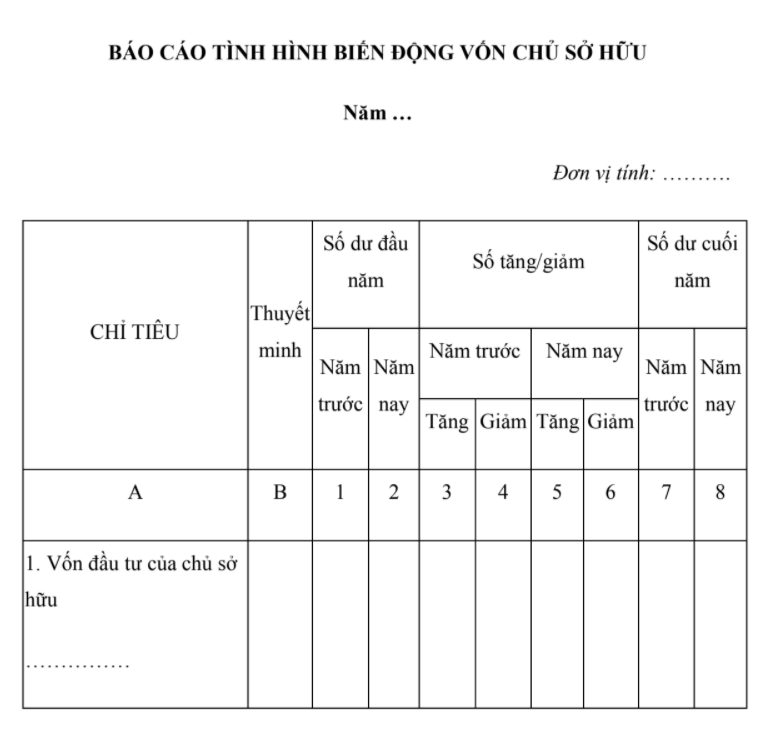
The owners' equity statement must present the following information:
-
Income for the period, including that of the parent company's owners and of non-controlling shareholders.
-
The effects of retrospective application or restatement of accounting policies on the items presenting other income or import-export transactions.
-
Between the beginning and end of the period, a reconciliation of the amount of each component of owners' equity must be disclosed. The elements to present include: profit/loss and other income.
-
Owners' effects: transactions, contribution levels, distributions, or ownership stakes in subsidiaries. Controlling these owners' equity impacts will not leave the company out of control.
The owners' equity statement must be presented in the following sections:
-
Board of Directors' report: the section introducing the Board of Directors and the Management Board, along with the Management Board's responsibility for preparing and reporting owners' equity.
-
Audit report: the section certifying that the equity statement has been audited and reported on the basis of the accompanying audit, along with the auditor's opinion, so that the report contains no material misstatements and is used solely for reporting to the State Securities Commission and other agencies under current regulations — and for no other purpose.
-
Owners' equity statement: a complete statement of changes in owners' equity includes the items below, along with capital movements by year. The owners' equity statement is extracted from the company's financial statements. Owner-invested capital — Share premium — Other owners' capital — Treasury shares — Asset revaluation differences — Foreign exchange rate differences — Development investment fund — Financial reserve fund — Other funds within owners' equity — Undistributed profit — Total
-
Notes to the owners' equity statement, including: General information about the company. Basis of preparation. Detailed notes to the statement (increases and decreases in contributed capital, the list of shareholders holding shares, the movement reconciliation table, details of capital contributions, and so on).
We hope this article has provided readers with complete information as well as illustrative examples of preparing an owners' equity statement!
Related articles
Bài viết liên quan

25 tháng 10, 2026 · 3 phut doc
2024年网页设计趋势预测如何? | Wotech Electronics
关于 2024 年网页设计趋势——步入 2024 年,年初正是我们为新事物预留时间的时刻。这也非常适合设计师群体唤醒我们内心的"艺术之魂"。闲话不多说,快来和 Markdao 一起浏览 2024 年的 UX/UI 设计趋势吧,说不定您就能为自己接下来的网页设计项目"迸发"出一个绝妙的点子呢!

25 tháng 10, 2026 · 1 phut doc
什么是网站(Website)?网站的详细定义及其带来的商业价值
什么是网站(https://www.markdao.com.vn/blog/website-la-gi)——这个问题或许已经无需定义,因为在如今这个信息时代,网站对每一家企业而言都是不可或缺的组成部分。正是网站帮助用户更近距离地接触企业所提供的产品和服务,从而提升经营效益。此外,要在当今竞争如此激烈的环境中求发展,网站是一个重要因素,它将带你走向品牌与销量上的双重成功。

25 tháng 10, 2026 · 1 phut doc
什么是SEO标准网站?一场"打赢"Google SEO标准的战役 | Wotech Electronics
99%的用户在购买前会先搜索信息,73%的用户只会访问排名前10的网站,并认定它们是值得信赖的品牌……在数字营销爆发的时代,这些数字有力地印证了SEO标准网站的重要性。然而,许多人对什么是SEO标准网站(https://www.markdao.com.vn/blog/huong-dan-toi-uu-seo-website-chuan-seo-on-page)仍然相当模糊,并未真正理解。达到SE…