
What Is a Customer Service Department? What Does It Contribute to a Business? | Wotech Electronics
Vũ Khôi
Tác giả tại Wotech Electronics Blog
What Is a Customer Service Department? What Does It Contribute to a Business?
Vũ Khôi
Author at Wotech Electronics Blog
Customers are the decisive factor in business success. That is why building an effective customer service function is always a top priority for companies. Especially in the digital era — where competitors abound on many platforms and customers have plenty of choices — attracting potential customers, building trust, and retaining them is a constant concern for businesses. So for prospecting and customer care to run effectively, a vital bridge is indispensable: the customer service department.
What Is a Customer Service Department?
A customer service department is the unit responsible for advising, supporting, answering questions, and guiding customers in order to meet their needs and expectations while achieving the company's goals.
An effective customer service department always puts customers' needs and wishes first, has full skills and expertise in communication, and captures customer information accurately and quickly. From there, it can devise consulting strategies that attract more potential customers.
>> See more: Customer service: the concept and its importance to businesses
Benefits of a Customer Service Department in a Business

Increase sales
A customer service department staffed with capable, skilled employees can easily introduce, advise, and persuade customers to buy when they are actively researching or hesitating over a choice. This reduces spending on ineffective promotional activities and significantly increases sales if staff understand customer needs and approach the right customers.
Retain existing customers and attract new ones
Product quality and customer service are the most important factors in building customer trust and attracting potential buyers. But for customers to discover and experience those products and services, the customer service department is indispensable. "The customer is king" remains the guiding principle for every employee. Greeting customers warmly, showing empathy, and enthusiastically advising them to try the company's products and services is the best way to build goodwill and keep them.
Attract potential customers
Strategies for developing customer service — such as promotional programs, care for loyal customers, VIP policies, and more — help improve the customer experience and effectively attract potential customers.
Create an effective working environment
Customer satisfaction is an important factor in fostering a positive attitude toward work within the customer service department in particular and across other related departments in the company in general.
>> See more: Customer information: benefits, and how to manage and collect customer information
What Does a Customer Service Department Do?

Customer service staff duties
Customer service staff are the direct bridge between customers and the business. Below is the list of duties of customer service employees that businesses should understand:
-
Capture and update information about the company's products and services as quickly and accurately as possible.
-
Receive and answer questions, requests, and complaints from customers about the company's products and services.
-
Proactively introduce and advise customers on the company's products and services.
-
Proactively contact, check in on, and care for VIP customers and customers who have used or are using the company's products and services.
-
Plan gift programs for loyal customers on special occasions.
-
Build effective customer support and care channels.
-
Run surveys to gauge customer satisfaction, then devise suitable solutions to fix any issues.
-
Work with the Marketing department to build promotional programs, campaigns, and discounts.
Customer service department manager duties
For customer service staff to communicate and care for customers effectively, a customer service manager is indispensable.
The customer service manager heads the department, understands customer needs and behavior deeply, and develops the customer service function by leading and motivating staff and building programs to develop potential customers.

-
Supervise and direct the department's daily operations
-
Respond promptly to customer service issues as they arise
-
Create procedures and policies to care for customers effectively
-
Propose initiatives and plan improvements and development for customer service
-
Implement and execute the company's loyalty programs
-
Maintain and record documentation of activities related to the customer service department
-
Recruit and train new customer service employees
-
Manage the department's approved budget
-
Prepare reports on the department's operations
-
Draft proposals and recommendations presenting the department's needs to the company
-
Stay up to date with new technologies and industry-related information
Professional requirements for a customer service manager position
-
A bachelor's degree in business administration or a related field
-
At least 5 years of proven experience in the customer service field
-
Proficiency in Microsoft Office and customer service software
-
Outstanding written and verbal communication skills
-
Knowledge of management practices and techniques
-
Ability to work independently and in teams
-
Excellent leadership skills
-
Strategic thinking and problem-solving ability
>> See more: The 5 most professional and optimal ways to care for customers
4 Key KPIs for a Customer Service Department
Like every other department, customer service needs KPIs to evaluate and measure each person's performance. Based on them, the organization can adjust its management methods and expand or cut headcount, all in service of the ultimate goal: improving the customer experience.
So how many KPIs does a customer service department need? Let's walk through the following four representative metrics!
Customer Satisfaction Score (CSAT)
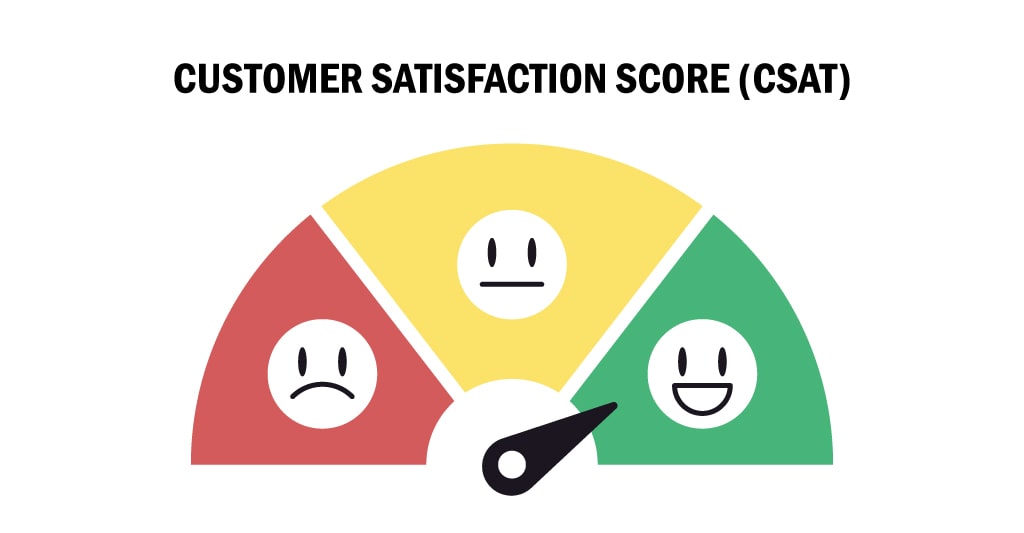
This is the most basic method for measuring how satisfied customers are with a business or with a particular product/service. CSAT usually appears as short questions designed on an emotional scale — smiling faces, sad faces, and so on — or on a star scale from 1 to 5 stars, corresponding to low-to-high ratings. The CSAT result is calculated as the number of customers who rated / the total number of ratings.
Note that neutral ratings are excluded from the numerator — if they were included in the formula, the CSAT score would drop, distorting the true level of customer satisfaction.
Net Promoter Score (NPS)
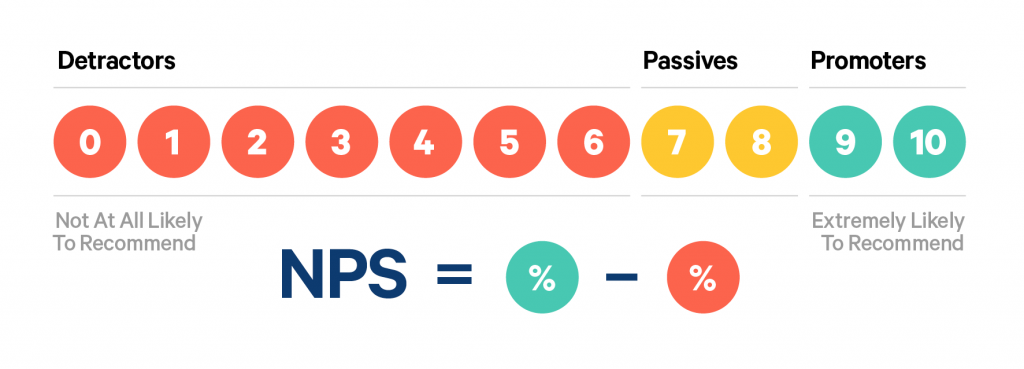
This metric measures customer loyalty to the business by asking a single question: "On a scale of 1–10, how likely are you to recommend this product/service/brand to friends and family?" The answers are divided into three groups:
-
Promoters (9–10 points): these customers feel goodwill toward the company; their repurchase rate and likelihood of referring new customers are very high.
-
Passives (7–8 points): these customers feel no particular impression about the brand — the "passively satisfied" group. They will leave the brand when another product that fits them better and outperforms appears.
-
Detractors (below 6 points): these are dissatisfied customers, or those with a poor impression of the business. The brand therefore needs to pay special attention to this group and care for them in a timely way.
Customer Retention Rate (CRR)
This metric reflects the share of customers who buy and use your products/services and come back within a given period. That period depends on each company's policy — weekly, monthly, quarterly, or yearly. Typically, though, it follows the purchase cycle and how often transactions occur. The customer retention rate is calculated with the formula:
CRR = (CE – CN)/CS x 100%
Where:
-
CE: customers at the end of the period.
-
CN: new customers acquired during the period.
-
CS: customers at the start of the period.
Customer Churn Rate (CCR)

The opposite of the customer retention rate (CRR), the Customer Churn Rate (CCR) is the share of customers who stop using the company's products/services within a given period. It is calculated with this formula:
CCR = (CS – CE)/CS x 100%
Where:
-
CE: customers at the end of the period.
-
CS: customers at the start of the period.
Improving Your Customer Service Department's Performance with SimCRM
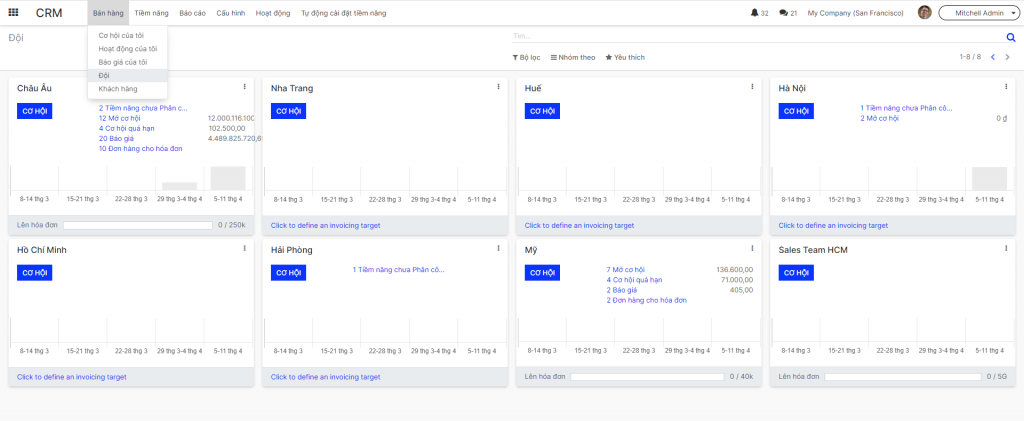
Instead of caring for customers through scattered channels such as email marketing and phone calls, businesses are increasingly adopting CRM software (customer relationship management) to evaluate team productivity and manage customer care on a single, comprehensive platform. Launched in early 2021, SimCRM is a customer relationship management platform that brings together leading modules: Employees, Projects, Email Marketing, Social Media, Sales, CRM, and more. Through the following benefits, SimCRM helps businesses build closer relationships with their customers:
-
Automated customer marketing: after customers are managed and divided into specific segments, SimCRM's Email Marketing module helps the business send email marketing campaigns automatically. Through these, businesses can send surveys (such as NPS, CSAT, etc.) to assess service quality and measure how satisfied customers are.
-
Set and track KPIs by individual, team, or department — such as total invoiced amounts and sales per country/salesperson/sales team.
-
Support for visual reports on KPI metrics, so managers can plan their next activities with greater accuracy.
SimERP currently lets you use its CRM package completely free for 30 days. Sign up for a trial using the form below.
Conclusion
With the knowledge about customer service departments shared above, SimERP hopes to help your business build and develop an effective customer service function that meets the company's needs and goals. In addition, if you'd like to try SimCRM free for 30 days, register here to experience a leading customer relationship management platform!
Related Articles
Bài viết liên quan

25 tháng 10, 2026 · 3 phut doc
2024年网页设计趋势预测如何? | Wotech Electronics
关于 2024 年网页设计趋势——步入 2024 年,年初正是我们为新事物预留时间的时刻。这也非常适合设计师群体唤醒我们内心的"艺术之魂"。闲话不多说,快来和 Markdao 一起浏览 2024 年的 UX/UI 设计趋势吧,说不定您就能为自己接下来的网页设计项目"迸发"出一个绝妙的点子呢!

25 tháng 10, 2026 · 1 phut doc
什么是网站(Website)?网站的详细定义及其带来的商业价值
什么是网站(https://www.markdao.com.vn/blog/website-la-gi)——这个问题或许已经无需定义,因为在如今这个信息时代,网站对每一家企业而言都是不可或缺的组成部分。正是网站帮助用户更近距离地接触企业所提供的产品和服务,从而提升经营效益。此外,要在当今竞争如此激烈的环境中求发展,网站是一个重要因素,它将带你走向品牌与销量上的双重成功。

25 tháng 10, 2026 · 1 phut doc
什么是SEO标准网站?一场"打赢"Google SEO标准的战役 | Wotech Electronics
99%的用户在购买前会先搜索信息,73%的用户只会访问排名前10的网站,并认定它们是值得信赖的品牌……在数字营销爆发的时代,这些数字有力地印证了SEO标准网站的重要性。然而,许多人对什么是SEO标准网站(https://www.markdao.com.vn/blog/huong-dan-toi-uu-seo-website-chuan-seo-on-page)仍然相当模糊,并未真正理解。达到SE…