What Is a Business Plan? How to Build an Effective Business Plan
Vũ Khôi
Tác giả tại Wotech Electronics Blog
What Is a Business Plan? How to Build an Effective Business Plan
Vũ Khôi
Author at Wotech Electronics Blog
A business plan plays a crucial role for every business. It is the guiding compass that takes the company to its destination and achieves its goals quickly and effectively. However, building a business plan is not easy. A business must truly understand its business purpose, resources, competitors, and customers, and devote plenty of time to surveying, researching, and analyzing.
In this article, SimERP will help you learn about a company's business plan and the rules to keep in mind when building one!
What is a business plan?
A business plan is a detailed outline of the business operations of a company, enterprise, or business unit over a given period, drawn up by management. The plan includes directions, objectives, and plans for each department, such as sales, marketing, finance, and more. Building a business plan gives the company a concrete direction for achieving its goals. The more detailed the plan, the higher its chances of being executed.
Depending on the purpose, business plans come in many different types. But in general terms, they all cover the main issues such as: resources, finance, sales strategy, objectives, and more. From there, the business can predict and anticipate risks and challenges, and seize opportunities to grow.
Rules for building a business plan
Have clear objectives
A business plan is the guide that leads the company to its destination. Therefore, you need to set a clear, specific objective. Only then can the business devise suitable plans all pointing toward the shared goal and achieve the best results. This also helps the company reduce waste of time and money. You can apply the 5W1H model to build a suitable direction for the business. The elements include:
-
Why: What are the goals and requirements of the plan? What does it mean for the business? What consequences will I face if the plan is not carried out?
-
What: What is the content of the work? What tasks must employees and managers perform to achieve the goal?
-
Where: Where does the work take place, and in which department? At which stages of the process?
-
When: When will the work be performed? When does it end?
-
How: What are the methods and materials for implementation? What are the standards and requirements for the tasks? What tools, resources, and personnel are needed to carry out the activity?
Research and analyze the market thoroughly
When building a business plan, the company must consider the market and its surrounding environment. These directly affect strategy and results. Today there are two main environments: micro and macro.
The macro environment includes factors such as: politics and society, economic conditions, technology, culture, and demographics. However, not every factor affects the business. Managers need to identify which factors are important and how their changes affect the plan. For example, with the socio-political factor, a change in agricultural export regulations directly affects companies exporting these products.
In addition, the business must analyze the micro environment carefully. Its main factors include: the industry market, competitors, suppliers, and customers. You need to track market changes and trends, as well as competitors' moves, to devise suitable plans.
The plan must be clear and concise
Creating a plan that is brief, clear, and complete helps readers and implementers fully grasp the issues and tasks they must carry out. Selecting information also becomes much simpler and faster.
Moreover, a plan is only effective for a certain period. Managers must frequently change and update it to fit each stage. Therefore, revising an overly long plan is time-consuming and prone to errors.
Suit the business
Any plan must suit the business. Managers need to clearly determine the company's business model, resources, and capabilities. Only then can they build the most reasonable plan and avoid future risks. For example, a manufacturing company's business plan usually includes suppliers and input materials. Meanwhile, service providers' plans usually say little about materials and instead focus on the service product and customer care.
What does a business plan contain?

Project summary
A plan can be quite long. Therefore, managers need a general summary of the project. This section explains the reasons, purpose, and overall approach to executing the project. Structurally, this is the opening section of the plan. In practice, however, you should write the summary after the plan is complete. At that point, you have finished the final plan and gained an overview of the project.
Market analysis
The business needs to pay attention to its market and analyze it thoroughly. Only then can it produce the most accurate and suitable plan. The factors include: suppliers, current competitors, future competitors, the target market, and customers. With a clear awareness of market conditions, you will find the right path, minimize risks, and reach your goals more easily.
Operational plan
How can the set goals be achieved? What are the main tasks to be done? These are the questions the business must answer in this section. Managers will specify the mode and manner of operation of each department, together with KPIs and rating scales.
Resource planning
Managers must determine what resources the plan requires, including: personnel, relationships, partners, sales channels, and more. Each plan leads to different resource requirements. Note that managers must express their requirements in concrete numbers for easy tracking and checking.
Financial planning
This is a vital element that must be present in any business plan. When planning finances, you should divide spending items into the smallest possible categories to minimize budget shortfalls, which would otherwise interrupt the plan's execution. In addition, the business needs to update revenue and spending daily to reduce the risk of losing money, and this also makes it easier for managers to evaluate the plan's effectiveness.
Attachments
Attachments supplement and clarify the information in the business plan. They usually include: balance sheets, cash flow statements, market analysis documents, potential customer analysis, business licenses, and more.
How to build a business plan

Define long-term goals
Depending on the product's stage and the company's direction, goals are set differently. For example, in a new-product business plan, the goals might be reaching many customers and increasing coverage. In an e-commerce business plan, companies usually set goals of increasing sales and the customer conversion rate. However, whatever the goal, managers must express it in concrete figures and weigh it against the company's and market's current situation, avoiding wishful thinking.
Determine the company's resources and capabilities
To ensure the plan is drawn up accurately, the business needs to identify its resources — people, technology, networks of relationships, and above all finance.
The greater the resources, the more conditions the business has to build big plans with bold moves. With limited resources, however, the business needs to weigh things carefully and take safe paths.
Research and analyze the market
When researching and analyzing the market, you need to assess: competitors, the business environment, and target customers. The business should study its direct competitors in depth and track their business moves. You should even learn a few approaches you consider good, and avoid making the same mistakes as competitors. In addition, the business needs to grasp the changes in its market — such as technology trends, new products, and changes in the industry's policies and distribution channels.
Research potential customers
Customers are at the center of every business plan. The company needs to study potential customers' buying habits, shopping needs, and general characteristics in depth. From there, build a portrait of the target audience. Furthermore, the business should segment customer groups to devise suitable approaches.
Specify methods and concrete tasks
Having analyzed the market and customers, and clearly defined its resources and goals, the business begins to build its methods, approaches, and concrete tasks. The clearer the list of tasks, the more risks the business reduces and the more likely it is to achieve its goals. Moreover, managers need to divide and assign these tasks to each department and set KPIs and measurement scales to monitor and evaluate work performance.
Execute the business plan
This is the stage where the company carries out its plan and checks how suitable and effective it is. Managers must closely monitor the work situation regularly so they can respond quickly when problems arise. You should use management software such as SimERP to control business operations better. With this software, the business can easily control everything from sales and projects to customer relationships and HR. Currently, the software offers businesses a free 30-day SimCRM trial.
Evaluate and adjust
After executing the projects, the business can evaluate the results of the business plan against the original measurement scales and goals. If problems arise, you should analyze them to find the causes and solutions. Furthermore, the company can make adjustments to fit the current situation and introduce new solutions to change the old plan.
A simple business plan template
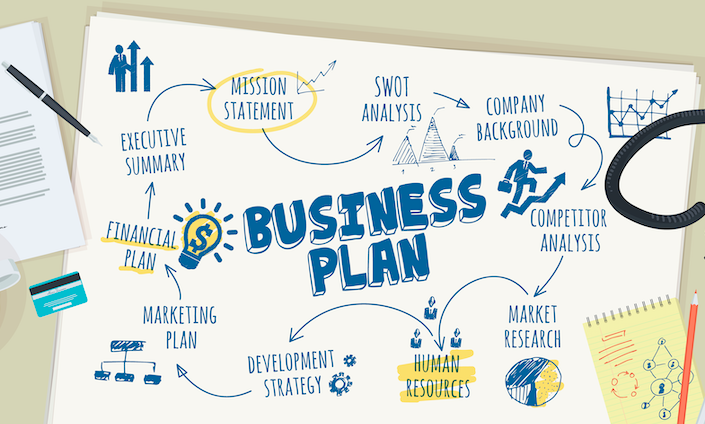
To help you understand how to build a business plan, SimERP suggests the 2021 business plan template widely used by businesses today.
Business plan summary
- General introduction to the business:
– General information.
– History of formation and development
– Products and services currently offered
– Analysis of the company's strengths, weaknesses, opportunities, and threats.
-
Objectives: What goals is the business aiming for?
-
Operating model: What business model does the company use?
-
Competitive advantages: What advantages does the business have over competitors? For example: products, technology, finance, human resources, etc.
-
General approach to achieving the goals: What methods does the business use to achieve its set goals and leverage its competitive advantages?
Market analysis
Macro environment
-
Economy: economic growth rate, inflation level, growth forecasts, etc.
-
Demographics: population, population distribution, education levels, etc.
-
Culture – society: shopping habits and behaviors, attitudes, needs and desires… and other cultural characteristics that may influence consumer behavior.
-
Technology environment: technology trends, technology usage habits, etc.
-
Politics – law: laws and decrees affecting your business environment and industry.
Micro environment
-
Market situation: the market's growth rate in previous periods? Future trends? New business methods?
-
Competitors: Who are the current competitors? Future competitors? Their strengths and weaknesses? Their business methods?
-
Suppliers: Do current suppliers have any problems? Who are the potential suppliers? A list of suppliers?
-
Customers: Customer characteristics? How are potential customers segmented? Their consumption habits and desires? The most suitable ways to reach them?
Marketing plan
-
Marketing strategy: price, product, methods of approach, and where those methods are implemented?
-
Marketing channels: What are the company's marketing channels? Which are the key channels to focus on? How will those channels be developed?
-
Marketing programs: Which marketing programs will be run throughout the period?
Sales plan
-
Sales channels: What are the online and offline sales channels? Which channels need emphasis? A plan for each channel.
-
Sales programs: What sales programs are being introduced (discounts, promotions, agent commissions)? At which channels and locations will they be run?
-
Organizing sales operations: What does the sales operations deployment chart include? The plan for building the system and refining the sales model?
HR plan
-
Management team: Who manages each activity in the plan? What management methods are suitable? How will issues be reported?
-
HR policies: How many employees? Salary and bonus policies? Benefits regimes? Working hours? etc.
Financial plan
-
Capital raising and usage plan: How much capital does the business need to invest? Allocated to what? Identify and analyze investment metrics? (ROA, ROE, NPV, IRR, etc.)
-
Key assumptions: Build assumptions for capital items, each cost element, revenue, and profit of the business.
-
Break-even analysis: What is the break-even point? Determine the output that generates total revenue just sufficient to cover total costs.
-
Business performance results: The company's current results and forecasts.
Appendix
-
Balance sheet, cash flow statement
-
Financial metrics table
-
Market analysis documents
-
References.
-
And any other necessary documents.
A business plan plays an important role for every business, determining the company's future success or failure. Therefore, managers must be extremely careful when building a plan and spend plenty of time researching and studying the related issues — resources, customers, the market, and more. We hope this article from SimERP has provided you with plenty of useful information.
Related articles
Bài viết liên quan

25 tháng 10, 2026 · 3 phut doc
2024年网页设计趋势预测如何? | Wotech Electronics
关于 2024 年网页设计趋势——步入 2024 年,年初正是我们为新事物预留时间的时刻。这也非常适合设计师群体唤醒我们内心的"艺术之魂"。闲话不多说,快来和 Markdao 一起浏览 2024 年的 UX/UI 设计趋势吧,说不定您就能为自己接下来的网页设计项目"迸发"出一个绝妙的点子呢!

25 tháng 10, 2026 · 1 phut doc
什么是网站(Website)?网站的详细定义及其带来的商业价值
什么是网站(https://www.markdao.com.vn/blog/website-la-gi)——这个问题或许已经无需定义,因为在如今这个信息时代,网站对每一家企业而言都是不可或缺的组成部分。正是网站帮助用户更近距离地接触企业所提供的产品和服务,从而提升经营效益。此外,要在当今竞争如此激烈的环境中求发展,网站是一个重要因素,它将带你走向品牌与销量上的双重成功。
25 tháng 10, 2026 · 1 phut doc
什么是SEO标准网站?一场"打赢"Google SEO标准的战役 | Wotech Electronics
99%的用户在购买前会先搜索信息,73%的用户只会访问排名前10的网站,并认定它们是值得信赖的品牌……在数字营销爆发的时代,这些数字有力地印证了SEO标准网站的重要性。然而,许多人对什么是SEO标准网站(https://www.markdao.com.vn/blog/huong-dan-toi-uu-seo-website-chuan-seo-on-page)仍然相当模糊,并未真正理解。达到SE…