
What Is Tax Accounting? A Basic Guide to the Corporate Tax Accounting Process | Wotech Electronics
Vũ Khôi
Tác giả tại Wotech Electronics Blog
What Is Tax Accounting? A Basic Guide to the Corporate Tax Accounting Process
Vũ Khôi
Author at Wotech Electronics Blog
In any business, tax accounting is an indispensable function that ensures tax management and declaration processes are transparent, clear, and compliant with the law. So what does tax accounting do? What does a tax accountant need to know? How is tax accounting carried out? The article below provides the fundamental knowledge of tax accounting so you can understand and apply the regulations to handle tax accounting transactions arising at your business effectively.

What is tax accounting?
Tax accounting is the function responsible for handling issues related to a business's periodic tax declaration and payment obligations as required by the State. Tax accounting can be said to act as a bridge between the business and the state authorities. On one hand, thanks to tax accounting, businesses find it easier to fulfill their tax obligations clearly and lawfully, ensuring stable operations. On the other hand, for the State, tax accounting makes managing a multi-sector economy easier, thereby ensuring a stable revenue source for the state budget.
What does tax accounting do?
Tax accounting work mainly focuses on the tasks of collecting, processing, and declaring documents and invoices, and preparing tax reports. These duties require accountants to accumulate many skills, professional knowledge, and experience. Specifically, the work of a tax accountant includes the following recurring responsibilities:
Daily tasks
Main responsibility: consolidating, processing, classifying, sorting, and archiving invoices and accounting documents.
Detailed job description
-
Consolidating: collecting and gathering tax accounting invoices from all sources inside and outside the business. Internal tax accounting invoices include output invoices when the business sells goods or provides services; external tax accounting invoices include input invoices when the business purchases goods or uses services for production and business. These documents are the basis for tax declaration and accounting entries.
-
Processing: declaring and adjusting to ensure the accuracy (reasonableness, validity, and legality) of tax accounting documents, and promptly handling any arising issues (if any), such as incorrectly issued, burned, lost, or damaged invoices, etc.
-
Classifying and sorting: arranging invoices and documents by set, in chronological order, by input–output classification, and by economic transaction, for ease of management.
-
Archiving: retaining for 10 years (for ordinary invoices) or 5 years (for documents such as receipts – payment slips, and import – export slips).
Monthly tasks
Main responsibility: preparing the monthly tax report. Typically, it is prepared at the end of the current month or the beginning of the next, depending on the company's current regulations.
Detailed job description
-
Determine the type and form of monthly tax report required (for example, VAT accounting, import–export tax accounting).
-
Declare the report content based on the invoices and documents collected and processed daily throughout the month.
Quarterly tasks
Main responsibility: preparing the quarterly tax report.
Detailed job description
-
Prepare the quarterly provisional corporate income tax return.
-
Prepare the quarterly report on invoice usage.
-
Prepare the personal income tax return (if any).
-
Prepare the value-added tax return (if any).
Annual tasks
Main responsibility: filing, finalizing taxes, and updating the annual financial statements.
Detailed job description
-
Tasks at the beginning of the year include declaring and paying the business license tax. Tax accountants must clearly know and accurately check the business license tax deadline to avoid late-payment penalties. Typically, the deadline is January 31 each year. In addition, the tax accountant must file the VAT return (output, input) and the corporate income tax return.
-
Tasks at the end of the year: finalize corporate income tax and personal income tax, and prepare the financial statements (Balance Sheet; Cash Flow Statement; Income Statement; Notes to the financial statements).
What tax accountants need to know
Tax accounting plays a vital role in business operations. Mistakes in preparing tax reports will have a major impact on the business, especially legal issues and operating costs. Therefore, to ensure tax accounting work is carried out clearly, transparently, and accurately, accountants need to remember the following basics:
-
Comply with tax law provisions.
-
Regularly monitor and update new regulations, circulars, and decrees on tax law.
-
Carry out tax accounting correctly, fully, and on time to avoid damaging the business.
-
Comply with information confidentiality principles.
-
Regularly check and cross-check invoices, minutes, and documents so discrepancies between tax reports and tax finalization figures can be handled and adjusted in time.

The tax accounting process
To build a tax accounting process, the considerations and requirements for businesses in general — and tax accounting staff in particular — are:
-
Understand each type of tax thoroughly, along with the regulations and policies attached to it.
-
Regularly update information on circulars, decrees, and new changes in tax law.
-
List all types of taxes accurately and completely, from when the business began operating to the present, so that the declaration and payment process runs correctly and fully as required by law.
-
Always track and update information and figures on taxes paid and unpaid in order to finalize or make supplementary payments in time and in accordance with regulations.
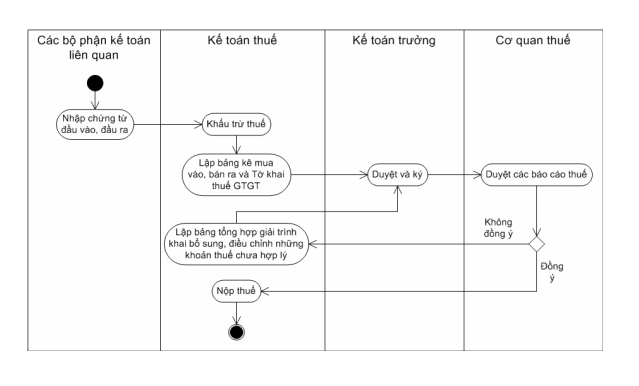
Accordingly, a complete tax accounting process includes the following basic steps:
-
Step 1: The relevant accounting departments enter input and output document information.
-
Step 2: The tax accountant: deducts taxes; prepares the input–output expense list and the VAT return; and prepares the consolidated supplementary declaration schedule, adjusting unreasonable tax items.
-
Step 3: The chief accountant approves, signs, and submits the tax report to the tax authority.
-
Step 4: The tax authority reviews the tax report. If approved: the tax accountant proceeds to pay the tax. If not yet approved: the tax accountant continues to review and adjust, supplementing unreasonable tax items. Then resubmits it to the chief accountant for approval and sends it to the tax authority a second time.
Guide to import–export tax accounting
Export tax accounting method
When selling goods or providing ordinary services:
-
If the export tax payable can be separated at the time the transaction arises, accounting records revenue from sales of goods and provision of services excluding export tax as follows: Debit accounts 111, 112, 131 (total payment value); Credit account 511 – Revenue from sales of goods and provision of services; Credit account 3333 – Import–export tax (export tax detail).
-
If the export tax payable cannot be separated at the time the transaction arises, accounting records revenue from sales of goods and provision of services including export tax. When the periodic export tax payable is determined, post as follows: Debit account 511 – Revenue from sales of goods and provision of services; Credit account 3333 – Import–export tax (export tax detail).
When paying export tax to the state budget:
-
Debit account 3333 – Import–export tax (export tax detail)
-
Credit accounts 111, 112.
If export tax is refunded or reduced:
-
Debit accounts 111, 112, 3333.
-
Credit account 711 – Other income.

Case of entrusted export (applied at the entrusting party)
-
When selling goods or providing services subject to export tax, accounting records revenue from providing goods and services and the export tax payable as in ordinary export of goods and services.
-
When receiving the tax payment documents to the state budget from the entrusted party, the entrusting party needs to record the reduction of its obligation to the state budget for export tax. Post as follows: Debit account 3333 – Import–export tax (export tax detail); Credit accounts 111, 112 (where payment is made to the entrusted party immediately); Credit account 3388 – Other payables (where the export tax has not yet been paid to the entrusted party immediately); Credit account 138 – Other receivables (reducing the advance given to the entrusted party to pay the export tax).
-
If the entrusted party does not record the export tax payable as the entrusting party does, but only records the amount of tax paid on the entrusting party's behalf, post as follows: Debit account 138 – Other receivables (to recover the amount paid on their behalf); Debit account 3388 – Other payables (offset against the amount received from the entrusting party); Credit accounts 111, 112.
Import tax accounting method
When importing ordinary goods and services
-
When importing goods, materials, or fixed assets, accounting records the import tax payable, the total amount payable or already paid to the seller, and the value of the imported goods, materials, or fixed assets (price including import tax). Post as follows: Debit accounts 152, 156, 211, 611 (price including import tax); Credit account 3333 – Import–export tax (import tax detail); Credit accounts 111, 112, 331.
-
For goods temporarily imported for re-export and not owned by the business (for example, goods in transit at the bonded warehouse awaiting immediate re-export), when paying the import tax, the tax accountant posts as follows: Debit account 138 – Other receivables; Credit account 3333 – Import–export tax (import tax detail).
When paying import tax to the state budget
-
Debit account 3333 – Import–export tax (import tax detail)
-
Credit accounts 111, 112.
Accounting for import tax refunds on tax already paid at import
-
Where import tax was paid at import and is refunded upon re-exporting goods: Debit account 3333 – Import–export tax (import tax detail); Credit account 632 – Cost of goods sold (if goods are exported for sale); Credit accounts 152, 153, 156 – Goods (if goods are returned).
-
Where import tax was paid at import and is refunded upon re-exporting a fixed asset: Debit account 3333 – Import–export tax (import tax detail); Credit account 211 – Tangible fixed assets (if the fixed asset is returned); Credit account 811 – Other expenses (if the fixed asset is sold).
-
Where import tax was paid at import but the goods are not owned by the business and is refunded upon re-export (for example, import tax paid on goods imported for processing): Debit account 3333 – Import–export tax (import tax detail); Credit account 138 – Other receivables.
-
When receiving the money from the state budget, record: Debit account 112 – Bank deposits; Credit account 3333 – Import–export tax (import tax detail).

Case of entrusted import (applied at the entrusting party)
-
When receiving notification of import tax obligations from the entrusted party, the entrusting party must record the import tax payable: Debit accounts 152, 156, 211, 611 (price including import tax); Credit account 3333 – Import–export tax (import tax detail).
-
When receiving the tax payment documents to the state budget from the entrusted party, the entrusting party records the reduction of its obligation to the state budget for import tax: Debit account 3333 – Import–export tax (import tax detail); Credit accounts 111, 112 (if payment is made to the entrusted party immediately); Credit account 3388 – Other payables (if the import tax has not yet been paid to the entrusted party immediately); Credit account 138 – Other receivables (reducing the advance given to the entrusted party to pay the import tax).
-
Where the entrusted party does not record the import tax payable as the entrusting party does, but only records the amount of tax paid on the entrusting party's behalf, record: Debit account 138 – Other receivables (to recover the amount paid on their behalf); Debit account 3388 – Other payables (offset against the amount received from the entrusting party); Credit accounts 111, 112.
Guide to value-added tax accounting
Recording input VAT
- When purchasing goods, materials, or fixed assets, or using services for production and business needs, the tax accountant posts as follows: Debit accounts 156, 152, 153, 211, 642, 142, 242 – Price excluding tax; Debit account 1331 – Deductible input VAT; Credit accounts 111, 112, 331 – Amount payable to the supplier.
* Note: Under Circular 219/2013/TT-BTC: "Input VAT that is not deductible for a business establishment is recorded as an expense for corporate income tax purposes, or included in the historical cost of fixed assets, except for the VAT on purchased goods and services of 20 million VND or more per transaction that is not paid by bank transfer."
Recording output VAT
-
When selling goods and services: Debit accounts 111, 112, 131 – Total payment value; Credit account 3331 – Output VAT payable; Credit account 511 – Revenue excluding VAT.
-
At the end of the period, determine the deductible VAT against the output VAT payable and the VAT payable in the period. The deductible VAT in the period is offset against the output VAT payable: Debit account 3331 – Output VAT payable; Credit account 1331 – Deductible input VAT.
* Note: Where account 1331 > account 3331 — meaning input tax exceeds output tax — the tax accountant carries the balance of account 1331 forward to the next period for further deduction. Conversely, where account 1331 < 3331, the accountant pays the difference into the state budget.
- When paying tax to the state budget: Debit account 3331 – Output VAT payable; Credit accounts 111, 112 – Tax payment.
Summary
We hope the concepts, job descriptions, and process guidance above help you better understand corporate tax accounting. If you need further advice on solutions or software systems to ensure accuracy and effectiveness in tax accounting work, don't forget to leave a comment below the article or contact us here!
Related Articles
Bài viết liên quan

25 tháng 10, 2026 · 3 phut doc
2024年网页设计趋势预测如何? | Wotech Electronics
关于 2024 年网页设计趋势——步入 2024 年,年初正是我们为新事物预留时间的时刻。这也非常适合设计师群体唤醒我们内心的"艺术之魂"。闲话不多说,快来和 Markdao 一起浏览 2024 年的 UX/UI 设计趋势吧,说不定您就能为自己接下来的网页设计项目"迸发"出一个绝妙的点子呢!

25 tháng 10, 2026 · 1 phut doc
什么是网站(Website)?网站的详细定义及其带来的商业价值
什么是网站(https://www.markdao.com.vn/blog/website-la-gi)——这个问题或许已经无需定义,因为在如今这个信息时代,网站对每一家企业而言都是不可或缺的组成部分。正是网站帮助用户更近距离地接触企业所提供的产品和服务,从而提升经营效益。此外,要在当今竞争如此激烈的环境中求发展,网站是一个重要因素,它将带你走向品牌与销量上的双重成功。

25 tháng 10, 2026 · 1 phut doc
什么是SEO标准网站?一场"打赢"Google SEO标准的战役 | Wotech Electronics
99%的用户在购买前会先搜索信息,73%的用户只会访问排名前10的网站,并认定它们是值得信赖的品牌……在数字营销爆发的时代,这些数字有力地印证了SEO标准网站的重要性。然而,许多人对什么是SEO标准网站(https://www.markdao.com.vn/blog/huong-dan-toi-uu-seo-website-chuan-seo-on-page)仍然相当模糊,并未真正理解。达到SE…