
Payroll Accounting: Concepts, Duties, and the Process under Circular 200
Vũ Khôi
Tác giả tại Wotech Electronics Blog
Payroll Accounting: Concepts, Duties, and the Process under Circular 200
Vũ Khôi
Author at Wotech Electronics Blog
Payroll accounting in a business plays a key role in managing the company's budget and wage fund, as well as ensuring that wage obligations to employees are met. So what does payroll accounting actually involve? Read the following article for a complete understanding of the concept, duties, methods, and payroll accounting process in line with accounting standards under Circular 200.

What Is Payroll Accounting?
The Concept of Payroll Accounting
Payroll accounting is the bookkeeping of wages based on timesheets, overtime hours (extra hours or work on public holidays), allowance and subsidy regimes, rewards and penalties, labor contracts, and so on. In payroll accounting, the business also has the obligation to pay the costs prescribed by the Labor Code, such as health insurance, social insurance, unemployment insurance, and trade union fees. In addition, payroll accounting must balance employees' income levels to sustain the company's wage fund. This allows the business to manage its finances accurately and efficiently, and lays the groundwork for long-term HR planning.

Duties of Payroll Accounting
The job of payroll accounting is to handle all matters related to employee wages. Payroll accounting duties are therefore diverse and demand a high level of professional expertise. Specifically, the payroll accountant's workflow at a company includes the following tasks:
-
Managing and monitoring daily attendance
-
Preparing timesheets for tracking and management
-
Ensuring the attendance process is complete and accurate
-
Compiling and recording changes in employee headcount, absences, and staff performance
-
Managing salary advances
-
Receiving and approving salary advance requests
-
Creating salary advance tables and advance vouchers according to the prescribed salary percentage
-
Preparing statistical records of the number of employees and the amount of salary advanced during the month, for archiving and as the basis for the official payroll period
-
Managing the payroll period: Building the payroll accounting table and salary-based deductions with all the wage calculation items for employees (days and hours worked; allowances; rewards or end-of-period deductions)

-
Making payroll accounting journal entries
-
Building detailed payroll tables for each employee based on timesheets, the provisions of the Labor Contract, and company policy
-
Calculating advances, allowances, payroll accounting, social insurance and health insurance, tax settlement, and so on
-
Completing the payroll table and submitting it to the chief accountant to await the director's approval
-
Paying employees on time, ensuring wages, trade union funds, and insurance contributions are calculated and allocated accurately
-
Handling other related administrative documents
-
Preparing periodic payroll reports, personal income tax settlement reports, and social insurance reporting forms as prescribed
-
Updating salary coefficients after each employee evaluation period to apply in payroll calculations
-
Controlling and managing the implementation of wage, insurance, and trade union fee policies and regimes, as well as the use of the company's wage fund
-
Coordinating with relevant departments to understand and prepare analytical reports on headcount changes and work performance quality
-
Archiving documents and books related to payroll accounting as prescribed
Payroll Accounting Methods
Guide to Payroll Accounting under Circular 200
- Use accounting software to book wage expenses
Periodically at month end, the accountant must fulfill the duty of calculating employee salaries based on timesheets, the provisions of the Labor Contract, and the company's regulations on wages, bonuses, and allowances. Before booking wage expenses, the accountant must determine the wage details (which employee, which department, what salary level?) and ensure compliance with the Circular's provisions so that each expense item is booked accurately.
- Calculate wages and allowances payable to employees
Debit Accounts 241, 622, 623, 627, 641, 642: Wages payable to employees.
Credit Account 334: Total wages payable to employees.
- Bonuses paid to employees: Determine the bonus amount drawn from the company's fund.
Debit Account 353: Bonuses payable to employees.
Credit Account 334: Total bonuses payable to employees.
- Accrued vacation wages for employees
Debit Accounts 622, 623, 627, 641, 642: Accrued vacation wages.
Credit Account 335: Total accrued vacation wages.
- Actual vacation wages payable to employees:
Debit Account 335: Actual vacation wages arising.
Credit Account 334: Total actual vacation wages arising.

- Booking insurance deductions based on wages
Each month, the business must pay the social insurance agency 32% of the total wage fund payable to employees (social insurance, health insurance, unemployment insurance, and occupational accident insurance), of which 21.5% is charged to business expenses and 10.5% is deducted from employees' wages. In addition, if a trade union has been established, the business must pay the district-level Labor Federation 2% of the wage fund payable to employees (trade union fees).
- Charged to business expenses
Total insurance the business must pay = 21.5% x Total wage fund covered by insurance
Debit Accounts 241, 622, 623, 627, 641, 642: Total insurance + trade union fees the business must pay
Credit Account 3383 (Social insurance): 17.5% x Total wage fund covered by insurance.
Credit Account 3384 (Health insurance): 3% x Total wage fund covered by insurance.
Credit Account 3386 (Unemployment insurance): 1% x Total wage fund covered by insurance.
Credit Account 3382 (Trade union fee): 2% x Total wage fund covered by insurance (if any)
- Deducted from employee wages
Total insurance employees must pay = 10.5% x Total wage fund covered by insurance
Debit Account 334: Total insurance employees must pay.
Credit Account 3383 (Social insurance): 8% x Total wage fund covered by insurance.
Credit Account 3384 (Health insurance): 1.5% x Total wage fund covered by insurance.
Credit Account 3386 (Unemployment insurance): 1% x Total wage fund covered by insurance.
-
Booking wage deductions
-
Salary advances
If an employee receives a salary advance during the period, the accountant needs to look up the actual amount advanced to deduct it from the wages payable to the employee.
Debit Account 334: Actual advance amount arising.
Credit Accounts 111, 112: Actual advance amount arising.
- Personal income tax
If an employee incurs personal income tax in the payroll period, the accountant needs to determine the tax amount to deduct it from the wages payable to the employee.
Debit Account 334: PIT amount withheld.
Credit Account 3335: PIT amount withheld.
When remitting personal income tax for taxable employees, based on Tax Declaration File 02/KK-TNCN and the payment voucher to the state budget, the accountant books:
Debit Account 3335: PIT payable.
Credit Accounts 111, 112: PIT payable.

-
Booking wage payments
-
Based on the payroll payment table, salary payment vouchers, or bank wage payment documents, the accountant books:
Actual wages paid = Total wages, allowances, and bonuses – Insurance payable – Wage deductions (advances, PIT)
Debit Account 334: Actual wages paid.
Credit Accounts 111, 112: Actual wages paid.
- If wages are paid to employees in products, the accountant needs to issue an invoice recording internal sales revenue and book it as follows:
Debit Account 334: Wages payable to employees.
Credit Account 5118: Other revenue (selling price of goods).
Credit Account 3331: VAT payable.
- Booking insurance payments
Each month, the business sets aside social insurance, health insurance, unemployment insurance, and trade union fees (if any) on the total wage fund payable to employees. The accountant books:
Debit Account 3383 (Social insurance): 25.5% x Total wage fund covered by insurance.
Debit Account 3384 (Health insurance): 4.5% x Total wage fund covered by insurance.
Debit Account 3386 (Unemployment insurance): 2% x Total wage fund covered by insurance.
Debit Account 3382 (Trade union fee): 2% x Total wage fund covered by insurance (if any).
Credit Accounts 111, 112: Total insurance + trade union fees payable.
- Booking social insurance benefits payable to employees
If employees fall ill, go on maternity leave, and so on during the period, the business must calculate the insurance benefits payable to them.
Debit Account 3383 (Social insurance): Benefit amount receivable.
Credit Account 334: Benefit amount receivable.
After the business submits the employee's social insurance benefit claim (sickness, maternity, and so on) to the Social Insurance Agency and receives the money transferred back, the accountant books:
Debit Account 112: Amount received.
Credit Account 3383 (Social insurance): Amount received.
When the business pays the social insurance benefit to the employee, the accountant books:
Debit Account 334: Benefit amount receivable.
Credit Accounts 111, 112: Benefit amount receivable.
Payroll Accounting Diagram
To help you understand better, the payroll accounting process and the booking of salary-based deductions can be summarized in the following diagram:
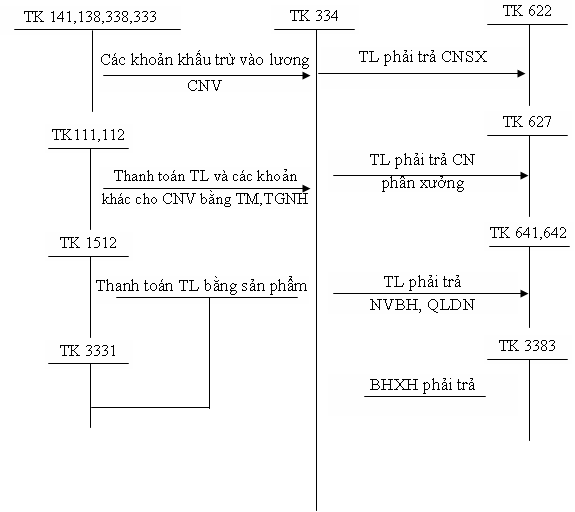
Together with the payroll accounting guide under Circular 200, we hope the diagram above has helped you grasp the basic steps for booking wages completely and accurately.
Summary
It is fair to say that payroll accounting is a highly specialized task that requires staff with extensive payroll accounting experience to perform completely and accurately. That is why using supporting accounting management systems and software is an indispensable investment that makes payroll accounting in a business easier and more effective. If you'd like to learn more about payroll accounting solutions, don't hesitate to post your questions in the comments section or contact us right away for answers!
Related Articles
Bài viết liên quan

25 tháng 10, 2026 · 3 phut doc
2024年网页设计趋势预测如何? | Wotech Electronics
关于 2024 年网页设计趋势——步入 2024 年,年初正是我们为新事物预留时间的时刻。这也非常适合设计师群体唤醒我们内心的"艺术之魂"。闲话不多说,快来和 Markdao 一起浏览 2024 年的 UX/UI 设计趋势吧,说不定您就能为自己接下来的网页设计项目"迸发"出一个绝妙的点子呢!

25 tháng 10, 2026 · 1 phut doc
什么是网站(Website)?网站的详细定义及其带来的商业价值
什么是网站(https://www.markdao.com.vn/blog/website-la-gi)——这个问题或许已经无需定义,因为在如今这个信息时代,网站对每一家企业而言都是不可或缺的组成部分。正是网站帮助用户更近距离地接触企业所提供的产品和服务,从而提升经营效益。此外,要在当今竞争如此激烈的环境中求发展,网站是一个重要因素,它将带你走向品牌与销量上的双重成功。

25 tháng 10, 2026 · 1 phut doc
什么是SEO标准网站?一场"打赢"Google SEO标准的战役 | Wotech Electronics
99%的用户在购买前会先搜索信息,73%的用户只会访问排名前10的网站,并认定它们是值得信赖的品牌……在数字营销爆发的时代,这些数字有力地印证了SEO标准网站的重要性。然而,许多人对什么是SEO标准网站(https://www.markdao.com.vn/blog/huong-dan-toi-uu-seo-website-chuan-seo-on-page)仍然相当模糊,并未真正理解。达到SE…