
Customer Surveys: The Process and Tips for Success | Wotech Electronics
Vũ Khôi
Tác giả tại Wotech Electronics Blog
Customer Surveys: The Process and Tips for Success
Vũ Khôi
Author at Wotech Electronics Blog
Alongside the development of the digital technology era comes an increasingly fierce competitive environment. To adapt and survive, businesses need an effective customer care strategy to retain customers and grow their loyal base. To do that, customer surveys are an essential activity for any business. By asking survey questions, businesses capture customers' perceptions of and feedback on the products/services they experience. From there, the business can adjust its plans and strategies to deliver a better customer experience.
So what is a customer survey, and why survey customers? Let's walk through the article below with SimERP.
What is a customer survey?

A customer survey is a questionnaire designed to help a business capture what customers think and feel about its brand, products, or services.
So how important is a customer survey to your business?
A business is essentially a purposeful system, where various elements (such as support staff, the sales platform, a clear marketing message, logistics, etc.) are interconnected to achieve the ultimate goal — giving your customers the best possible experience. To do this, you need to know what customers think and feel across the operations of the entire system.
Customer surveys help you collect data at specific touchpoints, such as right after a sale, when a potential customer chooses to leave the website without buying, or after a customer support ticket has been resolved and closed, etc. From there, planning actions based on the insights gathered will help you improve the experience for both current and future customers.
Types of customer surveys

There are many types of customer survey forms that businesses can use to collect customer feedback. Each survey type provides a different insight into customers and should be used at a specific point in the customer experience lifecycle. So choose wisely!
Below, SimERP shares the 3 most common types of customer survey forms.
The NPS survey form
The Net Promoter Score (NPS) is a metric that measures customer satisfaction and loyalty. Created in 2003 by Fred Reichheld — a partner at Bain & Company — the NPS system has been and is being widely applied across all industries.
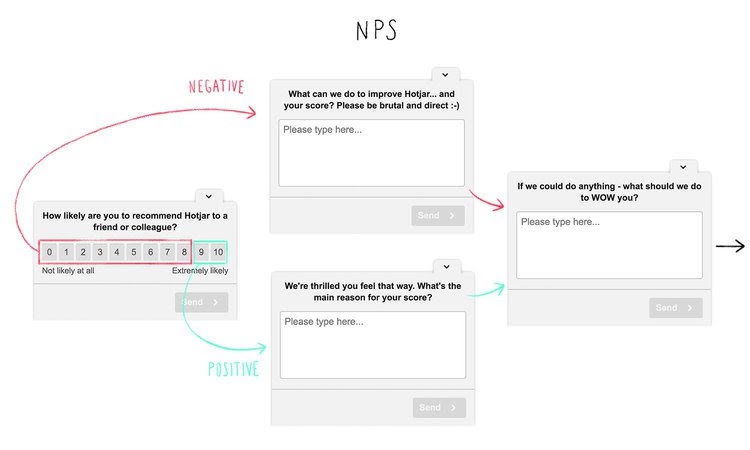
NPS is measured by asking customers: "On a scale from 0–10, how likely are you to recommend the product/service to friends/colleagues?" The answers to this question can be grouped into 3 categories:
-
Detractors (1–6 points): Customers choosing these scores are those who had a terrible experience with the product/service you provide. The business needs measures to appease them and improve the quality of its customer care. Otherwise, these customers may share their dissatisfaction with others.
-
Passives (7–8 points): These are indifferent customers who don't care much about the product/service you provide. They may recommend their experience to others or go looking for and use a competitor's product/service.
-
Promoters (9–10 points): These are loyal customers willing to recommend your product/service to others, helping you build a good reputation and add new customers.
To calculate the NPS, apply the following formula:
NPS = %Promoters – %Detractors
Example: If 60% of the answers are Promoters and 15% are Detractors, your NPS will be 40.
Because NPS is easy to report, it has become a powerful standard. Executive teams can set quarterly NPS targets and track whether they are met — a great first step in building a database for your customer experience program.
The CSAT survey form
The Customer Satisfaction Score (CSAT) measures how satisfied customers are with a specific situation. A CSAT survey has two parts: one question and one open answer.
CSAT asks "How satisfied are you with this product or interaction?" Respondents can choose from 1 (very dissatisfied) to 5 (very satisfied).
Respondents choosing 4 or 5 are considered "satisfactory responses," and the CSAT formula is:
CSAT = (Total satisfactory responses / total responses) x 100
When calculating CSAT, make sure to round the final result to the nearest whole number.
Unlike other survey types, CSAT provides insight into a specific customer interaction. This gives a detailed view of whether a digital or in-person experience exceeds, meets, or falls short of customer expectations.
Customer satisfaction surveys should be used throughout the product lifecycle to analyze how various aspects of the product are performing: such as sign-up, onboarding, and after using the core features.
The CES survey form
The Customer Effort Score (CES) is often called the customer effort index. This metric determines the degree of effort required to use and experience a product/service and the likelihood that customers will keep paying for it.
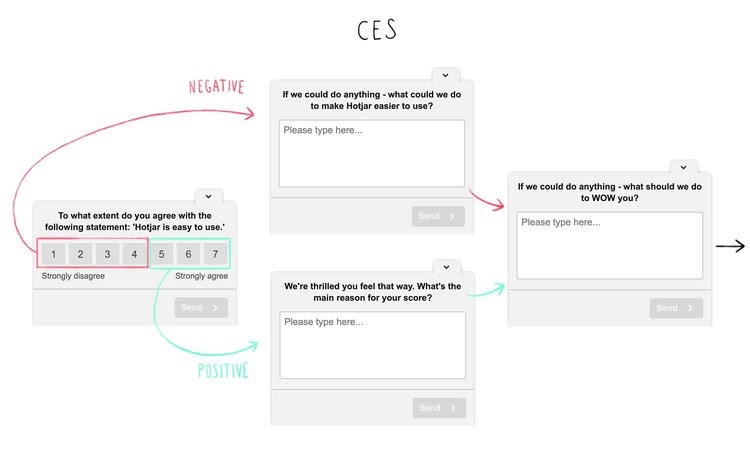
The question the CES survey asks is: "How satisfied are you with the product/service you experienced?"
To measure the CES, first you need to group your answers into ranges. For example: disagree covers all answers from 1 to 2, neutral is 3, and agree is 4 and 5. The customer effort score focuses on the "agree" range. To find your CES, take the number of answers in the agree range (4 and 5) and divide by the total number of respondents.
By capturing customers' thoughts and feedback, CES surveys are a great way to understand how seamless a specific process or workflow in your product or service is. Companies looking to improve channel metrics and conversion rates in particular will benefit greatly from CES surveys.
5 customer satisfaction survey templates
Understand your customers & raise your service quality!
Your information is invalid. Please try again!
Why survey customers?

Customer surveys are necessary for businesses and organizations to understand what customers think of their brand. It also gives you deeper insight into the entire customer experience and support journey. Other reasons you should consider surveying the customer experience include:
Helps retain customers
By tracking the entire customer journey, you can anticipate whether any product or service is going off track relative to the original goal. You can also forecast future sales through customer loyalty. Once you have the necessary information, you can plan adjustments to improve the customer experience and retain them.
Identify loyal customers
Through customer surveys, you can identify who is loyal to your product/service/brand. By starting with the NPS, you can segment your customers, and from there plan targeted brand messaging aimed at converting Detractors (dissatisfied customers) into Promoters (loyal customers).
Helps collect data for sound decision-making
The best business decisions are based on data and rarely on luck. Especially in the digital technology era, when the competitive environment is becoming fiercer and customer needs keep changing. Therefore, capturing and understanding customers' perceptions of products/services is extremely important. To do this, businesses should collect customer data effectively by applying a variety of customer survey forms flexibly and with a plan.
>>>> See more: 7 Effective Ways to Interact with Customers in Every Situation
The standard customer survey process

Setting up surveys is quite simple. However, to get the best survey results, you need a specific and suitable plan. That's because the content you want to research will determine the type of customer survey form you use and the right point in the customer journey at which you decide to survey.
Below are the 4 steps in the customer survey process.
Define the problem to research
First, you need to be clear about what you want to learn from the survey. From there, choose a touchpoint in the customer journey that you want to research.
Here are a few examples of things you could research at different stages of a typical e-commerce customer journey:
-
Pre-sale: Do customers have enough information to buy? Is anything preventing them from making a decision?
-
Post-sale: Are customers satisfied with the product? Was the ordering process easy, and do they suggest any changes? Will customers recommend your product/service to others?
-
After a support call: Have you resolved their problem? If so, how easily was it resolved? If not, how does that affect their view of your product and brand?
-
Rating an item low, canceling, or returning it: Are they unhappy with the product or service? If so, why?
Choose the right type of customer survey
Different survey types will help you determine whether your customers are satisfied and loyal to your product/service, and each type can also help you learn something more about their experience.
Design the customer survey
Each survey includes various question types depending on the survey's research purpose. Below are 7 common question types you can refer to.
Open-ended questions
An open-ended question allows respondents to freely write anything they want. This makes it easy for customers to express their feelings about their experience without being limited to preset answer options like other question types. From there, the business gains more information about challenges and opportunities to plan adjustments.
Example: What should we do to improve product/service quality?
The drawback of this question type is that it is hard to analyze the data. However, nowadays there are many technical tools that make analyzing open-ended questions easy if you are willing to dig in and explore them.
Closed-ended (multiple choice) questions
The answers in a closed-ended question are usually limited. However, this question type has the big advantage of being easy to analyze and requiring much less effort from customers to answer than open-ended questions.
Closed-ended questions include ordinal scale, binary scale, nominal, Likert scale, and semantic differential questions, all explained below.
Ordinal scale questions
These questions offer a series of answers corresponding to a numeric scale. For example, rating how easy the purchase was on a scale of 1–5. Be sure to define the scale clearly (e.g., 1: not easy at all, 5: very easy) so customers aren't confused.
Example: How easy was your onboarding? (1: not easy at all – 5: very easy)
Binary scale questions
These questions limit the answer to one of two possibilities: such as "yes/no" or "happy face/sad face." A binary scale is less ambiguous than a rating scale — where one person's 4-star experience might be another person's 5-star experience.
Example: Have we resolved your issue today? (Yes/No)
Nominal scale questions
Nominal questions assign distinct categories to the answers. The answers must not overlap (unless there is an "all of the above" option) and no numeric value is attached to the answers.
Example: What is your preferred payment method?
-
COD
-
Bank transfer
-
E-wallet
-
Smart mobile device
Likert scale questions
The Likert scale is a 5- or 7-point scale used to assess customers' feelings. The smallest number (always "1") indicates a very negative response, while the highest number (e.g., "7" on a 7-point scale) indicates a very positive response.
Example: To what extent do you agree with the following statement: [Product name] is very convenient and easy to use anytime, anywhere
1 – Strongly disagree
2 – Slightly disagree
3 – Neither agree nor disagree
4 – Slightly agree
5 – Strongly agree
Semantic differential scale questions
Semantic differential scale questions are similar to Likert scale questions in that both use a 5- or 7-point scale, but semantic differential questions do not ask respondents to 'agree' or 'disagree' with a statement. Instead, you ask customers to choose the point on the scale that best describes their perception.
Example: How do you feel about the knowledge we shared?
1 – Not helpful at all
2 – Slightly helpful
3 – Undecided
4 – Somewhat helpful
5 – Very helpful
Build and send the survey questions

Once you are ready to build your survey, the specific steps you take will depend on the tool you use. Whatever tool you choose, always keep the following 3 tips in mind:
- Roll out the survey with a plan
You don't need to set up dozens of surveys at once: start small and review how they perform and how effective the rollout is. If certain questions don't work, consider adjusting, replacing, or removing them if necessary.
- Choose the ideal time to deploy the survey
Remember that timing matters when sending out surveys.
For example, consider sending the customer service survey 20 or 30 minutes after the interaction — this gives customers enough time to figure out whether the issue was resolved. Similarly, when you run an NPS question about a product, make sure your customers have received your product and had enough time to use it beforehand.
- Evaluate the data (when your sample size is large enough)
Use a sample size calculator to figure out how many data points you need to achieve statistical significance (i.e., a sample that represents your customer base).
- Use a survey delivery tool
There are many tools that let you send surveys for free. A typical example is using a chatbot or email marketing to send surveys directly to your customers. A chatbot can be set up to send automated messages to all customers who have interacted with your fanpage on Facebook. Email marketing means sending bulk emails to a customer list you already have. If you have a large number of customer emails and don't know how to leverage them, that is truly a waste. You can try SimCRM's email marketing tool completely free by clicking the trial sign-up button below.
Tips for successful customer surveys
Dos
Set goals
The first question you need to answer before starting to design your survey: what do you want the investigation to achieve? Is it customer feedback on one touchpoint or a rating of the entire experience? Although the broader goal is usually to measure customer satisfaction (CSAT), writing down the goal will simplify your survey process.

Choose the right tool
Depending on the situation, conditions, and goals of the survey, you need to consider choosing the right analytical tool, one that delivers accurate, clear, and specific analysis.
Choose a survey template and customize it appropriately
Nowadays there are many providers of free or paid survey templates that you can consider. Working from a ready-made survey template is always easier than designing your survey from scratch. You can also customize it using your logo and brand colors to make it consistent with your brand.
Use open-ended questions
As mentioned above, open-ended questions let customers express their feelings and opinions more freely than closed-ended questions with limited answer options. Using open-ended questions flexibly and sensibly will encourage customers to be more open about sharing their experiences.
Review the survey
Once you've finished designing it, review it carefully to make sure your survey has enough content and works well. For more effective testing, you should put the survey through a review process within a team to get a more objective view of the answers.
Don'ts
Ask too many questions
Respondents hate question pages that take up a lot of their time and effort. So keep your survey short while still collecting the necessary information and keeping customers engaged. A highly effective survey usually has five to 10 questions.
Have no "required" questions
You cannot expect customers to answer every question you ask, especially when there is a lot of personal information that compromises privacy and annoys customers. Therefore, you need to choose question types sensibly to spark customers' interest.
Don't ask many demographic questions
Typically, demographic questions seem like a good choice for businesses to collect more information from customers. However, using these questions when unnecessary only makes your survey long-winded.
Avoid jargon or technical terms
The survey needs to be easy to read, simple, and understandable. There is a chance your customers may not know the technical terms your organization uses. A confused customer will hardly complete the survey or give you accurate answers.
Be compatible with every device
While preparing your online survey, make sure you test it on all handheld devices, including mobile phones, tablets, and laptops. Testing it beforehand will give you a better idea of how the survey will appear and how readable it is on a different device.
Conclusion: Building a survey that fits your business's research goals is quite easy if you understand the process and the important design considerations. Through surveys at different points in the customer journey, you will capture user information and perceptions more quickly and effectively. From there, you can put timely solutions in place to appease customers or adjust products/services to deliver the best possible customer experience.
Related articles
Bài viết liên quan

25 tháng 10, 2026 · 3 phut doc
2024年网页设计趋势预测如何? | Wotech Electronics
关于 2024 年网页设计趋势——步入 2024 年,年初正是我们为新事物预留时间的时刻。这也非常适合设计师群体唤醒我们内心的"艺术之魂"。闲话不多说,快来和 Markdao 一起浏览 2024 年的 UX/UI 设计趋势吧,说不定您就能为自己接下来的网页设计项目"迸发"出一个绝妙的点子呢!

25 tháng 10, 2026 · 1 phut doc
什么是网站(Website)?网站的详细定义及其带来的商业价值
什么是网站(https://www.markdao.com.vn/blog/website-la-gi)——这个问题或许已经无需定义,因为在如今这个信息时代,网站对每一家企业而言都是不可或缺的组成部分。正是网站帮助用户更近距离地接触企业所提供的产品和服务,从而提升经营效益。此外,要在当今竞争如此激烈的环境中求发展,网站是一个重要因素,它将带你走向品牌与销量上的双重成功。
25 tháng 10, 2026 · 1 phut doc
什么是SEO标准网站?一场"打赢"Google SEO标准的战役 | Wotech Electronics
99%的用户在购买前会先搜索信息,73%的用户只会访问排名前10的网站,并认定它们是值得信赖的品牌……在数字营销爆发的时代,这些数字有力地印证了SEO标准网站的重要性。然而,许多人对什么是SEO标准网站(https://www.markdao.com.vn/blog/huong-dan-toi-uu-seo-website-chuan-seo-on-page)仍然相当模糊,并未真正理解。达到SE…