Vũ Khôi
Tác giả tại Wotech Electronics Blog
Customer Needs Surveys: Tips and How to Run Them
Vũ Khôi
Author at Wotech Electronics Blog
Surveying customer needs is a necessary activity, carried out according to plan in any business strategy. Grasping the right needs and consumption trends of your target customers helps the business adjust and improve its products/services in a timely manner, enhancing the customer experience and increasing competitiveness. So what is the effective way to run a survey, and what should you pay attention to? Join SimERP in the article below.
What Are Customer Needs in Marketing, and What Are Their Characteristics?

Customer needs are what customers want in order to satisfy themselves; they arise when there is a gap between what customers currently own and what they wish to own. There are two main types of needs:
-
Existing needs: needs that are visible and expressed outwardly.
-
Latent needs: needs that even the consumers themselves cannot perceive. Although it is hard to uncover this type of need, you can absolutely turn it into an existing need by awakening it through advertising, customer needs surveys, and other activities.
Because life is constantly changing along with an ever-developing era, to understand customer needs effectively, marketers need to know the following characteristics of needs:
They Change Over Time
Many factors influence changing needs — mood, necessity, advertising, influence from others, and so on — so needs can easily change over time. Therefore, businesses need to be flexible and promptly grasp changes in customer needs to improve products/services accordingly.
They Change According to Certain Patterns
These patterns of need are usually tied to special stages of everyday life — seasonal shopping, holidays, and so on — or to emerging trends and fads. Grasping these patterns correctly helps the business respond to market changes with more effective solutions and campaigns.
Consumers Can Never Satisfy All Needs at Once
According to Maslow's hierarchy of needs, human needs are divided into 5 levels as follows:

Physiological needs:
These are all the needs required for human survival — eating, drinking, sleeping, resting, and so on. Only when these needs are satisfied will customers move on to needs at higher levels. Industries commonly associated with these needs are restaurants, hotels, eateries, and the like.
Safety needs:
These are needs that satisfy customers' concerns about health, financial, and personal safety, and therefore relate to industries such as insurance, banking, and hospitals.
Belonging and relationship needs:
These are the emotional needs within relationships — friends, family, and so on. Through them, businesses should pay attention to customer care activities that make customers feel close and cared for, in order to increase goodwill and conversion.
Esteem needs:
Here, customers strive to be recognized, respected, and appreciated by others. Therefore, you should time your customer survey campaigns so that customers recognize their own importance in the business's activities.
Self-actualization needs:
This is the highest-level need, expressing the desire to live according to one's passions and interests, stemming from the wish for personal growth. That's why unique campaigns that express lifestyle and personality and elevate human value will always have a powerful impact and convey the message to customers effectively.
Needs Always Increase
In each person's life, needs never stop and always grow over time. This is both an opportunity and a challenge for businesses. The challenge is that businesses must grasp needs in time and deliver solutions and improvements suited to their products/services in order to grow and stand firm in the market. Since human needs are unlimited, they create the conditions for a business's continuous development when it runs the right campaigns with a strong competitive advantage.
Ways to Run Customer Needs Surveys

In today's technology-driven era with a fiercely competitive market, grasping customers' needs and information correctly and promptly is vital for meeting, satisfying, and improving the customer experience. Therefore, surveying customer needs is an indispensable activity in any business strategy.
You've built a suitable customer needs survey form but don't know where and how to deploy it? Follow these effective ways to get feedback from customers, suggested by SimERP:
In-person interviews:
Meet customers face to face and survey their needs. This method gets you feedback the fastest, and is typically seen at product promotion tables at a fixed location such as a school, store, or supermarket.
Paper-based surveys:
This is the traditional method of surveying customer needs, commonly seen at stores, where customers are asked to write their feedback on paper.
>>>> See more: 12 simple, free tools for creating customer survey forms
Phone surveys:
This method involves calling customers directly to ask about their needs regarding the products/services the company offers. However, this method is costly in both money and manpower, with a low response rate.
Email surveys:
Email is a platform with a large user base, projected to keep growing year after year. Using this tool after customers complete a purchase, experience the product, cancel a subscription, or stop buying — with a small gift attached and well-chosen questions — will help you achieve your needs-survey goals better.
However, plenty of users receive the email but never respond to your survey. You've surely encountered this more than once. The problem lies in personalization. You can't spam people by bcc-ing a huge list. Or perhaps you used email marketing and sent the same content to your entire list.
Your content should include some information directly relevant to the reader — it makes a far better impression. For example, "Dear Mr. Nguyen Van A,…" works better than a generic "Dear Sir/Madam".
You can use email marketing software with this personalization feature. For example, it's also available in the Email Marketing module of CRM software. If you're interested, you can sign up for a free trial here.
In-store kiosk surveys:
Instead of trying to capture customer needs on paper, using a kiosk system with kiosk mode (which protects customer information) in the store after customers have experienced the product/service simplifies the process and saves time and manpower.
Website surveys:
By setting up survey pop-ups that appear automatically, customers will easily see them when they visit your website. You can give away promo codes or vouchers as an attached gift to encourage customers to take the survey, achieving a higher response rate.
Tips to Keep in Mind When Creating a Customer Needs Survey
Clearly Define the Goal of the Survey
Without a clear, specific goal, you won't know where to start or how to design the questions — wasting lots of time and effort while the results fall short of expectations.
A proper customer needs survey goal relates to the product/service the business offers, and addresses the market segment or target customers.
Example: Survey the online shopping needs of students in Ho Chi Minh City with XX samples.
The clearer and more specific the goal, the more useful the information you receive for analyzing customer needs and buying behavior.
Design the Customer Survey
Planning, correctly defining the survey goal, and designing a customer needs survey that fits the stated objectives are the essential steps for running an effective customer needs survey.
However, mistakes during questionnaire design are unavoidable and can keep the business from achieving the desired results. Here are some useful tips to consider.
Apply the KISS Principle
KISS stands for "Keep it simple & straightforward" — keep it simple and get straight to the point. In designing customer needs survey questions, this is a key factor determining whether your response rate is high or low. Choosing short, clear, easy-to-understand questions that precisely serve the survey goal makes customers feel comfortable, makes it easy for them to pick answers, and makes them willing to respond if the survey length fits the time they're prepared to spend.
Avoid Yes/No Questions
This type of question only lets respondents choose Yes or No. So why avoid them when surveying customer needs?
As mentioned above, customer needs are always changing. Allowing only a Yes/No choice gives customers no chance to explain why the need arose — and you lose the opportunity to truly understand it. In this case, Yes/No is itself a bias, whereas the goal of surveying is to capture customer trends and find ways to awaken needs.
So replace this type of question with multiple-choice questions. While this format limits the answers, it still presents enough options to awaken needs around the product/service — and what they choose is what they prioritize.
Use Open-Ended Questions Wisely
The drawback of open-ended questions is easy to see: they make data analysis difficult. However, the benefit they bring is honest feedback from customers, who get the chance to freely express their needs.
Because this type of question requires respondents to come up with their own answers, it demands more effort from them. If you don't use open-ended questions wisely, customers will feel annoyed and skip them. Therefore, the optimal approach is to use only 1–2 open-ended questions, with suggested content such as:
-
What new product/service would you like to experience at our store in the future?
-
Is there anything you'd like us to improve?
To keep customers from rambling or drifting off-topic, set a maximum character count in each text input box to get the most valuable feedback.
How to Order Questions and Answers
This is an issue often overlooked or dismissed as unimportant when designing a customer survey. Yet experience shows that how you order questions directly affects how customers answer.
Typically, a questionnaire is structured in 5 parts:
-
Opening: explain why the survey is being conducted with a positive attitude and sincere wording to encourage customer cooperation.
-
Screening: use questions to identify and screen survey participants.
-
Warm-up: use questions to jog memory and steer respondents toward the questionnaire's subject.
-
Core: use questions aimed squarely at the survey goal, ordered by increasing specificity and difficulty, moving from detail to general questions. Note that questions about sensitive matters should come last.
-
Closing: questions that collect additional demographic information from respondents (age, gender, etc.).
>>>> See more: 5 steps to build a target customer survey script
In addition, the ordering of answer options also affects respondents' feedback. Today, respondents tend to choose the first option in multiple-choice questions. To address this, you can randomize the answer order (don't do this for rating-scale answers).
Mistakes to Avoid When Designing a Survey
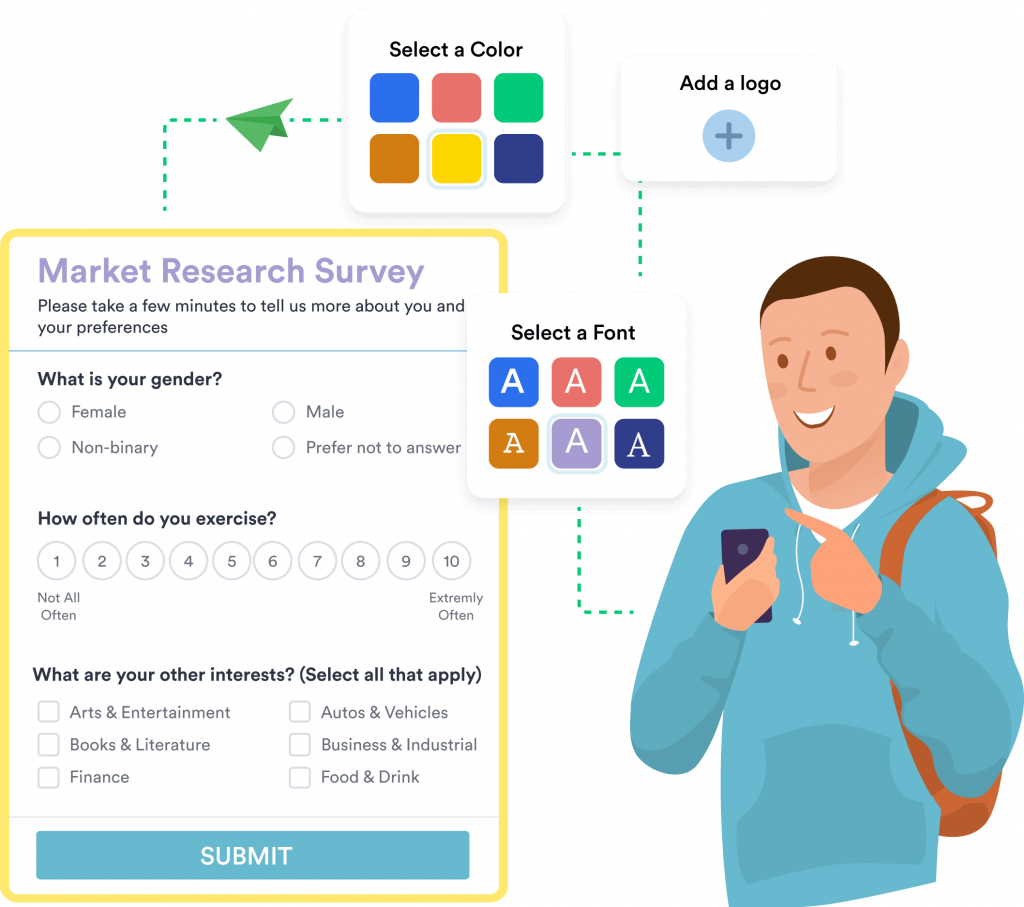
When designing a questionnaire, avoid these common mistakes:
Creating a Long Questionnaire
Many people tend to ask every question they think is necessary to meet their own goals, without considering how respondents feel. Faced with a long questionnaire, viewers often feel "overloaded" by the volume of information they're asked to provide — they get nervous, feel it takes too much time and effort, and the response rate drops.
So design the questionnaire selectively, aligned with a clear stated goal: only ask relevant questions that help you better understand different aspects of the business, and use survey tools that let you link your customer database to their survey answers for the best results.
Using Leading Questions
A leading question frames the issue in a way that pushes readers toward one side of the argument. Usually, these questions already contain the information the survey creator wants confirmed, rather than trying to get the right answer and asking for respondents' honest choice. Using this type of question makes respondents uncomfortable and suspicious, so the survey results fall short of expectations.
Example of a leading question: "How wonderful was your experience at our exhibition yesterday?"
Instead of steering readers toward a "wonderful experience" they may never have had, change it to the following question to get the most honest feedback: "Please share your experience of our exhibition yesterday."
Using Hard-to-Answer Questions
Difficult questions are written in a way that forces respondents to give answers that don't accurately reflect their views or situation.
Example: Which brand of beer do you usually buy?
This question creates difficulty and won't get honest responses if the respondent doesn't drink beer — or actively dislikes it. This can cause discomfort and is a reason they abandon the survey.
In the case of the example above, you could first ask a preliminary question about whether the respondent drinks beer at all, and use skip logic to let non-drinkers move past questions that don't apply to them.
>>>> See more: How to properly design a customer survey about a new product
Collect and Analyze Customer Survey Results

After collecting customers' survey responses, the next thing you need to do is analyze the survey results (feedback). Here is the feedback-handling process for listening to customers effectively:
-
Read the responses: assign the right person to set aside time to read the feedback, and classify responses by nature: positive, negative, or suggestions/requests for solutions.
-
Resolve feedback: divide the work among team members according to the feedback categories. Complaints and misunderstandings should be scheduled for resolution within 24 hours, along with ways to soothe the customer.
-
Analyze: analyze the survey results received to assess business performance, spot weaknesses that need improving, and learn more about customer needs.
-
Improve: identify the areas customers care about where you can have the greatest impact; think of two or three initiatives for the next month or quarter that you believe will create impact, and measure your improvement in the following month or quarter.
-
Share across the company: share the analysis results with staff in the relevant departments via real-time updates, dashboards, and weekly emails.
Think of Your Customers Before You Survey Them
In an ever fiercer competitive environment, grasping needs in a timely manner and running customer needs surveys effectively is an activity businesses always prioritize when planning product/service improvements for maximum results. With these pointers on creating a customer survey, SimERP hopes to be useful to you in planning and deploying a needs survey that fits your business's goals.
Related Articles
Bài viết liên quan

25 tháng 10, 2026 · 3 phut doc
2024年网页设计趋势预测如何? | Wotech Electronics
关于 2024 年网页设计趋势——步入 2024 年,年初正是我们为新事物预留时间的时刻。这也非常适合设计师群体唤醒我们内心的"艺术之魂"。闲话不多说,快来和 Markdao 一起浏览 2024 年的 UX/UI 设计趋势吧,说不定您就能为自己接下来的网页设计项目"迸发"出一个绝妙的点子呢!

25 tháng 10, 2026 · 1 phut doc
什么是网站(Website)?网站的详细定义及其带来的商业价值
什么是网站(https://www.markdao.com.vn/blog/website-la-gi)——这个问题或许已经无需定义,因为在如今这个信息时代,网站对每一家企业而言都是不可或缺的组成部分。正是网站帮助用户更近距离地接触企业所提供的产品和服务,从而提升经营效益。此外,要在当今竞争如此激烈的环境中求发展,网站是一个重要因素,它将带你走向品牌与销量上的双重成功。

25 tháng 10, 2026 · 1 phut doc
什么是SEO标准网站?一场"打赢"Google SEO标准的战役 | Wotech Electronics
99%的用户在购买前会先搜索信息,73%的用户只会访问排名前10的网站,并认定它们是值得信赖的品牌……在数字营销爆发的时代,这些数字有力地印证了SEO标准网站的重要性。然而,许多人对什么是SEO标准网站(https://www.markdao.com.vn/blog/huong-dan-toi-uu-seo-website-chuan-seo-on-page)仍然相当模糊,并未真正理解。达到SE…