
Business Accounting Software: Concept, Role, Selection Criteria, and a Complete Solution | Wotech Electronics
Vũ Khôi
Tác giả tại Wotech Electronics Blog
Business Accounting Software: Concept, Role, Selection Criteria, and a Complete Solution
Vũ Khôi
Author at Wotech Electronics Blog
Accounting is the work of calculating, processing, and communicating financial and non-financial information about the activities of an organization or business. Accounting therefore plays a vital role in managing capital and reflecting how effectively the business operates. However, accounting is demanding work in terms of expertise and accuracy when dealing with numbers. That is why accounting software is an indispensable tool that makes accountants' work easier and more time-efficient, keeping financial transactions running smoothly. In the following article, we introduce a comprehensive accounting management solution for businesses: Odoo accounting software.

What is accounting software?
Accounting software is defined as a solution that helps businesses collect, store, and produce financial reports automatically according to current accounting rules, using a computer program or a system of online tools and applications. To carry out accounting management tasks, the accounting manager enters figures, transactions, and ledger documents for the software to process. With its preconfigured mechanisms and workflows, the accounting software processes the raw data and, on that basis, builds financial statements. This allows the business to make accurate observations and assessments when setting important financial and business goals.
Common types of accounting software
There are many ways to classify accounting software. By business function, there are specialized packages such as: financial accounting software, management accounting software, auditing software, tax accounting software, and cost accounting software. By service package, there are two main types: off-the-shelf (turnkey) software and software custom-built to a company's order, specifically:
Turnkey accounting software
This is an application pre-designed by software developers with default features that serve basic accounting tasks according to common accounting standards.
-
Advantages: Fast support from the development team, with complete, detailed user documentation. In addition, turnkey accounting software is cheap and more stable, helping businesses save on software investment and upgrade costs.
-
Disadvantages: Turnkey software does not adapt well to the specific fields, industries, and needs of a business.
Custom-built accounting software:
This is an application written to a business's own requirements.
-
Advantages: It thoroughly solves the particular needs of businesses across different fields and industries, especially those operating in niche markets.
-
Disadvantages: Because the software is custom-designed to order, it is usually not widespread and runs on its own mechanisms. Support for users is therefore more limited and the investment cost is high.

Each type of software has its own strengths and weaknesses. Depending on needs, the specifics of the field, and financial resources, a business can choose the software that best fits its purposes.
What is ERP accounting software?
Beyond classifying software by function and service package, there is another classification based on the software system itself, with two types: standalone (conventional) software and accounting software built on an enterprise resource planning platform (Enterprise Resource Planning, abbreviated as ERP) — ERP accounting software. Simply put, compared with standalone applications, ERP accounting software is one application within the ecosystem of an enterprise resource planning system. With ERP accounting software, a business can easily link accounting tasks (for example: payments, advances, transaction document reconciliation, preparing the balance sheet) with other operations (for example: project management, sales management, warehouse/inventory checks, etc.) and retrieve data from different business areas or departments through interconnected applications (modules) on ERP platforms.
The role of business accounting software
In today's 4.0 technology era, using business accounting software is essential for organizations and companies to simplify and automate accounting and auditing activities. With the support of accounting software, businesses can use their resources more effectively.
Generally, adopting accounting software delivers the following benefits to a business:
-
Maximum savings in cost, manpower, and processing time.
-
Greater accuracy in managing figures and accounting reports. Fewer errors and deviations compared with manual calculation and reporting methods.
-
Automatically generated diagrams, charts, and reports that are clearer and more visual, making it easier for managers to handle accounting and financial information.
-
Easier storage and internal communication of information, with high security and flexible information-permission control.
How do you choose the right accounting software?
To choose accounting software that fits the business's needs, the head of accounting should set specific criteria before deciding to invest in any software solution.

Typically, businesses need to weigh the following basic factors:
-
Ease of use: Includes an intuitive, friendly interface; simple usage that is easy to grasp (even for users without accounting training); and operations that are fast, accurate, and easy to perform (for example: data entry, error correction, generating charts and reports).
-
Investment and upgrade costs: In principle, the cost of investing in and upgrading accounting software depends on the functions it provides, the specifics of the field, and the business's customization requirements. Based on financial capacity and real needs, a business can set a specific budget ceiling for accounting software.
-
Fit with the business's needs: Depending on the company's field, industry, and scale, the business must weigh how well the software matches the accounting department's operations to make the right choice. For example, a company with around 10–50 employees and revenue of about 100 billion VND/year only needs small-business accounting software to match its scale and be easier to manage.
-
Features: Includes the diversity of features, how well they meet needs, and how standardized the accounting functions are.
-
Security: This is paramount, since accounting directly involves managing books, documents, and confidential financial data such as capital and business transactions. So to choose accounting software with strong security, businesses should use licensed software from reputable developers and distribution partners that many other companies trust.
SimERP accounting software: A complete solution for businesses
What is SimERP?
SimERP is an enterprise resource planning (ERP) software built on Odoo — the world's most popular ERP software with outstanding advantages. SimERP includes many different features such as accounting management, project management, HR management, customer relationship management (CRM), and more. Notably, as an open-source platform, Odoo ERP is highly flexible, allowing businesses to easily customize and develop applications suited to their own needs.
Features of SimERP accounting software
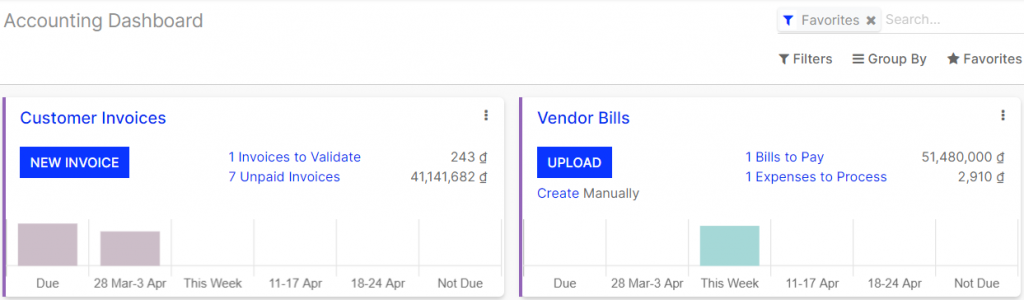
Among the default modules provided, SimERP's accounting software (Accounting) is a comprehensive online accounting management solution for businesses. It is an application with high information security and flexible permission control. With an easy-to-use interface and dedicated accounting functions, SimERP's Accounting app has been and remains SME accounting software well suited to many Vietnamese businesses.
In essence, the features of Odoo accounting software include:
-
Bank synchronization: Synchronize bank statements automatically or through file uploads.
-
Easy balance sheet preparation: Automate 95% of the closing process with smart accounting tools, saving maximum time and manpower.
-
Cost and invoice management: Tight control over vendor bills and notifications about upcoming payable amounts.
-
Fast, efficient payment with e-invoices and automatic tracking:
-
Create and send invoices and receive online payments professionally.
-
Set up reminders for parties with outstanding debts.
-
Generate invoices automatically from sales orders, delivery orders, or by time and materials.
-
Rapid invoicing: Create recurring invoices professionally; easily track payments.
-
Create intuitive, easy-to-understand accounting reports:
-
Easily produce income statements, cash flow statements, or balance sheets
-
Quickly filter, zoom, annotate, and compare any data.
-
Build reports from business analytics data under any basis of accounting.
-
Reduce manual transaction recording: Easily retrieve data from other financial management apps integrated on the Odoo ERP platform such as Expenses, Point of Sale (POS), Inventory, Sales, and more.
Currently, SimERP is offering a free 30-day SimCRM trial. Sign up to experience the accounting features!
Summary
We hope the article above has given you complete information about the concept and role of business accounting software, as well as how to choose an effective solution that fits your business.
Related articles
Bài viết liên quan

25 tháng 10, 2026 · 3 phut doc
2024年网页设计趋势预测如何? | Wotech Electronics
关于 2024 年网页设计趋势——步入 2024 年,年初正是我们为新事物预留时间的时刻。这也非常适合设计师群体唤醒我们内心的"艺术之魂"。闲话不多说,快来和 Markdao 一起浏览 2024 年的 UX/UI 设计趋势吧,说不定您就能为自己接下来的网页设计项目"迸发"出一个绝妙的点子呢!

25 tháng 10, 2026 · 1 phut doc
什么是网站(Website)?网站的详细定义及其带来的商业价值
什么是网站(https://www.markdao.com.vn/blog/website-la-gi)——这个问题或许已经无需定义,因为在如今这个信息时代,网站对每一家企业而言都是不可或缺的组成部分。正是网站帮助用户更近距离地接触企业所提供的产品和服务,从而提升经营效益。此外,要在当今竞争如此激烈的环境中求发展,网站是一个重要因素,它将带你走向品牌与销量上的双重成功。

25 tháng 10, 2026 · 1 phut doc
什么是SEO标准网站?一场"打赢"Google SEO标准的战役 | Wotech Electronics
99%的用户在购买前会先搜索信息,73%的用户只会访问排名前10的网站,并认定它们是值得信赖的品牌……在数字营销爆发的时代,这些数字有力地印证了SEO标准网站的重要性。然而,许多人对什么是SEO标准网站(https://www.markdao.com.vn/blog/huong-dan-toi-uu-seo-website-chuan-seo-on-page)仍然相当模糊,并未真正理解。达到SE…