
Corporate Financial Management: Concepts, Skills, and Effective Management Methods | Wotech Electronics
Vũ Khôi
Tác giả tại Wotech Electronics Blog
Corporate Financial Management: Concepts, Skills, and Effective Management Methods
Vũ Khôi
Author at Wotech Electronics Blog
Finance is a prerequisite for any activity of an organization or business. Therefore, planning for corporate financial management is a very important task that directly affects the business objectives that have been set as well as how resources are allocated to achieve those objectives.
Moreover, corporate financial management is also a job that demands a high degree of accuracy in calculation and planning, and it consumes a great deal of time and manpower. So, to carry out this work as effectively as possible, a business first needs to clearly understand the role, methods, mechanisms, and processes involved, and know how to use a corporate financial management app in the most cost-efficient way.
What Is Corporate Financial Management?
The concept of corporate financial management
Corporate financial management is the management of the financial relationships that arise in the production and business operations of a company or organization. Simply put, corporate financial management means managing capital and cash flow to maximize a company's profits. A company's capital sources include all cash, assets, income, receivables, and payables, among others.
Corporate financial management is an activity tied to the finance and accounting department and is expressed through the management of financial reports. Specifically, corporate financial management includes tasks such as financial planning; controlling activities related to transactions and finances such as procurement, investment, and the use of the company's capital for activities laid out in the financial objectives. These objectives can be short-term or long-term as follows:
-
Short-term objectives: Ensuring capital for business operations; fully executing the company's financial rights and obligations; carrying out spending safely, economically, and effectively.
-
Long-term objectives: Building capital sources aligned with the company's strategy; planning capital recovery and capital turnover; reviewing and approving strategic investment regulations and setting long-term financial development goals for the business.
The role of financial management in a business
Financial management is a very important job for every business manager. Good financial management not only helps a company maximize profits but also enables it to achieve its stated objectives and accelerate its growth.

In essence, corporate financial management plays 2 main roles:
-
Controlling the flow of finances across all of the company's activities or production and business operations.
-
Determining the survival of the business and its ability to grow in the future, through the following specific corporate financial management activities:
-
Financial planning within the business: Planning the financial resources the company has available while making the most of financial leverage. As a result, capital efficiency is improved — in other words, profits increase relative to invested capital.
-
Deciding on investments and financing: Reviewing and weighing effective corporate financial management methods; determining investments and financing in a way that ensures profits grow in proportion to the investment in fixed assets such as machinery or production technology, and so on, to meet market demand.
-
Controlling business operations and status by monitoring cash flow: Every activity within a business affects financial management. Through cash flow, business leaders can therefore oversee most of the ongoing activities and their effectiveness via the current financial situation.
Common challenges in corporate financial management
In practice, financial management raises many issues — from inaccurate data and a lack of human resources to limitations in tools. The 4 most typical challenges in corporate financial management are:
-
Managing income and expenses based on estimates and predictions without proper analysis, making it impossible to fully control all revenue sources or cut costs.
-
Infrequent, loose control of receivables and debts, with no sound debt-handling policy, which can easily lead to cash deficits.
-
Lax control over materials and goods, and over inventory in and out movements, causing capital losses and waste.
-
No financial plan or specific financial objectives; no control over cash inflows and outflows or over debt collection and repayment schedules.

In addition, businesses may face other difficulties, such as letting fraudulent or dishonest acts slip through, or not using software to manage, store, and extract financial information completely and accurately.
How to manage corporate finances effectively
To manage corporate finances effectively, a business manager not only needs to master the professional knowledge and skills of finance and accounting management, but also needs to understand the mechanisms, processes, and fundamental principles of actual operations.
Corporate financial management skills
To manage corporate finances well, a business first needs to recruit highly qualified professionals to avoid making wasteful or loss-making decisions that affect company operations. Specifically, financial management staff must be able to plan, forecast budgets, and control cash outflows and inflows (revenue, profit, costs). The indispensable skills include:
-
Distinguishing types of assets (long-term vs. short-term; fixed vs. current) and types of transactions (cash vs. bank transfer), and so on, when managing finances.
-
Understanding the terms and figures on invoices, documents, and all kinds of financial reports.
-
Analyzing data, evaluating business forecasts, and planning finances for both the short and long term.
-
Calculating and setting financial targets for investments and strategic projects.

The corporate financial management framework
Effective financial management not only helps a business reduce investment costs but also ensures that capital is always available when needed to keep company operations running smoothly. Below are the essential principles of the corporate financial management framework that you cannot afford to overlook:
-
Always maintain a reserve fund: Building a reserve fund provides just enough finance to keep the business running through difficult times, or to invest immediately when an opportunity arises. Many business owners pay no attention to building a reserve fund, leaving them without the financial resources to respond to a crisis in time. A typical example is the impact of the Covid-19 pandemic on business operations. A crisis can strike at any moment, without warning.
-
Always have a business plan: A clear business plan shows where the company currently stands in the market and what goals it needs to reach. From a financial standpoint, planning helps the company allocate finances effectively and organize the necessary business activities to optimize revenue. This allows the owner to calculate and forecast the capital needed to keep the business running.
-
Reduce debt: Bad debt is not only stressful — it also directly affects the company's revenue and its future business plans. Businesses should therefore not let bad debts carry over from year to year. Instead, resolve them quickly before the end of the fiscal year to keep operations stable.
-
Forecast cash flow: Maintain detailed, periodic cash flow forecasts by item and product, for example on a rolling 6-month basis. Identify shortfalls and plan to cover all of them by arranging working capital or other funds.
-
Update reports regularly: Alongside cash flow forecasts, reports should be updated regularly to keep track of key business figures. Every month, the business should reconcile revenues, loans, deposits, and interest once. If any issue arises, it can all be dealt with quickly.
-
Manage systematically: Systematic management helps a business continuously update, record statistics on, and track all types of finances. Credit card transactions, bank loans, brokerage fees, mortgages, payroll funds, and so on all need regular monitoring and control. The difficulty for most businesses is centralized, systematic management following a consistent logic.
To solve this problem, financial management software will save you a great deal of time processing figures. That gives financial managers more time to plan and develop suitable business strategies.

Typically, financial management in medium and large enterprises is handled by an accountant or a business analyst hired externally. Meanwhile, small business owners often have to take on the analysis and financial management for their own company themselves. For that reason, there are also some financial management principles for small businesses to keep in mind:
-
Keep the accounting books carefully and systematically from the moment the business is founded. This will save the company a significant amount of money in the early stages.
-
From the start, build a corporate culture and set disciplinary rules and procedures, say no to fraudulent behavior, and establish policies to control employees' internal activities.
-
Invest in technology from the outset — investing later makes data synchronization far more complicated.
Using corporate financial management software
To minimize the risks in financial management, a business needs to eliminate manual data entry wherever possible, and restrict permissions and access to confidential data. In today's Industry 4.0 era, investing in a comprehensive corporate financial management solution is more necessary than ever.

With a comprehensive management system, all data on cash flow, income and expenses, and invoices (overdue, paid, unpaid) is updated automatically. Moreover, the data can easily be monitored across departments, with flexible permissions for multiple users at once. As a result, managers take more initiative in management instead of depending on reports from accounting as before. Key financial metrics are updated directly in the software, with no need for Excel reports or the outdated practice of paper ledgers and notebooks.
Top 3 financial management software solutions for SMEs
SimERP
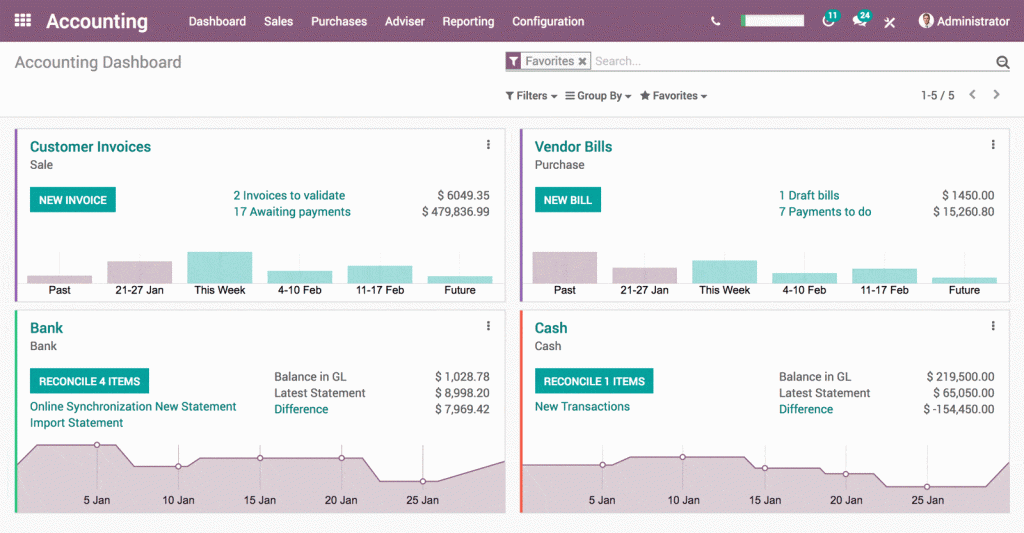
The SimERP enterprise resource planning software is built on the Odoo ERP platform — a combination of many modules covering the full range of business functions, including CRM, Sales, Project Management, and Human Resource Management. For finance, SimERP also offers many dedicated modules such as Accounting, Invoicing, Expense Management, and Inventory.
Advantages of SimERP software
-
A comprehensive software system developed with more than 1,000 features covering the full range of business needs.
-
Easy-to-use interface: minimalist design, user-friendly.
-
High flexibility: easy to customize and build your own applications to fit the company's financial management needs.
-
High information security with flexible permission controls.
Disadvantages
- Some modules do not fit Vietnamese standards: for example, the Accounting module in Odoo ERP still follows international accounting conventions.
To learn more about the methods, costs, and customization of corporate financial management software on the Odoo ERP platform, contact the experts at Magenest today.
SAP Business One
SAP Business One comes fully integrated with the features businesses need: financial management, customer care, logistics management, sales, and operational support across the entire system. SAP Business One supports multiple languages for businesses.

Advantages
-
Consolidates all accounting processes, including the general ledger, journal entries, receivables, and payables.
-
Automatically records entries into the accounting system in real time whenever a task is performed.
-
Provides a wide range of reporting and analytics systems and tools, giving businesses a comprehensive, complete, and clear view of how their operations are performing and enabling faster, more accurate decisions.
Disadvantages
- No Vietnamese language support for users.
Oracle
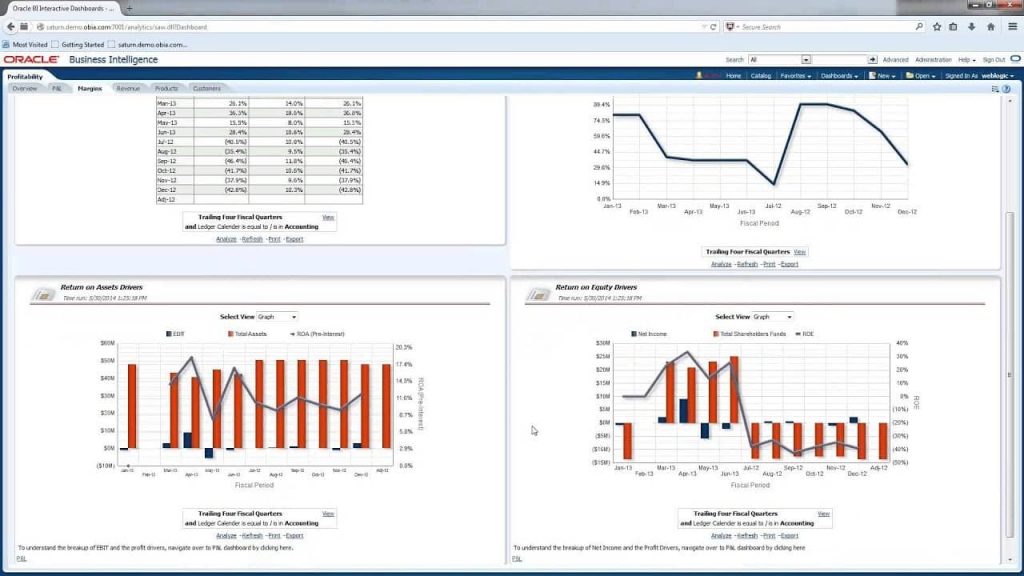
Oracle gives businesses resource planning tools for Finance, Human Resources, Distribution, and Manufacturing. Oracle's financial management features include: Expenses, Asset Management, Order Management, Reporting, and Business Planning.
To match the operations of each specific business and industry, you can also install the software for particular business domains such as real estate, human resources management, and health and environment, among others. Through its online software, Oracle allows managers to easily oversee business operations and keep work updated quickly and regularly.
Advantages
-
The software has a friendly, easy-to-use interface.
-
Supports a wide variety of business fields.
Disadvantages
- The software's native language is English, so the Vietnamese version is difficult to use.
Summary
It is fair to say that financial management is a core activity in running a business. To manage and use capital effectively, a business not only needs to comply with the rules of financial governance but also needs a comprehensive software solution to ensure accuracy and reduce financial risks in its business operations.
If you have any questions, don't hesitate to leave a comment below this article and Magenest will be happy to advise and answer them!
Related Articles
Bài viết liên quan

25 tháng 10, 2026 · 3 phut doc
2024年网页设计趋势预测如何? | Wotech Electronics
关于 2024 年网页设计趋势——步入 2024 年,年初正是我们为新事物预留时间的时刻。这也非常适合设计师群体唤醒我们内心的"艺术之魂"。闲话不多说,快来和 Markdao 一起浏览 2024 年的 UX/UI 设计趋势吧,说不定您就能为自己接下来的网页设计项目"迸发"出一个绝妙的点子呢!

25 tháng 10, 2026 · 1 phut doc
什么是网站(Website)?网站的详细定义及其带来的商业价值
什么是网站(https://www.markdao.com.vn/blog/website-la-gi)——这个问题或许已经无需定义,因为在如今这个信息时代,网站对每一家企业而言都是不可或缺的组成部分。正是网站帮助用户更近距离地接触企业所提供的产品和服务,从而提升经营效益。此外,要在当今竞争如此激烈的环境中求发展,网站是一个重要因素,它将带你走向品牌与销量上的双重成功。

25 tháng 10, 2026 · 1 phut doc
什么是SEO标准网站?一场"打赢"Google SEO标准的战役 | Wotech Electronics
99%的用户在购买前会先搜索信息,73%的用户只会访问排名前10的网站,并认定它们是值得信赖的品牌……在数字营销爆发的时代,这些数字有力地印证了SEO标准网站的重要性。然而,许多人对什么是SEO标准网站(https://www.markdao.com.vn/blog/huong-dan-toi-uu-seo-website-chuan-seo-on-page)仍然相当模糊,并未真正理解。达到SE…