
The Sales Process in CRM: A Solution for Sales Process Management
Vũ Khôi
Tác giả tại Wotech Electronics Blog
The Sales Process in CRM: A Solution for Sales Process Management
Vũ Khôi
Author at Wotech Electronics Blog
CRM is software chosen and used by many companies to optimize their sales processes. However, most CRM systems today come with a variety of distinct features, and few businesses manage to take full advantage of all of them. That is why the sales process in CRM was conceived — to help businesses streamline both their internal workflows and the way CRM operates.
So what is the sales process in CRM, and how many steps does it involve? How can you manage your sales process in CRM effectively? Let's dig deeper with SimERP in this article.
What Is the Sales Process in CRM?

The sales process in CRM is the practice of using CRM to optimize a business's existing sales process. This gives the business a more comprehensive view of the customer journey as well as customers' psychology and shopping habits.
In addition, with the information collected, business leaders can analyze it and make forecasts and set strategies suited to their sales teams.
The Importance of the Sales Process in CRM
The sales process helps you identify which stage of the buying journey a customer is currently in. Based on that, the business decides the next steps to take to convert a lead into a final customer. The process helps you monitor and manage customer activities, as well as the performance of your sales staff based on their lead conversion rates. Since every business has a different business model and different goals, each will build its CRM sales process differently. Businesses therefore need to design a CRM sales process and choose software that fits their own needs.
Benefits of Using CRM to Manage the Sales Process
An Improved Sales Process
The business builds its sales process around the customer's buying stages. This lets you identify the right activities at each stage to turn leads into real customers. It also reveals the stages where leads hesitate or drop out of contact, so you can devise appropriate solutions.
Financial Management and Forecasting
When using CRM software, the business can track the total value of deals in the sales pipeline, the number of customers, and conversion rates. This allows you to calculate and forecast future revenue.
Sales Strategy Analysis

The business can pinpoint problems at each stage of the sales process. This reveals mistakes and helps build suitable solutions to address them.
Effective Sales Activity Management
When building a sales process with CRM, the business gains an overview of customers' habits and buying journeys. From there, it can analyze and make important decisions related to products, approaches, and customer persuasion.
Evaluating Employee Performance
The business can track employee performance, the activities staff carry out to persuade customers, revenue, and conversion rates. This makes it possible to assess each employee's work performance and capabilities.
Workforce Allocation
Based on each employee's assessed capabilities, experience, and skills, the business can decide who should handle which sales deals. This ensures the business uses its resources more effectively and that work runs more smoothly.
7 Standard Steps for Managing the Sales Process in CRM
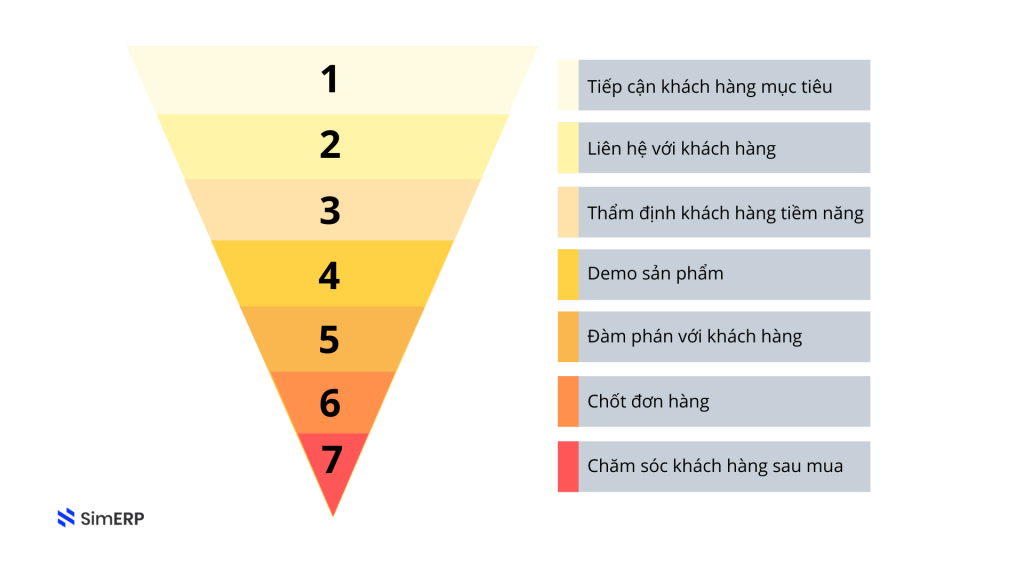
Step 1: Reach Your Target Customers
Through advertising, communications, and marketing and sales activities, target customers with needs discover the business. Typically, the company tailors the content on its website, media channels, ads, or sales scripts to suit its audience in order to reach target customers effectively. Those customers then explore the offer, leave their contact details via the website, respond to the sales team, or contact the company directly.
Step 2: Contact the Customer
The business reaches out and responds to customers to learn about their needs. At this stage, the business discovers what target customers propose and want. From there, it can devise solutions and engage more deeply.
Step 3: Qualify the Lead
This is a crucial step in any sales process. After discussing the solution and product information, customers will express their views and attitudes — whether or not they actually want to use your company's products or services. Based on this, sales staff can evaluate and identify genuine leads and persuade them to book a product demo and discuss the product in greater depth.
Step 4: Product Demo

After the conversation and exchange with the lead, if the customer is persuaded by the product's or service's features, the business should schedule a demo with them. The salesperson presents how the product works, its details, and its advantages.
Step 5: Negotiate with the Customer
If the customer is convinced and wants to buy your product, the salesperson negotiates pricing, accompanying services, terms, payment methods, and a few other conditions to ensure the deal fits the needs of both the customer and the business. Once this step is complete, the business moves on to the next step: closing the deal and signing the contract.
Step 6: Close the Deal

The contract spells out all the terms clearly and specifically, including price, payment method, accompanying services, products to be delivered, dispute resolution methods, insurance, and more. Once the contract is signed, the business prepares to deliver the product and perform the service as promised.
Step 7: Post-Purchase Customer Care
This is the final step of the CRM sales process. Caring for customers and nurturing relationships with them matters to every business. According to research by HubSpot, increasing the customer retention rate by 5% can boost a business's profits by 25% to 95%. It is far easier to persuade existing customers to keep using your products and services than to win over new ones, because they already know and have experienced those products and services.
SimERP's CRM Sales Process
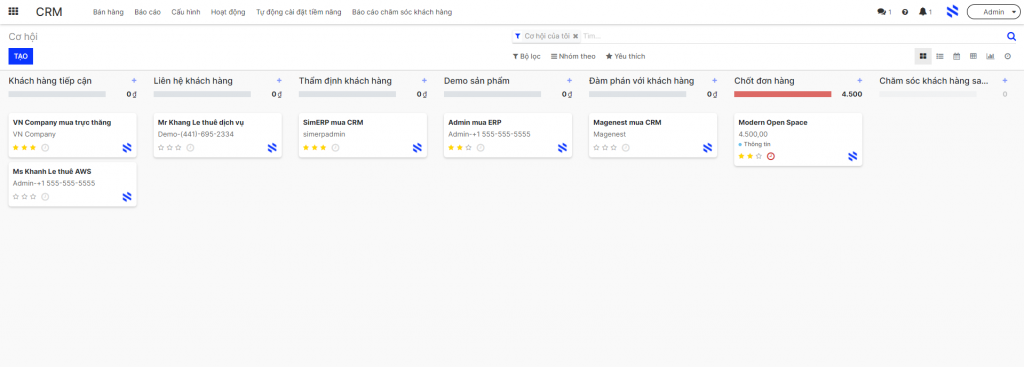
First, the business sets up and adjusts the steps in CRM to match a conventional sales process. The steps include Customer Reach, Contact Customer, Lead Qualification, Product Demo, Negotiation, Deal Closing, and Customer Care.
*Reach and Store Customer Information*
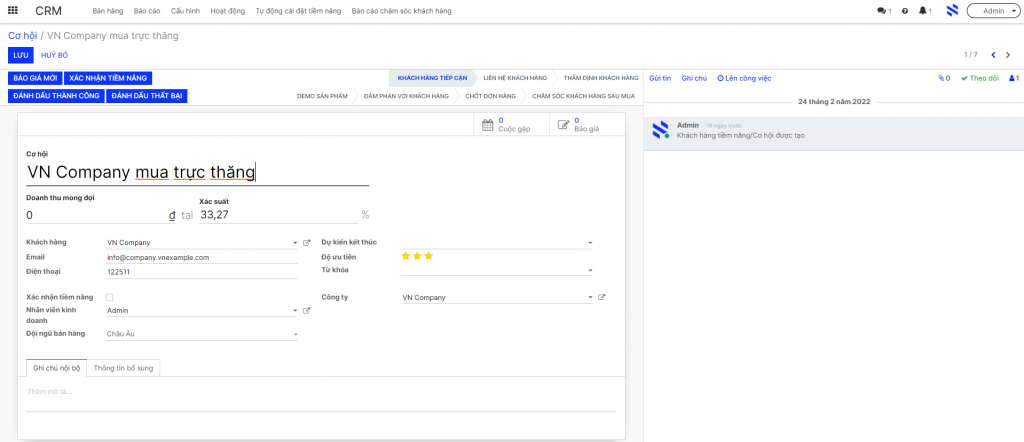
Marketing staff run campaigns to reach as many target customers as possible. SimERP provides marketing tools such as email marketing, helping the business promote itself across multiple channels. In addition, users can manage marketing projects through the project management feature. Once customers reach out and leave their details, the business stores customer information such as Name (Organization/Contact), opportunity (price, product), email, and phone number. Users can even set expected revenue targets for each prospect.
*Contact the Customer*
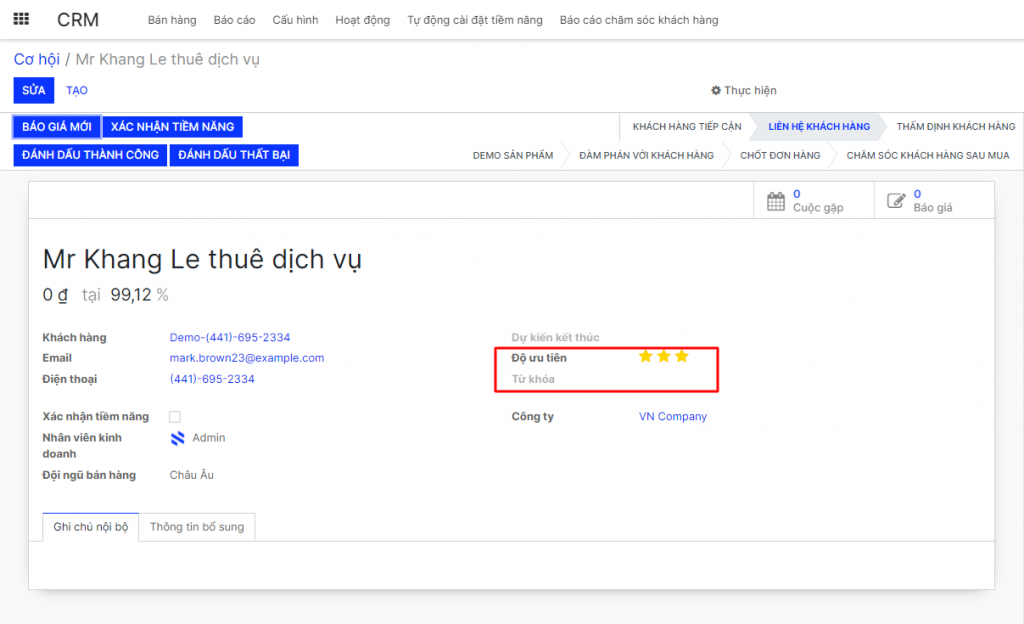
After a customer leaves their details or contacts the business, the next step is to reach out and clarify what they need. Here, users can save notes, additional information, and a priority level for each customer. The priority level is assessed based on lead quality and the customer's requirements.
*Evaluate and Confirm the Lead*
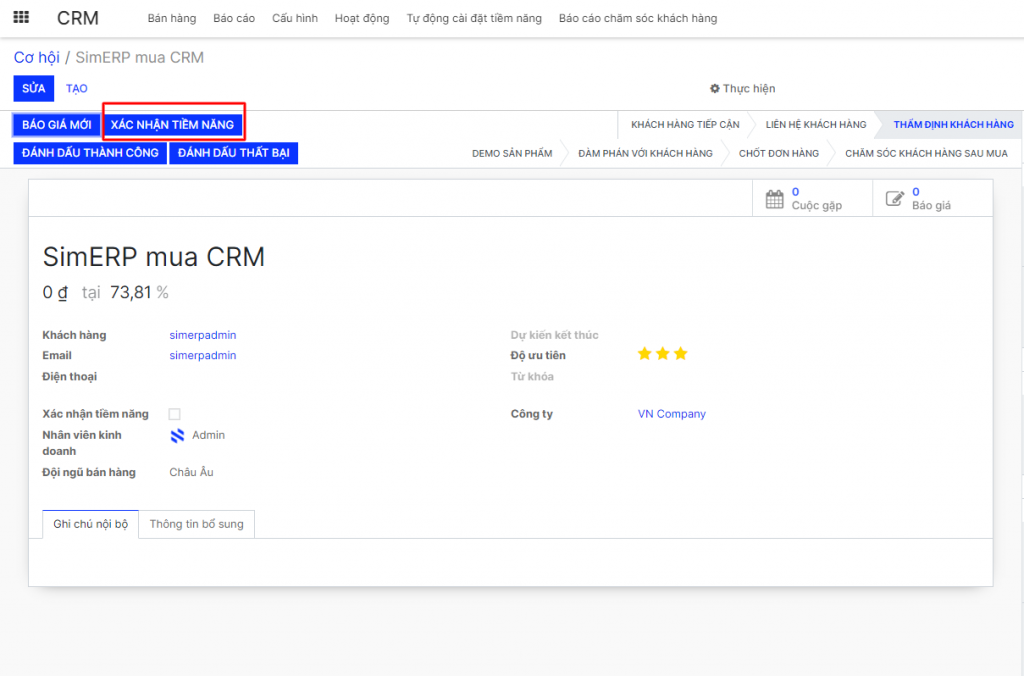
After contacting the customer, the business assesses whether this is a genuine lead, for example by selecting "confirm as qualified." At this stage, the business creates and sends a quotation to the customer. If the customer agrees, the company arranges a further meeting to discuss more and demo the product.
*Set Up a Meeting and Demo the Product*
The salesperson sets up the product demo to engage the customer in a deeper discussion, sharing more details about the products, services, and price tiers. After the demo, the customer's information moves to the next, higher stage: negotiating with the customer.
*Negotiate with the Customer*
In this step, the salesperson negotiates prices and services that both parties can accept. If it succeeds, the user marks the deal as won.
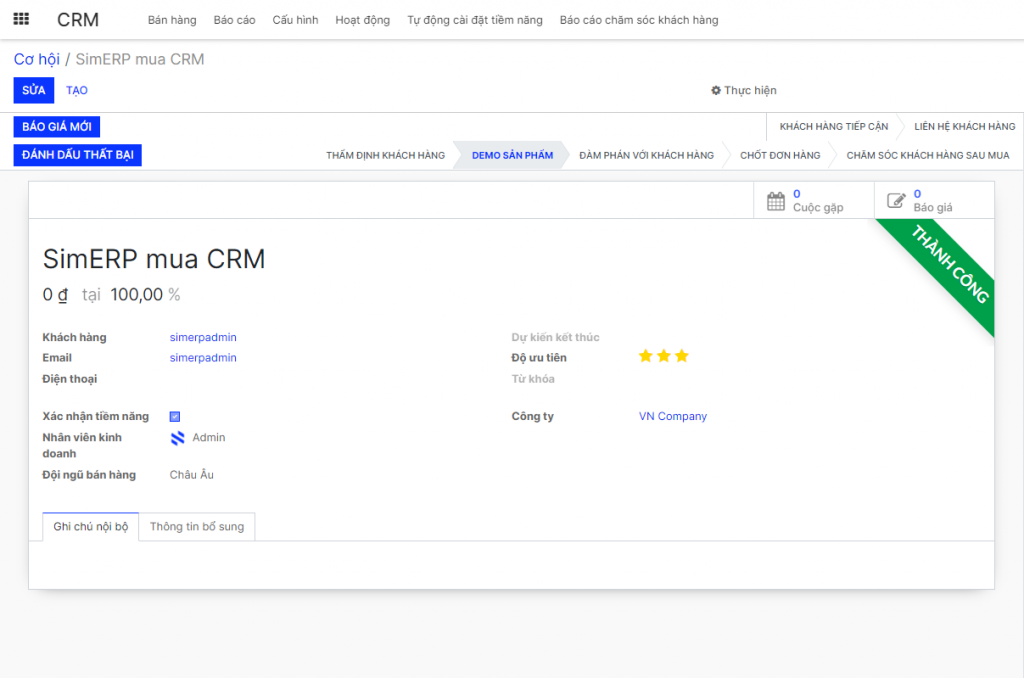
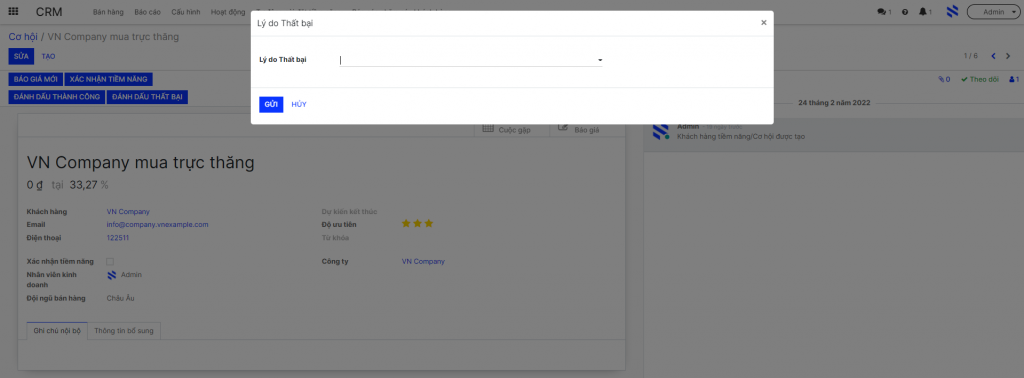
However, if persuasion fails despite the effort, the business marks the deal as lost and records the reason. If it succeeds, the business moves the customer's information to the final step: closing the deal.
*Close the Deal and Sign the Contract*
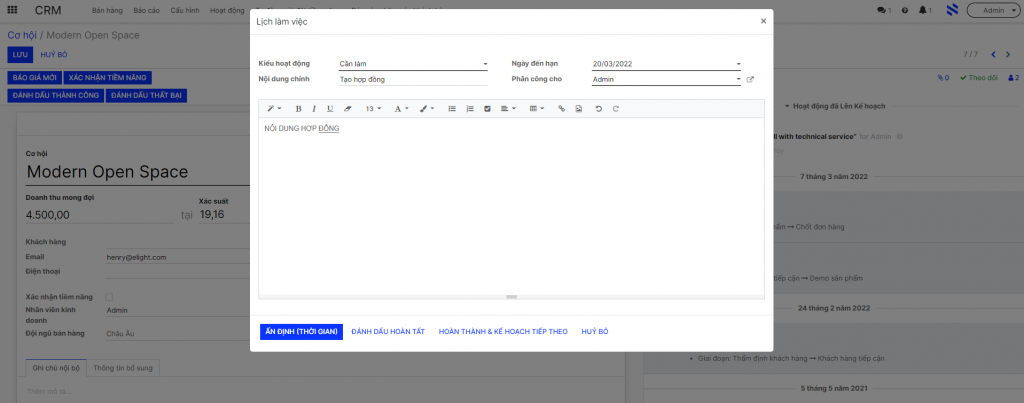
In this step, the business finalizes the price, services, products, and related terms to sign the contract. The business sets up activities such as issuing an invoice or creating and sending the contract. Finally, the company delivers the product and performs the service for the customer.
*Post-Purchase Customer Care*
After the order is completed and the product or service is delivered, the business needs to carry out customer care activities such as responding to customer requests, answering questions, and handling warranty issues. Users create the necessary activities under each customer's name and check them regularly.
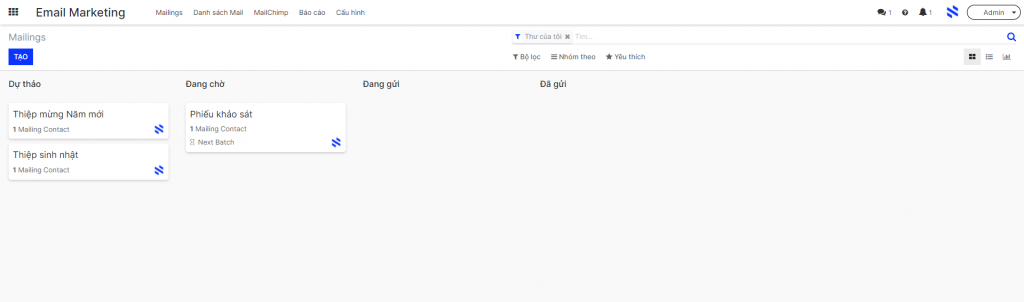
In addition, the business can create customer care email templates — such as cards, gifts, or discount codes — using the email marketing feature. The business can track metrics such as open rates, link clicks, replies, or bounced emails, and from there evaluate the quality of each email marketing campaign.
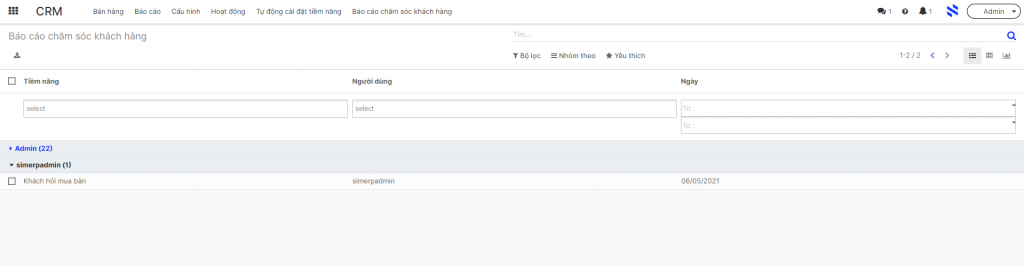
Within the CRM feature, users can compile statistics and reports on customer care activities by each staff member.
Today, SimERP is offering a free 30-day SimCRM package for businesses. Sign up now to experience the sales process in CRM!
Closing thoughts
Building and managing a sales process in CRM is essential for businesses: it makes it easy to follow the customer's buying journey and turn potential opportunities into successful ones. Businesses should also use software with CRM features to optimize their operations and boost work efficiency.
Related Articles
Bài viết liên quan

25 tháng 10, 2026 · 3 phut doc
2024年网页设计趋势预测如何? | Wotech Electronics
关于 2024 年网页设计趋势——步入 2024 年,年初正是我们为新事物预留时间的时刻。这也非常适合设计师群体唤醒我们内心的"艺术之魂"。闲话不多说,快来和 Markdao 一起浏览 2024 年的 UX/UI 设计趋势吧,说不定您就能为自己接下来的网页设计项目"迸发"出一个绝妙的点子呢!

25 tháng 10, 2026 · 1 phut doc
什么是网站(Website)?网站的详细定义及其带来的商业价值
什么是网站(https://www.markdao.com.vn/blog/website-la-gi)——这个问题或许已经无需定义,因为在如今这个信息时代,网站对每一家企业而言都是不可或缺的组成部分。正是网站帮助用户更近距离地接触企业所提供的产品和服务,从而提升经营效益。此外,要在当今竞争如此激烈的环境中求发展,网站是一个重要因素,它将带你走向品牌与销量上的双重成功。

25 tháng 10, 2026 · 1 phut doc
什么是SEO标准网站?一场"打赢"Google SEO标准的战役 | Wotech Electronics
99%的用户在购买前会先搜索信息,73%的用户只会访问排名前10的网站,并认定它们是值得信赖的品牌……在数字营销爆发的时代,这些数字有力地印证了SEO标准网站的重要性。然而,许多人对什么是SEO标准网站(https://www.markdao.com.vn/blog/huong-dan-toi-uu-seo-website-chuan-seo-on-page)仍然相当模糊,并未真正理解。达到SE…