
What Is Customer Satisfaction? How to Measure It Effectively | Wotech Electronics
Vũ Khôi
Tác giả tại Wotech Electronics Blog
What Is Customer Satisfaction? How to Measure It Effectively
Vũ Khôi
Author at Wotech Electronics Blog
In today's era of integration and advanced technology, capturing customer needs and feedback is extremely important. You need to know what customers want and how satisfied they are with your products/services so you can put timely, practical solutions in place. After all, the key goal of every business is to raise customer satisfaction and reap the benefits from it. In the article below, SimERP will share the theory and how to measure satisfaction effectively. Follow along.
The theory of customer satisfaction

There are many different theories of customer satisfaction, such as those of Bachelet (1995), Richard L Oliver (1997), and Zeithaml and Bitner (2000). Below, SimERP introduces the 2 most popular ones.
Philip Kotler's theory
Philip Kotler (2001) defines customer satisfaction as "the feeling of pleasure or disappointment of a customer when comparing the actual result received from consuming a product with their expectations."
Although Kotler uses abstract terms such as pleasure and disappointment, this definition is not meant to be vague. His customer satisfaction model is the same as Richard L Oliver's:
Customer satisfaction = f (perceived actual outcome, buyer's expectations)
Expectations here are the customer's beliefs that a certain product/service will produce the results they think, based on their experience, feelings, awareness, or previous shopping behavior. On the other hand, the buyer's expectations are influenced by:
-
Results received from the product in the recent past
-
Word of mouth, recommendations/suggestions
-
Reviews of the product/service
-
What competitors say about the product or service
-
What marketers promise
Richard L Oliver (1997) holds that customer satisfaction is the consumer's response when their desires are fulfilled.
The similarity between Kotler's and Oliver's definitions or theories is that both view customer satisfaction as a response to an experience. Does that imply that the nature of satisfaction changes if the experience changes? Will a satisfied customer stay satisfied forever? This is very unlikely, especially in industries with fierce competition to provide better experiences and win more customers. Therefore, pursuing customer satisfaction is also a long-term process.
According to this definition, satisfaction goals are set by customers themselves before they decide to buy. This is also why they start looking for more information at this point — evaluating, comparing, considering alternatives, etc. Therefore, website content will be the factor that differentiates you and impresses customers. Customer feedback works the same way.
After customers choose a product or service, they begin evaluating the actual experience against the expected experience. This is the testing stage, and a thorough marketing process will make the difference for high-value products, and especially for low-value products with low acceptance.
Paul Farris's theory
In his book "Marketing Metrics," Paul Farris defines customer satisfaction as follows: "the number of customers, or percentage of total customers, whose experience with a product/service exceeds the satisfaction targets set in the company's report."
In practice, this definition has been endorsed by the Marketing Accountability Standards Board (MASB) as the standard definition of customer satisfaction and is also the most widely applied one.
Farris holds that customer satisfaction is a leading indicator of purchase intention and consumer loyalty. Moreover, Farris's definition has two important implications. First, satisfaction is not just an abstract concept — it can be measured in concrete numbers. Second, you can absolutely set customer satisfaction index targets for your business and from there make adjustments, possibly transforming or refreshing current products and services to achieve that target.
>>>> See more: Customer Satisfaction Research: Role and Influencing Factors
Customer satisfaction models

Now that you understand what customer satisfaction is, SimERP introduces 4 satisfaction models based on research.
The expectation–disconfirmation model
This is the model put forward by Richard L Oliver in his research on customer satisfaction. According to him, the degree of customer satisfaction depends on the difference between the actual result received and the expected result. Oliver identifies 3 levels of satisfaction:
-
If the actual result is lower than expectations, the customer will be dissatisfied
-
If the result received equals expectations, the customer will be satisfied
-
If the actual result is higher than expectations, the customer will be highly satisfied with the product/service experience you provide
The American Customer Satisfaction Index (ACSI) model
ACSI uses customer interviews as input to a multi-equation econometric model developed at the University of Michigan. The ACSI model is a cause-and-effect model with indices for the drivers of satisfaction on the left side (customer expectations, perceived quality, and perceived value), satisfaction (ACSI) in the center, and the outcomes of satisfaction on the right side (customer complaints and customer loyalty).
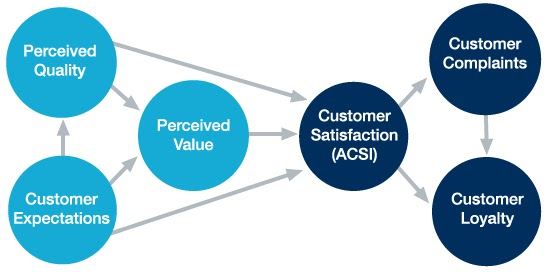
The indices (shown in the diagram below) are multivariate components measured by a number of weighted questions in the model. The assessment questions measuring customers' evaluations of the determinants of each index are implemented on a scale from 0 to 100. Accordingly, the higher the expectations, the higher the standard for the perceived product/service. If the business meets them, it will boost customer satisfaction and loyalty; otherwise, it will result in complaints about a terrible experience.
The Norwegian Customer Satisfaction Barometer (NCSB) model
The first NCSB model is identical to the ACSI model except that it includes company image and its relationships with customer satisfaction and loyalty.
The new NCSB model is as follows:
-
(1) Replacing the value construct with a "pure" price construct
-
(2) Replacing customer expectations with company image as a consequence of satisfaction
-
(3) Including two aspects of relationship commitment as well as company image as drivers of loyalty
-
(4) Incorporating the potential direct impact of price on loyalty
-
(5) Including complaint handling as a driver of both satisfaction and loyalty.
To align with the development in marketing from a transaction orientation to a relationship orientation among service providers, the NCSB model has been expanded over time to focus on the affective and calculative components of commitment. While the affective component leans more toward emotion, the calculative component is based on the more rational aspects of the relationship, such as switching costs. The commitment constructs are modeled to mediate the effects of satisfaction on customer loyalty (behavioral intentions).
The European Customer Satisfaction Index (ECSI) model
In the ECSI model, customer expectations, perceived quality, perceived value, satisfaction, and the customer loyalty construct are modeled the same as in ACSI.
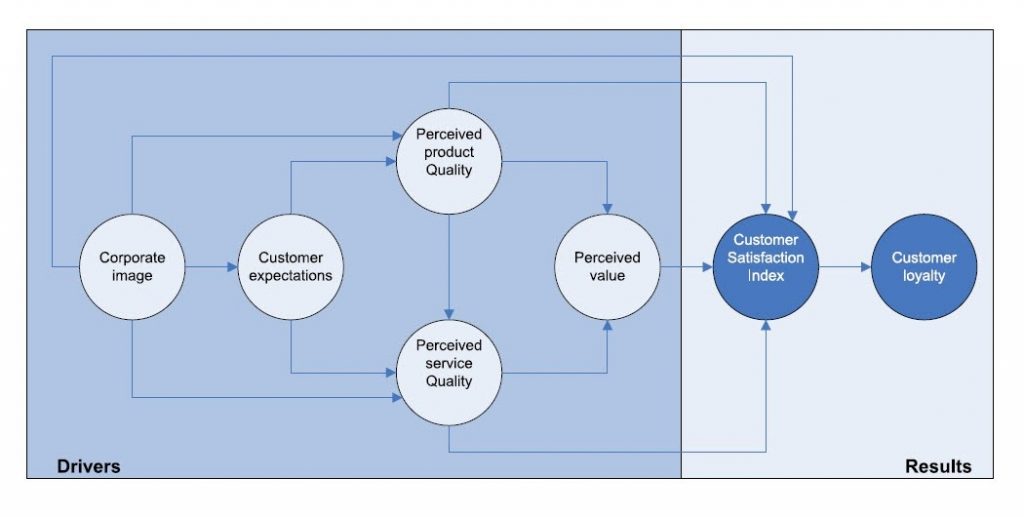
There are two basic differences between the ACSI and ECSI models. First, the ECSI model does not include the complaint behavior rate as a consequence of satisfaction. Second, to align with the original NCSB model, the ECSI model incorporates company image, as this factor has been identified as directly influencing customer expectations, satisfaction, and loyalty. In addition, the ACSI index is typically used in the public sector, while ECSI is commonly used to measure products across industries.
Why measure customer satisfaction?

Measuring customer satisfaction is important so that a business can:
-
Capture customer perceptions, trends, and behaviors and evaluate campaign results: Through the collected analytical data, the business will know what customers truly want and the trends and behaviors most frequently performed for a given transaction. In addition, through the data tables, the business will know how effective its campaign was, forming the basis for better-suited campaigns in the future.
-
Improve the customer experience: Once you know customers' needs and wishes, the business can put solutions and adjustments in place in its products/services to help them meet the highest expectations.
-
Retain customers effectively and increase competitive advantage: Satisfying customer needs to retain them and reap the benefits from them is always a key goal in business operations. Through measurement to capture needs and put timely solutions in place, the business will impress and retain customers longer, while increasing its competitive advantage by adjusting strategy according to customer behavior and needs.
>>>> See more: Customer Feedback: How to Collect and Handle Feedback from Customers
How to measure customer satisfaction
Customers often exhibit positive behaviors after experiencing a product/service, such as rating products on websites, posting reviews, recommending them to friends and relatives, or repurchasing, etc. Those are some examples of customer satisfaction. So how do you know how satisfied your customers are with your products/services?

First, you need to understand that measuring customer satisfaction is a carefully planned and designed process. To do it, SimERP shares the detailed steps for measuring effectively below:
Define your goals
Before starting any process, you need a specific, detailed plan with a goal to orient all activities. So what is your goal with this survey?
-
Improving product/service quality
-
Improving the customer care system
-
Improving your customers' experience on social media or websites, etc.
Once the survey goal is defined, you need to choose the customer satisfaction metric that fits that goal.
Choose a customer satisfaction metric
The choice of customer satisfaction metric may differ from one business to another. Put the customer at the center and pay attention to the important factors that shape the customer experience and their satisfaction, so you can choose the metric that truly impacts your business.
These valuable metrics may refer to:
-
Website and shopping experience
-
Product or service quality
-
Quality of customer support service
-
Company image from the customer's point of view
-
Customer loyalty, etc.
Below are 3 key metrics that help you measure effectively.
Net Promoter Score (NPS)
This is the metric that determines the degree of affection and attachment customers have toward your product/service and their likelihood of recommending the experience to friends and relatives.
NPS is measured on a scale from 0–10 addressing the question: "How likely are you to recommend the product/service to relatives and friends?"
There are 3 main classifications:
-
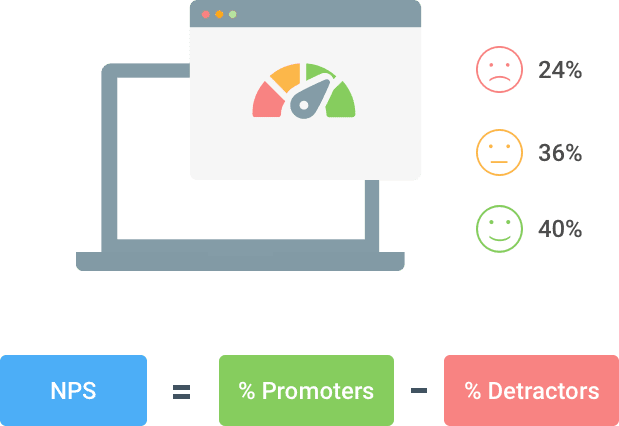
Promoters: These are customers who give you a 9 or 10. They are loyal customers willing to share their experiences with others.
-
Passives: They are customers who give you a 7 or 8. This group is not loyal to the product/service and holds a neutral attitude. They may switch to a competitor's product/service, and you cannot be sure whether they will share their experience with others.
-
Detractors: With scores of 6 or below, these are people who had a terrible experience with the product/service you provide, give negative feedback, and share their disappointment with others.
The NPS formula = %Promoters – %Detractors, i.e., the percentage of people satisfied with the product/service minus the percentage of dissatisfied people.
Customer Effort Score (CES)
The Customer Effort Score indicates whether customers can access your products and services easily and conveniently. Therefore, you can apply CES to survey many different activities, such as the ordering process, purchasing, interacting with staff, customer care service, etc.
CES poses the question: "Do you find it easy to access the company's products/services?" based on a scale from 0–7, with 0 being completely disagree and 7 completely agree.
Through this, CES lets you know what difficulties customers face when engaging with your brand, so you can promptly put solutions in place to raise customer satisfaction.
Customer Satisfaction Score (CSAT)
The Customer Satisfaction Score (CSAT) measures how satisfied customers are with a product/service or their interaction with support staff. It is measured on a scale from 1 to 5 based on the nuances of 5 faces, with 1 being extremely low satisfaction and 5 the highest satisfaction.
The CSAT formula = (Number of satisfied customers / total number of responses) x 100
Design the survey to fit your goals
Depending on each business's situation and goals, there will be different purposes and ways of conducting the survey.
Below are 4 common survey types:
-
In-app surveys: usually quick surveys consisting of just a few questions and requiring instant responses, sent to your customers while they are still using the service.
-
Email surveys: let you ask a larger number of questions and give customers enough time to answer when they are ready. This survey can use Google Forms or suitable supporting software.
-
Post-service surveys: help you capture customers' satisfaction points after a service is delivered. For example, you can create survey forms via the chat window after a conversation ends. With live chat software, you can capture their experience with your brand and the operator.
-
Holding regular quarterly meetings: help you meet customers face-to-face and address their feedback directly to measure their satisfaction with the products/services you provide. However, this method requires more time, effort, and cost to carry out.
>>>> See more: 5 Ways to Create Customer Satisfaction Survey Templates
Besides deciding how to send the survey, you need to set survey questions that truly reflect your goals. Then send your survey through the channels skillfully and professionally. For example, for the email channel, instead of sending anonymous bulk emails, you should use email marketing to personalize the emails, which helps readers and raises open rates. That in turn helps you increase the response rate to your survey through this channel.
You can try SimCRM's email marketing — it lets you try all of its features free for 30 days! Sign up by clicking the button below!
Set the survey delivery timing

To measure customer satisfaction, the timing of the survey determines the response rate and the survey's effectiveness. Below are 4 important moments you can consider:
Right after the customer interacts with the business
Sending at this moment helps you get the most honest feedback. If customers are unhappy with the product/service you provide, they will not hesitate to express their negative feelings or even refuse to take the survey. Customers who respond positively will feel the company's care and become better disposed toward it.
In addition, capturing customer feedback right after the interaction lets the business adjust products/services and put solutions in place promptly to appease customers, and plan to improve their experience next time.
Before making changes
Many businesses often roll out and improve their products/services/features first and survey customers afterward. However, doing this carries major risks: they may not be able to adjust or respond promptly to negative feedback, or lack the funds to make revisions. Therefore, surveying customer feedback is not only a gesture of appreciation toward customers, giving them a chance to voice their opinions, but also helps the business get an overview, anticipate risks, and plan sensible adjustments.
After a marketing campaign ends
Surveying customers is a great tool for the team to evaluate the effectiveness of a marketing campaign. Through the feedback collected, you will know whether the campaign succeeded and spot the negative points that need adjusting. The mistakes from this campaign will be lessons learned for future marketing campaigns.
When customers stop using your product/service
Surveying customers when they no longer use the product/service is always something businesses must do to understand customers' needs and desires better. If the churn rate is too high, it shows there are flaws in the product/service giving customers a poor experience. So detect signs of customer churn in time to put appeasing solutions in place and improve product/service quality to retain them better.
Regardless of whether you choose to collect customer feedback after one interaction or wait a while, be careful not to pester them by constantly sending new surveys. The important thing is to respect customers' time and space if you want your surveys to produce meaningful, accurate results.
Put solutions in place
The survey becomes meaningless if you don't know how to use the collected data to identify problems and devise solutions. These solutions may relate to products, services, technology, or ways of satisfying customers.
First, you should identify the touchpoint at which your customers run into a problem and try to understand why the problem arises. Then you need to dig deeper, identifying the causes and the direct and indirect impacts that created the problem. Finally, once you are aware of the problem, you must decide which department should do what to fix the issue and its effects to avoid future trouble.
Conclusion
Measuring customer satisfaction tells the business about customer loyalty, the effectiveness of campaigns, and the flaws in business processes that need fixing. From there, the business can put practical solutions in place to improve product/service quality and enhance the customer experience.
Related articles
Bài viết liên quan

25 tháng 10, 2026 · 3 phut doc
2024年网页设计趋势预测如何? | Wotech Electronics
关于 2024 年网页设计趋势——步入 2024 年,年初正是我们为新事物预留时间的时刻。这也非常适合设计师群体唤醒我们内心的"艺术之魂"。闲话不多说,快来和 Markdao 一起浏览 2024 年的 UX/UI 设计趋势吧,说不定您就能为自己接下来的网页设计项目"迸发"出一个绝妙的点子呢!

25 tháng 10, 2026 · 1 phut doc
什么是网站(Website)?网站的详细定义及其带来的商业价值
什么是网站(https://www.markdao.com.vn/blog/website-la-gi)——这个问题或许已经无需定义,因为在如今这个信息时代,网站对每一家企业而言都是不可或缺的组成部分。正是网站帮助用户更近距离地接触企业所提供的产品和服务,从而提升经营效益。此外,要在当今竞争如此激烈的环境中求发展,网站是一个重要因素,它将带你走向品牌与销量上的双重成功。

25 tháng 10, 2026 · 1 phut doc
什么是SEO标准网站?一场"打赢"Google SEO标准的战役 | Wotech Electronics
99%的用户在购买前会先搜索信息,73%的用户只会访问排名前10的网站,并认定它们是值得信赖的品牌……在数字营销爆发的时代,这些数字有力地印证了SEO标准网站的重要性。然而,许多人对什么是SEO标准网站(https://www.markdao.com.vn/blog/huong-dan-toi-uu-seo-website-chuan-seo-on-page)仍然相当模糊,并未真正理解。达到SE…