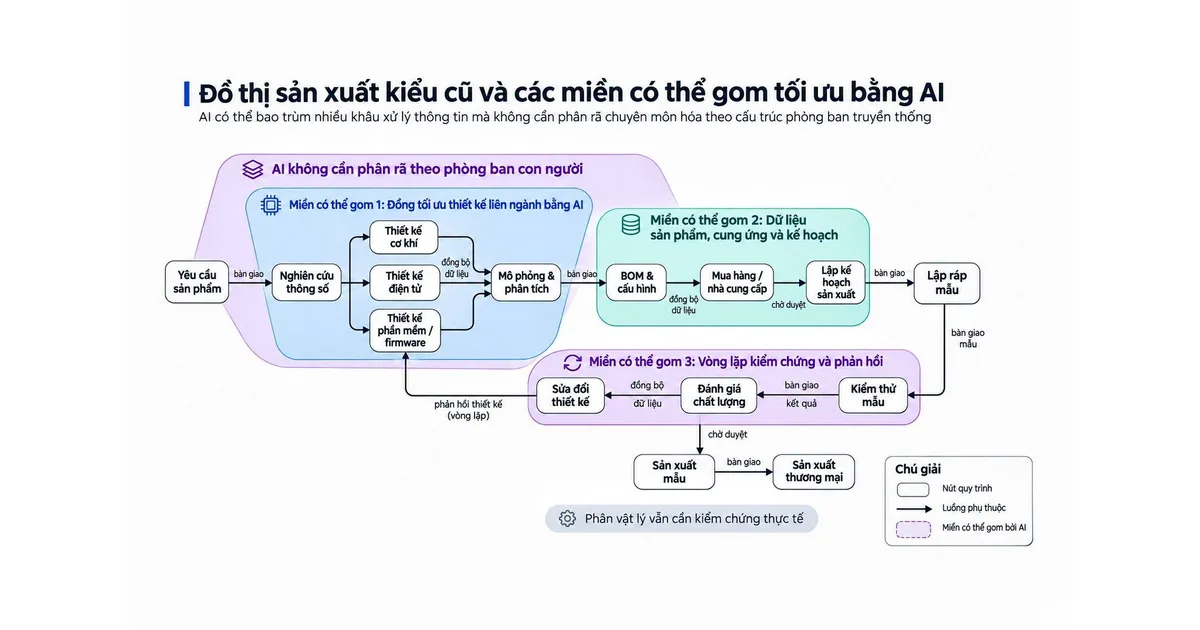
Old Specialization Is Dead: When AI Reorganizes Work by the Production Graph, Not by Department
Vũ Khôi
Tác giả tại Wotech Electronics Blog
Old Specialization Is Dead: When AI Reorganizes Work by the Production Graph, Not by Department
A computer only needed to move to the next room, five meters away — yet the job took 6 to 10 hours of travel, about 15 pages of paperwork, and 400 euros. Every link in the chain did its job correctly. Only the whole system was absurd.
Quick answer: Old specialization — specialization designed for the local, slowly changing capabilities of humans — is dead, according to Lâm Nguyễn's argument. When AI can access a unified product data model and use specialized engineering tools, work can be reorganized by actual dependency relations instead of by job positions. Companies face two investment choices: keep the process and equip each employee with AI — gains arrive immediately but hit a ceiling very early; or reorganize the entire process around product data — harder and costlier today, but with far greater expansion potential if three foundational problems are solved: unified data, automated verification systems, and decision rights redistributed by risk level.
Old specialization is the organization of work by department and job position, born from real human limits: one engineer can hardly master structures, circuits, control, supply, and cost all at once. Companies had to divide labor, establish authority, and set up handover procedures. The price is information reinterpreted at every handover, departments waiting on each other, and a small change triggering a flood of meetings.
Lâm Nguyễn's post starts from a hint: in the leaked prompt, skill, and harness architecture of Anthropic for the Fable/Mythos 5.2 model — the company whose AI model, according to the post, successfully solved the Riemann problem — what can we learn? The author's answer: old specialization is dead.
The computer and the five-meter move
In Bullshit Jobs (2018), David Graeber recounts the story of Kurt, who worked for a subcontractor of the German army. A soldier moved to another room five meters away and needed to take his computer along. He had to fill out a form. The form went through the IT contractor, the logistics contractor, then the HR contractor. Kurt drove hundreds of kilometers to unplug the machine, pack it, and complete the paperwork. Someone else carried the box to the next room. Kurt unpacked it, set it up again, and drove back. By his account, the job took 6 to 10 hours of travel in total, about 15 pages of paper, and 400 euros.
It is clear that every link could have done its job correctly. Only the whole system was absurd.
Over time, each department reports that it completed its tasks well, while products still reach the market slowly. Take changing the battery of a UAV. Mass, center of gravity, flight time, electric current, heat, mounting structure, bill of materials, and cost can all change. Technically, those are dependency relations within a single problem. Organizationally, they can mean five or six departments and many rounds of exchange.
The laws of physics decide the first part. The second part is a human choice from an era when information-processing capacity was limited per individual.
What AI changes: organize by the graph, not by department
When AI accesses a unified product data model and then uses specialized engineering tools, we have a basis for reorganizing work by actual dependency relations instead of by job positions. The problem now resembles finding a production graph with the lowest total execution cost, satisfying all constraints on quality, safety, and verifiability. The optimal graph does not necessarily have the fewest nodes. It must eliminate steps that no longer add value without losing the conditions a product needs to be accepted.
This is not an entirely new idea either. Concurrent engineering, PLM, MBSE, and the digital thread have pursued connected product data for years. What AI can change is the execution capability and the coordination cost of realizing those architectures.
Two investment paths, two contrasting slopes
Suppose a company has a budget to invest in AI today and faces two choices:
| Criterion | Path 1: Keep the process, equip each employee with AI | Path 2: Reorganize the process around product data |
|---|---|---|
| Initial results | Arrive immediately, lower deployment risk | May cost more and work less efficiently at present |
| Limits | Appear very early if the operating structure does not change | Unclear — depends on solving the foundational problems |
| Example of the limit | An engineer finishes a drawing in 2 hours instead of 2 days, then still waits a week for the next department; if the accelerated step is only 20% of total time, then even if AI does it almost instantly, the whole cycle speeds up at most 1.25× | Replacing 10 employees with 10 agents while keeping 10 steps only creates an automated bureaucracy — that is the trap of path 1, not path 2 |
| Current AI capability | Good enough to use right away | Still weak at tasks coordinating multiple software tools: the EngiWorld benchmark published in 2026 evaluated 7 AI models, with only 6 of 168 attempts succeeding (3.6%) |
| Expansion potential | Limited by the bottlenecks that remain | Greater, if unified data, automated verification, and redistributed decision rights are solved |
But the two options are not a static report snapshot; they are not fixed. METR data from 20/11/2026, according to the post, estimates that the length of tasks AI can complete autonomously at a given success rate is doubling roughly every 3.6 months. The same research notes that models remain weaker than experts in situations lacking clear experimental feedback. These numbers do not allow us to conclude that industrial AI will progress at the same speed. They do show, however, that autonomous agent capability is shifting fast while reliability remains the major obstacle.
From here, two different investment trajectories emerge. The first optimizes productivity within the existing structure. The second builds an architecture that can exploit the capabilities of future AI generations more deeply. The latter is not guaranteed to win. It only has greater expansion potential if the company solves the foundational problems. That foundation consists of unified data, automated verification systems, and decision rights redistributed by risk level. All three develop at the organization's transformation speed, not at the model's release speed.
So the important question is not whether AI today can replace an entire R&D department. The current answer is no, judging by the ability to execute every function completely and reliably. The question to ask is: when that capability is good enough, will the company already have an architecture to exploit it, or will it have to start building from scratch?
Who has to answer?
A new entrant does not need to recreate the entire capability of a long-established company. It only needs to offer a good-enough product for one segment, at a cost and speed the incumbent struggles to match. Short development cycles bring experimental data sooner. Accumulated data makes the next designs more accurate. The advantage no longer lies only in how fast work is executed, but shifts to the ability to learn and improve continuously.
Meanwhile, the person assigned to judge whether a step is still necessary is often the person managing it. Nobody is necessarily incompetent. The problem lies in incentive mechanisms that make individually reasonable decisions add up to a disadvantage for the whole company. A department can hit every KPI while the company steadily loses competitiveness.
Such self-correction cannot be expected to come only from the execution level. It is the responsibility of leadership — people with enough authority to change the operating architecture instead of merely asking employees to use AI.
Apply it now: a three-model experiment over six months
The work to be done is not very complicated methodologically, according to the author. Pick one real technical change, then trace backward from requirements to a verified product:
- Measure the status quo: real working time, waiting time, how many times data is re-entered, and approval steps that add no meaningful evidence.
- Run three models in parallel on equivalent tasks: (a) the traditional process, (b) the old process with AI assistance, (c) the process restructured around product data.
- Compare five metrics: total time, cost, rework rate, acceptance quality, and the level of human intervention.
- Re-evaluate six months later with new models. What matters is not only which model is better today, but the rate of improvement of each architecture across AI generations.
The author does not claim that every slow-to-transform company will collapse. Factories, certifications, customers, experimental knowledge, and supply chains remain real advantages. But using those assets as a reason to believe there is plenty of time left is a dangerous inference.
When a competitor has found a better operating structure, the competitive gap can widen faster than the incumbent's ability to adapt. The first signal sometimes comes not from a technology report but from a lost contract, a price forced down, or a profit margin no longer sufficient to feed the machine. By then, transformation is no longer a proactive choice. Caution in industry is necessary. But caution must rest on verification and experimentation, not on the belief that an organization that once succeeded will necessarily keep fitting.
What is worth noting is not that we do not know how far AI will go. What is blameworthy is refusing to test the assumptions that determine the company's very survival.
Kurt's computer only needed to move five meters. Among the thousands of processes we operate, how many such computers are there? And if a competitor finds a way to move them in just a few minutes, what advantage do we have left to compete with?
1. What does "old specialization" mean? It is the organization of work by department and job position, born because one person cannot deeply master every field at once. The price is information reinterpreted at every handover, departments waiting on each other, and a small change triggering many meetings.
2. How does AI change specialization? When AI accesses a unified product data model and uses specialized engineering tools, work can be reorganized by actual dependency relations — a production graph with the lowest total cost, satisfying quality, safety, and verification constraints — instead of by job positions.
3. Why does equipping each employee with AI still hit a ceiling? Because the bottleneck is in the structure, not in the speed of each step. According to the argument, if the accelerated step is only 20% of total time, then even if AI does it almost instantly, the whole cycle speeds up at most 1.25×. Replacing 10 employees with 10 agents while keeping 10 steps only creates an automated bureaucracy.
4. Is current AI capability enough to restructure processes? Not yet, fully. According to the post, the EngiWorld 2026 benchmark evaluated 7 AI models on tasks coordinating multiple software tools, with only 6 of 168 attempts succeeding (3.6%). But METR data from 20/11/2026 shows the length of tasks AI can complete autonomously doubling roughly every 3.6 months — capability is shifting fast, while reliability remains the major obstacle.
5. Where should a company start? Pick one real technical change, measure real work time, waiting time, and data re-entry, then run the same task under three models (traditional, old + AI, restructured around product data) and compare total time, cost, rework rate, acceptance quality, and human intervention. Re-evaluate six months later with new models.
Source: post by Lâm Nguyễn on Facebook (referencing Anthropic's prompt/skill/harness architecture for Fable/Mythos 5.2; EngiWorld 2026 and METR 20/11/2026 figures as cited in the post). Cover image: the production graph diagram from the post.
Bài viết liên quan

23 tháng 11, 2026 · 7 phut doc
AgentScope: Alibaba DAMO Academy's Open-Source Python Framework for Building AI Agents — 100% Apache 2.0
China has just released a Python framework for building AI agents. 100% open source, Apache 2.0 license. It is called AgentScope — and the difference, according to the post introducing it, is that it…

23 tháng 11, 2026 · 11 phut doc
Almost 2027 — Do You Have a Real System for Running Agents Yet? A Linux Mini PC, Backups Twice a Day, and the Cost Question
Last week, sick at home, Vương Nguyên Bình started upgrading the machine running his agents. His post is a blunt reminder: if you really intend to use agents for work, prepare the foundation for your…

23 tháng 11, 2026 · 9 phut doc
OpenAI Discloses Internal Numbers: GPT-6.2 Astra Solved a Millennium Prize Problem, an Unnamed Internal Model Is Already at 0.732
On November 22, Jakub Pachocki, OpenAI's Chief Scientist, published "Perplexity and Intelligence" and did something no lab has done: he disclosed the internal pretraining log-perplexity of each model…