
What Is Customer Debt? How to Track and Manage Receivables Effectively | Wotech Electronics
Vũ Khôi
Tác giả tại Wotech Electronics Blog
What Is Customer Debt? How to Track and Manage Receivables Effectively
Vũ Khôi
Author at Wotech Electronics Blog
Customer debt (receivables and payables) is one of the issues that the vast majority of businesses care about and prioritize — yet not every business knows how to manage it effectively and appropriately. Debt management affects whether a company's working capital cycle is shortened or lengthened, helping managers plan when to collect from customers or pay suppliers.
What Is Customer Debt?

Put simply, customer debt refers to amounts receivable from customers or amounts payable to suppliers. Depending on the nature of the debt, it is divided into two types:
-
Accounts receivable: arises when a business sells its goods or services to any customer. The customer then has an obligation to pay the business for the value of those goods or services.
-
Accounts payable: arises when a business buys goods or services from an individual or another supplier. In the common understanding, debt only truly arises when there is a credit purchase or sale. Once the obligation between buyer and seller has been fulfilled, it is no longer called debt. However, quite a few businesses still book it as an ordinary payable — the only difference being that the day the debt arises is also the day it is paid in full.
Tracking Customer Debt

To track customer debt while keeping the latest debt-related entries up to date, the accounting department must have a tracking file in Excel or use accounting software.
Based on the information in contracts, invoices, payment vouchers, goods issue/receipt notes, bank notices, exchange rates, discounts, returned goods, and so on, the accountant updates the debt tracking file to monitor it continuously and regularly.
Accountants in the business must fully understand the accounting process, how to track customer debt, and how to prepare debt reports: document circulation, document control, payment processes, etc., because debt collection is tightly linked to accounting documents.
The customer debt tracking table is created primarily to give the business the most comprehensive view of how its debt has moved for all transactions arising in the period. From there, company management can make decisions on payment policies, credit terms, promotions, discounts, and more for customers.
The basis for preparing this table is the receivables ledger. Each row on the receivables template represents one of the business's customers. In other words, however many customers the business has, the receivables template needs that many rows.
Managing Customer Debt
Definition
Customer debt management is the process of tracking and recording amounts receivable from customers when the business sells goods or services, and amounts payable to suppliers that arise when the business buys goods or services from an individual or another supplier. Managing debt helps the business control its financial situation more effectively.
Customer Credit Policy
Depending on the characteristics of the suppliers, customers, and debt situation, each business will have its own regulations and management policies. Some organizations manage by time, some by customer group or supplier group, and some small units may manage ad hoc. The business needs clear rules on debt management to limit problems from arising.
For instance, the business should impose certain requirements to keep debt from spiraling out of control: require customers or suppliers to sign agreements, mandate on-time payment, and clearly state the penalty customers face for late payment.
How to Manage Debt Effectively

Every business wants to make the most of its capital — to collect receivables from customers quickly while extending the time it takes to pay its debts to suppliers. To use every source of capital sensibly, the business needs an effective approach to managing customer debt. Here are some points to keep in mind:
-
Evaluate and segment customers into groups for easier management.
-
Build and develop sensible, clear sales policies from the start for each customer segment and each distribution tier.
-
Staff each stage adequately: dedicated personnel to push for fast, on-time collection of receivables from customers. Employees directly involved in collecting and paying customer debt need solid skills such as: storing all customer transaction documentation, in every form, completely and carefully; always staying calm and maintaining a professional working manner; closely monitoring every payment move or rescheduling request from the customer. Personnel should assess and review debt reports weekly and monthly. Set targets and KPIs to evaluate the payment status of payables and the effectiveness of receivables management.
The Customer Debt Reconciliation Statement
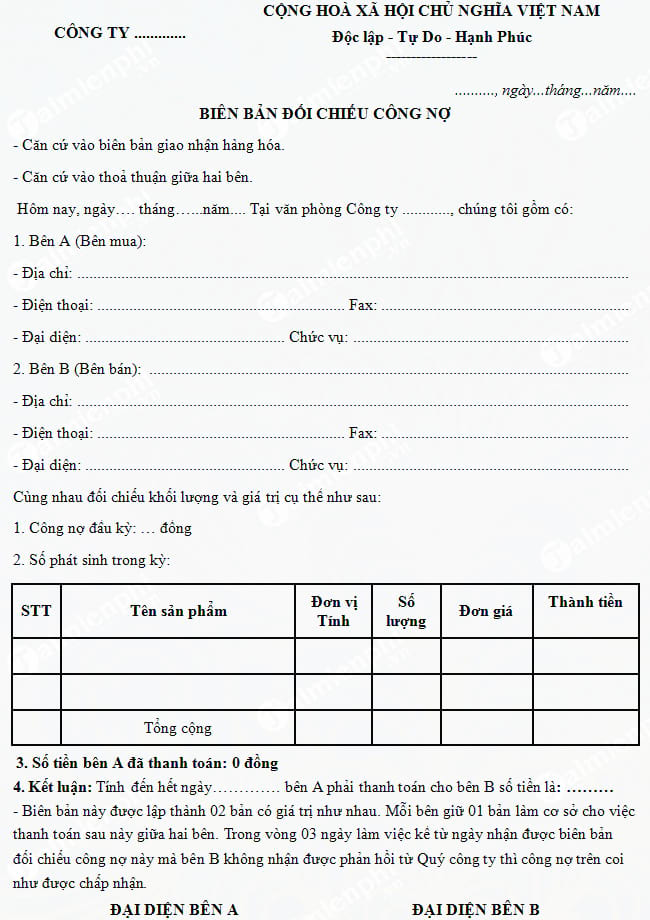
A customer debt reconciliation statement is a template created to record the reconciliation of your company's debt with other companies that had transactions in the period, making it easy for the business to track and remind partners about outstanding debt. In addition, the reconciliation template is used to confirm the payment status and remaining debt balance of both parties. The template should contain complete information on both parties involved, the transaction details, detailed product/service information, the debt balance arising in the period, and so on, so both parties can reconcile before confirming payment.
When to prepare a customer debt reconciliation statement
-
The reconciliation template is usually prepared on demand or periodically, monthly or annually, according to the agreement both parties reached beforehand on the buyer's payment schedule to the supplier.
-
The customer debt reconciliation template is prepared to serve as the basis for checking the payment status of both parties — especially for VAT invoices over 20 million VND — for reporting to the tax authority.
-
When a contract expires and the two parties have not yet paid each other in full, a debt reconciliation statement is required.
Notes when preparing a customer debt reconciliation statement
When preparing a customer debt reconciliation statement, keep the following in mind:
-
First, the reconciliation statement is not part of a loan agreement or an annex to a commercial contract, but it carries equivalent legal validity.
-
Second, because it is a document involving money with legal weight regarding the obligations of the parties, the customer debt reconciliation statement must be filled in with detailed, accurate, clear, and complete information.
-
Third, both parties should agree in advance on the payment period, the interest arising from late payment, and the resolution plan when preparing the statement.
-
Fourth, for the reconciliation statement to have legal validity, it must be fully signed and stamped by the business; for individuals, a signature or thumbprint is required.
The Customer Debt Confirmation Record
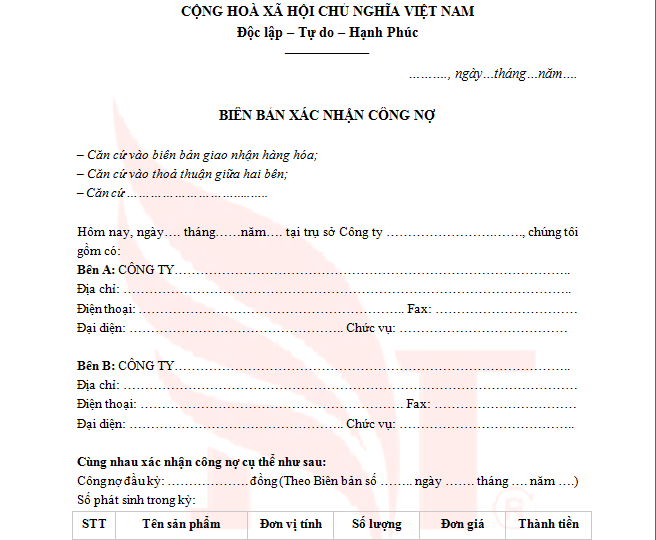
The customer debt confirmation record is a familiar document for businesses engaged in trade.
The debt confirmation template is used by organizations and applied to individuals and suppliers with outstanding unpaid debt. Confirming debt ensures transparency for unpaid loans, avoiding later disputes and errors.
When there is a need to re-confirm precisely the debts between a business and its partners, or between individuals, the two parties will prepare a debt confirmation record after completing their mutual reconciliation of the debts.
The customer debt confirmation letter template can also include a commitment to a repayment schedule.
Customer Debt Reporting Under Circular 200
The customer debt template under Circular 200 is a form widely used at businesses to summarize their detailed debt situation. The customer debt report template under Circular 200 applies to businesses of every operating scale.
The consolidated customer debt report template under Circular 200 is compiled in an Excel file, making it very convenient for accountants to track and calculate the business's receivables and payables. The content of the consolidated report template was issued under Circular 200/2014/TT-BTC on the corporate accounting regime, with the aim of ensuring uniformity across all units and in the management work of the relevant state agencies.
The main content presented in the consolidated customer debt report template under Circular 200 includes information related to the company code, the supplier or customer name, the opening balance of debt, followed by the debts arising during the period. The person preparing the report needs to carefully re-check the information to ensure absolute accuracy before passing it to the accountants and company leadership for signature and stamp confirmation.
Using Customer Debt Management Software

Benefits of Customer Debt Management Software
Synchronized data management: Customer debt tracking software helps the business owner track and manage data conveniently in a single system, minimizing scattered data to the greatest extent. At the same time, using debt management software is more optimal than managing in Excel, because with Excel the data has to be stored across many independent files, and Excel does not link to the company's e-invoicing or barcode scanning systems.
Less redundant paperwork: Sales and purchase orders are recorded in detail — not only the debt value but also the quantity and amount for each product.
Consolidated information: Information on customer and supplier debt is managed centrally, making it easy to search and classify.
Confirmations and debt reporting: The software can periodically confirm debts with customers and suppliers and prepare debt reports. From there, the business can issue customer payment notices through retrieval codes or built-in linked templates — and especially through automated reminders.
Easy tracking: Management software can track each case in detail, because debt is managed by debt number and debt owner.
Fewer errors: Users can quickly process and apply payments and receipts to match each specific customer debt, even when many transactions are carried out for the same customer.
Top 3 Popular Customer Debt Tracking Software Today
SimERP Financial Accounting Software

Built on the Odoo accounting software, SimERP inherits data rigorously, accurately, and instantly from other departments in the organization and business, thereby boosting employee productivity while giving administrators and company leadership an always-current overview and timely insight into the company's production and business operations.
SimERP integrates with other operational management modules such as Sales, Purchasing, and Inventory, providing an integrated solution for the business.
Benefits of SimERP Accounting:
The accounting feature of SimERP is built and designed to meet the needs of the accounting department:
-
Built to Vietnamese accounting standards (VAS), compliant with Ministry of Finance regulations.
-
SimERP accounting software links tightly and updates data instantly from other departments: Sales, Marketing, CRM, and more.
-
Journal entries are posted automatically according to predefined rules, reducing the workload of accounting staff by up to 70%.
-
Information and figures are entered only once from the company's business activities — purchasing, sales, inventory management, payroll, e-commerce channel sales, etc. — and then passed to the accountant, avoiding the avoidable errors of entering the same document multiple times, as is the case with ordinary accounting software.
-
SimERP Accounting connects directly to banks and online payment methods such as PayPal, NganLuong, VNPay, etc. Transactions are synchronized hourly and happen very quickly;
-
Real-time reporting is updated the moment any automatic entry arises, so managers always have figures to support operational decisions, and the accounting department no longer struggles to compile data and reports.
KiotViet Sales Software
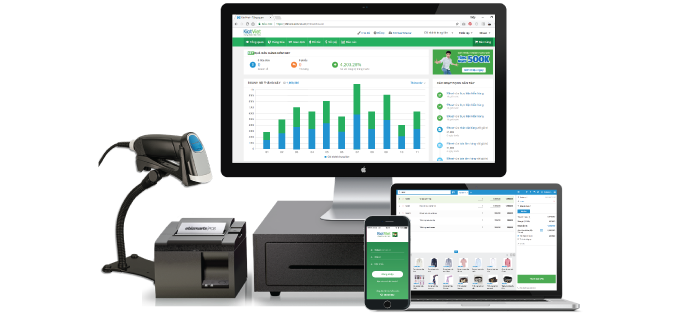
With a friendly, attractive interface, users can work easily with quick, simple operations. Moreover, managers can access and monitor customer debt conveniently and quickly, anytime and anywhere, on any device with the software installed.
Managing customer debt through a combination of sales management software and Excel is a trend delivering maximum efficiency for shops and businesses. KiotViet is a sales software with debt management support that is very popular among users today, with standout features such as: importing debt Excel files into the software, exporting debt files to Excel, importing and exporting goods lists and report data, and more.
Combining sales management software with Excel files in customer debt management not only makes it easier for shops and businesses to track debt, but also helps drive smooth and effective business operations.
Sapo POS Sales Software
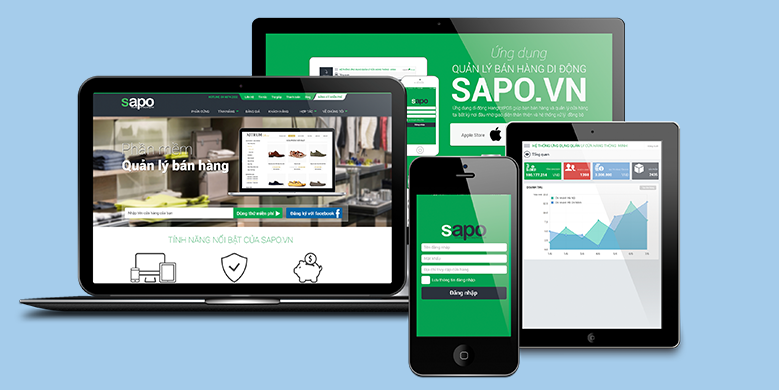
Sapo POS is a sales and customer debt tracking software trusted and used by more than 67,000 shops and businesses. All debt from customers, suppliers, and partners is managed synchronously and accurately in the software. Instead of writing debt down in a ledger or filling in an Excel debt management file, Sapo POS records debt automatically whenever purchases, sales, or shipping activities occur. Users no longer have to spend time tracking and calculating debt. Especially when a shop sells online on Facebook and ships goods, Sapo POS helps the shop owner track delivery orders right in the Sapo app, and calculates shipping fees and COD amounts clearly, making end-of-period debt reconciliation easy.
With modern cloud computing technology, all data stored in the software is synchronized automatically. Users no longer worry about lost or misplaced data as with ledger-based calculation. In addition, users can work from a computer or mobile devices — and even when switching to a new device, all data related to customer, supplier, and shipping partner debt is automatically synced to the machine without any additional steps.
Conclusion
Good customer debt management helps a business use its capital effectively, because if customers owe the business too much, it will not have enough financial resources to keep its production and business operations circulating.
We hope the information in this article has given you the fundamentals of customer debt and how to manage it effectively. If you have any questions, leave a comment below this article and SimERP will answer you promptly!
Related Articles
Bài viết liên quan

25 tháng 10, 2026 · 3 phut doc
2024年网页设计趋势预测如何? | Wotech Electronics
关于 2024 年网页设计趋势——步入 2024 年,年初正是我们为新事物预留时间的时刻。这也非常适合设计师群体唤醒我们内心的"艺术之魂"。闲话不多说,快来和 Markdao 一起浏览 2024 年的 UX/UI 设计趋势吧,说不定您就能为自己接下来的网页设计项目"迸发"出一个绝妙的点子呢!

25 tháng 10, 2026 · 1 phut doc
什么是网站(Website)?网站的详细定义及其带来的商业价值
什么是网站(https://www.markdao.com.vn/blog/website-la-gi)——这个问题或许已经无需定义,因为在如今这个信息时代,网站对每一家企业而言都是不可或缺的组成部分。正是网站帮助用户更近距离地接触企业所提供的产品和服务,从而提升经营效益。此外,要在当今竞争如此激烈的环境中求发展,网站是一个重要因素,它将带你走向品牌与销量上的双重成功。

25 tháng 10, 2026 · 1 phut doc
什么是SEO标准网站?一场"打赢"Google SEO标准的战役 | Wotech Electronics
99%的用户在购买前会先搜索信息,73%的用户只会访问排名前10的网站,并认定它们是值得信赖的品牌……在数字营销爆发的时代,这些数字有力地印证了SEO标准网站的重要性。然而,许多人对什么是SEO标准网站(https://www.markdao.com.vn/blog/huong-dan-toi-uu-seo-website-chuan-seo-on-page)仍然相当模糊,并未真正理解。达到SE…