Demystifying SEO Through Two Concepts: Internal & External Links | Wotech Electronics
Vũ Khôi
Tác giả tại Wotech Electronics Blog
Demystifying SEO Through Two Concepts: Internal & External Links
Vu Khoi
Author at Wotech Electronics Blog
SEO is a vast field that keeps expanding, and its concepts are constantly being restated with countless different interpretations. One way of answering what SEO is in this article is explained through two lenses: Internal and External links. Are you ready to explore?
Exploring What SEO Is Through Internal Links
Because internal links are a fairly important part of SEO, they also help us define what SEO is. The sad truth is that internal linking is often neglected in SEO, especially Onpage SEO, even though in practice it's easy to manage and operate. The internal link is undervalued relative to the tremendous potential, usefulness, and conversion power it can deliver.
But if you've also underrated internal links, don't laugh at yourself — this is really just the result of a shortage of systematic, professional documentation on this type of link. But now you know how important it is, and Markdao will help you get to know this magical SEO tool.
What Are Internal Links in SEO? How Do They Affect Your SEO Efforts?
What are internal links and how do they work?
An internal link, simply put, is a link that goes from one page to another page on the same domain. Internal links usually connect content within the site and are typically used in the main navigation. To visualize it, an internal link is like a shortcut, letting users "teleport" to another area of the website without performing manual navigation.
A basic code sample for this type of link is:
So what benefits do internal links bring to SEO?
- They help users "tour" a website more easily.
- They establish a clear, specific information hierarchy for the website.
- They create tight connections between pages, optimizing the site for search engines and spreading ranking power among those pages. That is, if a page that already ranks well is linked to another page, the connected page also receives the power to climb the rankings quickly.
Internal Links and Their Impact on SEO
First, internal links are most useful for establishing site structure and spreading link value. For this reason, they help build the website to be search-engine-friendly, boosting SEO performance without too much effort on your part.
For individual pages, search engines like Google need to "inspect" the content on the page in order to classify it against their enormous keyword index. Search engines also need to be granted access to the link structure in order to crawl. A common and very serious mistake is hiding the main link navigation, making it inaccessible to search engines. This puts those websites at risk of being "invisible" in search engine results.
To prevent this situation, we use internal links to connect pages within the same domain. This structure has the minimum available number of clicks between the home page and any other page. This is very useful because it allows link value (ranking power) to flow throughout the site, from top to bottom, thereby raising the ranking potential of every page. This structure is common on high-performing websites (like Amazon.com) in the form of category and subcategory systems.
In short, internal linking connects other pages within the same website, where the link itself has a certain relevance to the topic being discussed. Pointing internal links helps Google judge that your website is genuinely useful, because of its ability to navigate users from page to page and draw them to interact across many pages. This makes internal linking an important criterion supporting SEO, giving practitioners a clearer view of how SEO works and improving activities that support Onpage SEO.
External Links Help You Understand More About What SEO Is and Their Specific Impact on SEO
Besides internal links, external links are another part of SEO that cannot go unmentioned. They play an important role in the process of optimizing search engine rankings. So let's learn what external links are!
What Are External Links, and What Benefits Do They Bring to SEO?
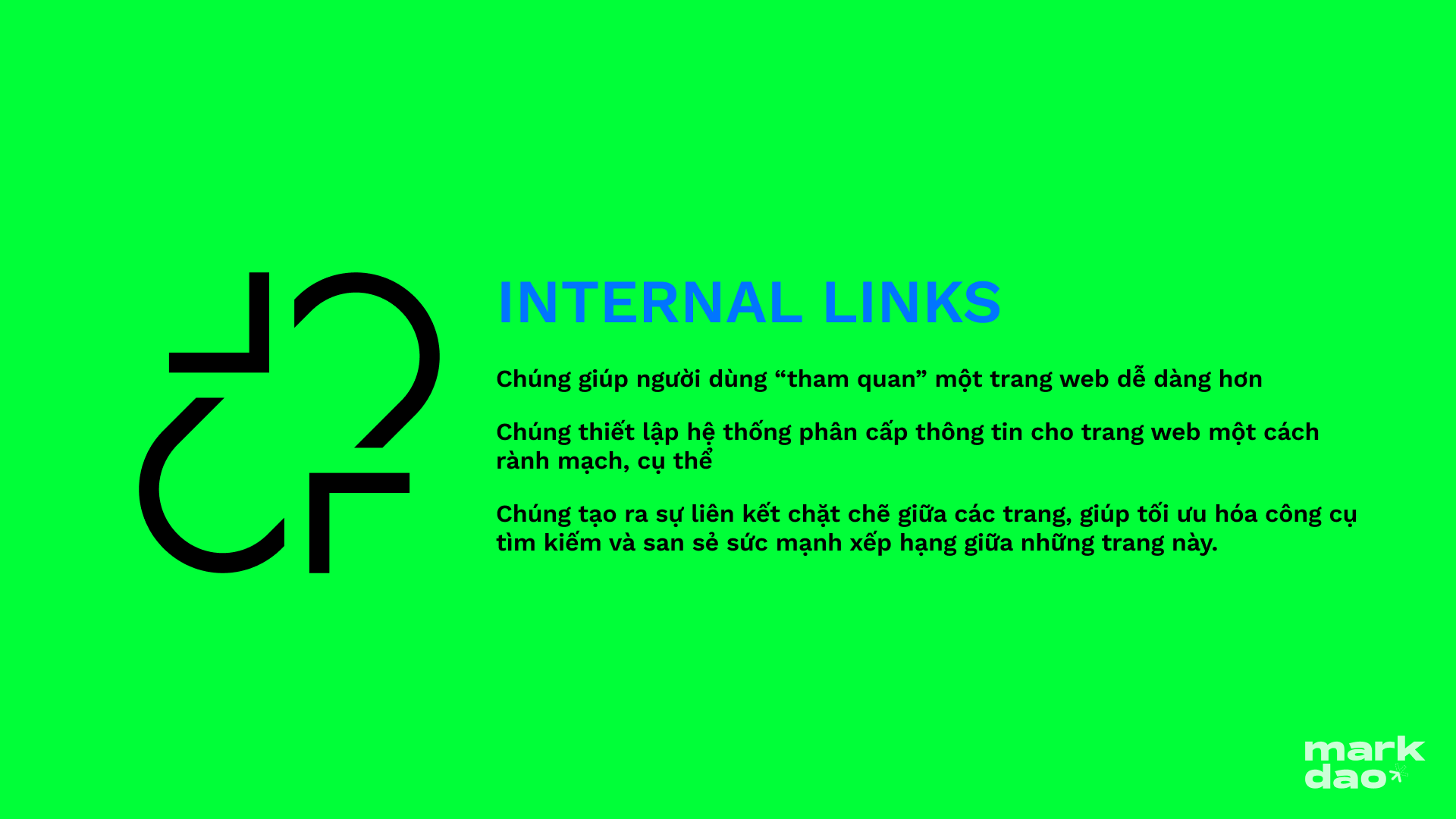
External links are hyperlinks that point to any domain other than the one the link exists on. In other words, while internal links connect to pages within the same domain, external links cross the border to point to other domains.
Code sample for external links and their advantages
An external link has the following sample code:
It uses descriptive keywords in the anchor text that reflect the same topic or the keywords the page is trying to target. In practice, however, you don't have to use a single keyword every time — in fact, you shouldn't, because this can be flagged by Google as spam. Instead, try to create many different types of link text, diversifying the context and usage scenarios for users and for search engines alike.
3 characteristics of external links that distinguish them from their "sibling" named internal
- External links are the most important source of ranking power.
- Search engines treat them as third-party votes that increase trustworthiness.
- The "title" link attribute is not used for ranking purposes.
According to specific research on search engine ranking factors, earning external links is a goal of the utmost importance for achieving high rankings. This stems from the idea that external links are one of the best ways for search engines to determine the popularity of a given website.
You can read about the history of SEO to learn more about the emergence of external links and their enormous impact. Here, we'll summarize the story briefly: Google made a splash with the launch of PageRank. This algorithm counted hyperlinks as votes for the popularity of each web page: the pages with the most links pointing to them were considered the most popular. When they were deemed relevant to a specific query, the most popular and relevant pages became the first listed in Google's results. Although this algorithm has become far more complex today, its core function remains unchanged.
Nowadays, the major search engines use many different metrics to determine the value of external links. A few typical metrics include: the trustworthiness of the linking domain, the popularity of the linking page, the relevance of the content between the source page and the target page, the anchor text used, and more.
Beyond these metrics, external links matter for 2 main reasons:
- Popularity
While traffic is a rather "messy" metric that search engines find hard to measure accurately, external links are both a more stable and more measurable option. That's because they are publicly displayed and easy to archive.
- Relevance
External links provide very valuable correlations for search engines. The text used in links usually reflects the content of the page being linked to. An article about wool sweaters that includes an external link to a page introducing wool fabric, with the anchor text "wool material," helps readers find the useful, extended information they need. This helps search engines establish knowledge hubs across the Internet, which are then used to determine the importance of a given web document.
What Has Expanding the Definition of SEO Through Internal and External Links Done for SEO?
In the past, when asked what SEO is, most people thought it simply meant writing articles and stuffing in as many keywords as possible to get to the top of Google. As technology becomes more and more advanced, Google's algorithms have steadily matured. That creates a lot of pressure on the SEO journey, requiring us to adapt or be left behind.
In that environment of evolve-or-fall-behind, SEO has gradually been redefined and broadened. Internal and external links have proven exactly that. Today, an SEO practitioner is no longer just someone who writes articles and inserts keywords. Behind an article ranking #1 on Google lies the tireless effort of an entire team: from content creation to image optimization, Offpage SEO on forums and communities, and link building... Throughout that long process, Internal and External Links contribute significantly to strengthening the power of SEO.
So no matter how difficult it gets, you should make an effort to leverage these two powerful tools. Markdao believes that, used properly, they will improve your SEO results in ways you wouldn't expect. If you don't know where to start, or you need a teammate to give you a hand, contact Markdao right away!
Related Articles
Bài viết liên quan

25 tháng 10, 2026 · 3 phut doc
2024年网页设计趋势预测如何? | Wotech Electronics
关于 2024 年网页设计趋势——步入 2024 年,年初正是我们为新事物预留时间的时刻。这也非常适合设计师群体唤醒我们内心的"艺术之魂"。闲话不多说,快来和 Markdao 一起浏览 2024 年的 UX/UI 设计趋势吧,说不定您就能为自己接下来的网页设计项目"迸发"出一个绝妙的点子呢!

25 tháng 10, 2026 · 1 phut doc
什么是网站(Website)?网站的详细定义及其带来的商业价值
什么是网站(https://www.markdao.com.vn/blog/website-la-gi)——这个问题或许已经无需定义,因为在如今这个信息时代,网站对每一家企业而言都是不可或缺的组成部分。正是网站帮助用户更近距离地接触企业所提供的产品和服务,从而提升经营效益。此外,要在当今竞争如此激烈的环境中求发展,网站是一个重要因素,它将带你走向品牌与销量上的双重成功。
25 tháng 10, 2026 · 1 phut doc
什么是SEO标准网站?一场"打赢"Google SEO标准的战役 | Wotech Electronics
99%的用户在购买前会先搜索信息,73%的用户只会访问排名前10的网站,并认定它们是值得信赖的品牌……在数字营销爆发的时代,这些数字有力地印证了SEO标准网站的重要性。然而,许多人对什么是SEO标准网站(https://www.markdao.com.vn/blog/huong-dan-toi-uu-seo-website-chuan-seo-on-page)仍然相当模糊,并未真正理解。达到SE…