Restaurant & Hotel Accounting – 2022 Update | Wotech Electronics
Vũ Khôi
Tác giả tại Wotech Electronics Blog
Restaurant & Hotel Accounting – 2022 Update
Vũ Khôi
Author at Wotech Electronics Blog
Restaurant accounting is a rather difficult task because of the diversity of this sector and the meticulousness and detail it demands. Yet it plays a pivotal role in business operations — good accounting means higher profit, and only then can the business survive and grow. The article below will help you better understand how to do restaurant accounting.
Restaurant accounting
Restaurant accounting is divided into several different types. Below, we'll give you a clearer picture of accounting for dining restaurants and accounting for hotel restaurants.
Accounting for dining restaurants
Input costs
– Each month and week, when purchasing ingredients for preparation, food, additives, beverages, etc. for the cooking and selling stages, record:
-
Debit Account 152, Account 156
-
Debit Account 133
-
Credit Account 331, Account 111, Account 112, etc.
(on the warehouse purchase documents, if any)
– Daily and weekly, the kitchen storekeeper issues stock from the warehouse to the Kitchen and bar departments for preparation, record:
-
Debit Account 621
-
Credit Account 152
(on the raw material issue documents)
– Labor costs of kitchen staff, assistant cooks, and bar staff involved in the preparation process, record:
-
Debit Account 622
-
Credit Account 334
(Account for this in the software's payroll module; if the payroll module is not used, accounting can be done via other business vouchers)
– Monthly premises rental costs, record:
-
Debit Account 627
-
Debit Account 133 (if any)
-
Credit Account 331, Account 111, Account 112, etc.
(account for this on the service purchase documents or payment vouchers/bank transfer slips, or track it as prepaid expenses)
-
Debit Account 627
-
During the period, if additional tools and instruments are purchased for immediate use and allocated in one go during the production and preparation process
-
Debit Account 133 (if any)
-
Credit Account 331, Account 112, Account 111, etc.
(on purchase documents not passing through the warehouse or payment vouchers)
– High-value tools and instruments issued for use in the Kitchen and bar:
-
When purchased and put into use, record:
-
Debit Account 242
-
Debit Account 133 (if any)
-
Credit Account 331, Account 111, Account 112, etc.
(on purchase documents not passing through the warehouse or payment vouchers/bank transfer slips)
-
When allocated monthly, record:
-
Debit Account 627
-
Credit Account 242
(on the tool and instrument allocation documents, or other business vouchers if tools and instruments are not tracked in the software)
– Fixed assets used in the Kitchen and bar:
-
When purchased and put into use, record:
-
Debit Account 211
-
Debit Account 133 (if any)
-
Credit Account 331, Account 111, Account 112, etc.
(on purchase documents not passing through the warehouse or payment vouchers)
-
When allocated monthly, record:
-
Debit Account 627
-
Credit Account 214
(on the fixed asset depreciation documents, or other business vouchers if fixed assets are not tracked in the software)
– At the end of the month, after costs have been aggregated, compute the cost of goods in the following steps:
Step 1: Determine the costing period for the month
Step 2: Allocate overhead costs
Step 3: Close out costs
-
Debit Account 154
-
Credit Account 621, Account 622, Account 627
Step 4: Accept and close out cost of goods sold
-
Debit Account 632
-
Credit Account 154
Step 5:
-
Production cost summary report
-
Detailed production cost ledger
-
Project profit/loss summary
-
Project profit/loss detail
-
Material norms comparison table (if any)
Accounting for selling expenses and business expenses
Labor, overhead, depreciation, and utilities are accounted for the same way as above and booked to Account 641 or Account 642 depending on the actual cost type.
Accounting for output revenue
Daily and each period, the sales accountant, based on invoices, accompanying purchase orders, and payment slips from sales staff and cashiers, records the number of dishes sold and issues invoices, recording:
-
Debit Account 111, Account 112, Account 131
-
Credit Account 511
-
Credit Account 333 (with invoice number)
(on sales documents that double as issue slips)
Some notes
– Beverages are treated as merchandise, handed over to the bar or reception staff for management, sale, and separate reporting
– Auxiliary material costs can be issued to the kitchen, bar, etc. and then allocated daily; any unused balance is left in Account 154
– Each invoice needs an attached itemized list to track dishes and calculate costs
– For customers who don't take an invoice, the accountant compiles a list and issues a single invoice at the end of the day.
Accounting for hotel restaurants
The accountant uses Account 632 for tracking and accounting as follows:
– Direct material costs: the cost of materials supplied to rooms and bedrooms, such as soap, tea, toilet paper, toothbrushes, standard-serving water, cream, shampoo, etc.
- Booked to Account 621 (under Decision 15) or Account 154 (under Decision 48)
– Direct labor costs: including salaries, wages, payable allowances, and salary-based deductions of room and housekeeping service staff
- Booked to Account 622 (under Decision 15) or Account 154 (under Decision 48)
– Manufacturing overhead: including the salaries of direct managers, salaries of service staff such as receptionists, tool costs, fixed asset depreciation, and other cash costs
- Booked to Account 627 (under Decision 15) or Account 154 (under Decision 48).
– Under accounting per Decision 15, add the closing entry at the end of the month
-
Debit Account 154
-
Credit Account 621, Account 622, Account 627
-
Under both Decisions, costs are closed out to cost of goods sold: Debit Account 632 / Credit Account 154
– Accounting for water beyond the standard:
Typically, hotels default to providing each room with 1 bottle of water per day (per guest). This is called water within the standard (already included in the room rate).
If the guest consumes additional water available in the room (beyond the default standard) and this water is charged, account for it as follows:
- Debit Account 1111 / Credit Account 5111, Credit Account 33311, and Debit Account 632 / Credit Account 156, Account 152 for the cost of the additional water charged.
– The accountant does not track direct cost-of-goods costs using Account 632; instead, all incurred costs are recorded in the two selling expense accounts (Account 641 under Decision 15, Account 6421 under Decision 48) and the business administration expense account (Account 642 under Decision 15, Account 6422 under Decision 48).
Hotel accounting

Method 1:
Costing method for hotel operations:
The accountant uses Account 632 for tracking and accounting as follows:
– Direct material costs: the cost of materials supplied to rooms and bedrooms, such as soap, tea, toilet paper, toothbrushes, standard-serving water, cream, shampoo, etc.:
-
Booked to Account 621 (under Decision 15) or Account 154 (under Decision 48)
-
Direct labor costs: including salaries, wages, payable allowances, and salary-based deductions of room and housekeeping service staff:
-
Booked to Account 622 (under Decision 15) or Account 154 (under Decision 48)
– Manufacturing overhead: including the salaries of direct managers, salaries of service staff such as receptionists, tool costs, fixed asset depreciation, and other cash costs:
- Booked to Account 627 (under Decision 15) or Account 154 (under Decision 48)
Under accounting per Decision 15, add the closing entry at the end of the month:
-
Debit Account 154 / Credit Account 621, Account 622, Account 627
-
Under both Decisions, costs are closed out to cost of goods sold: Debit Account 632 / Credit Account 154
-
On water beyond the standard:
Typically, hotels set up each room (in the minibar) with 1 bottle of water per guest per day — this is called water within the standard (already included in the room rate).
If water beyond the standard (consumed in addition by the guest) is charged, this revenue is accounted for as:
-
Debit Account 1111 / Credit Account 5111, Credit Account 33311
-
Debit Account 632 / Credit Account 156, Account 152 for the cost of the additional water charged.
Method 2:
– Not computing costs for hotel operations:
The accountant does not track direct cost-of-goods costs using Account 632; instead, all incurred costs are recorded in the two selling expense accounts (Account 641 under Decision 15, Account 6421 under Decision 48) and the business administration expense account (Account 642 under Decision 15, Account 6422 under Decision 48).
SimERP – The solution for restaurant and hotel accounting
About SimERP
In the digital age, restaurant and hotel accounting through technology is receiving ever more attention. At the same time, businesses are looking for suitable solutions to manage and collect information from multiple sources as accurately as possible to support accounting work in the context of Covid-19 and today's social distancing. And SimERP is the best possible choice.
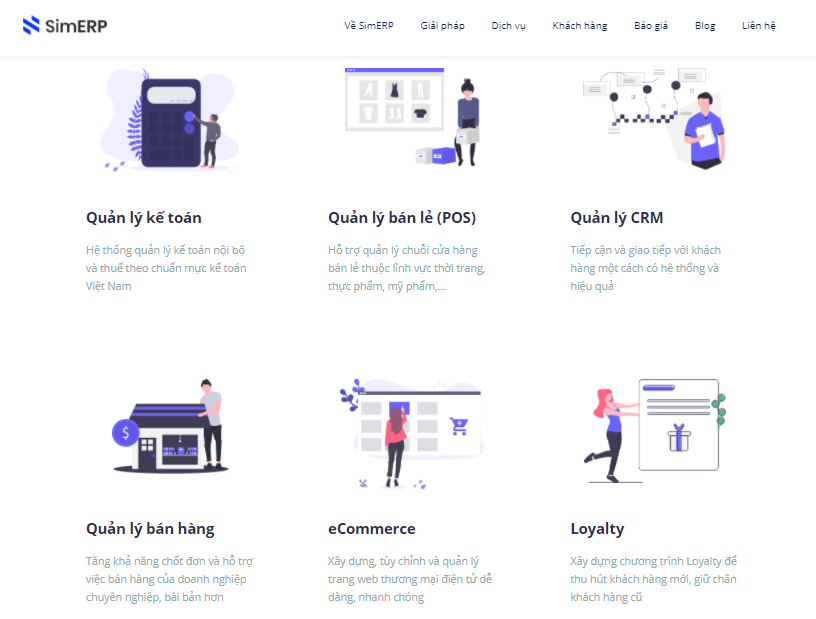
SimERP is an enterprise resource planning software used for restaurant accounting, built on Odoo — the world's most popular ERP software — with these outstanding advantages:
- An accounting solution compliant with Vietnamese standards
The Accounting module is adjusted and supplemented according to the decisions, laws, and circulars issued by the Ministry of Finance and the State. Therefore, every business in Vietnam can use this software.
- A powerful permission system
Information being integrated on one system doesn't mean everyone has completely free access — administrator approval and permission are required. This allows the business to manage well while keeping important information secure.
- Flexible number of users
Restaurant accounting involves a large volume of information from many sources, so SimERP allows a large number of users to access it while still ensuring security and high accuracy.
- Diverse deployment models
There are several different deployment models to suit a company's systems: on-premise (deployed on the company's own servers with a dedicated IT operations team), on-cloud (deployed on a cloud platform without customization), or Hybrid (a combination of on-cloud and on-premise) for application development.
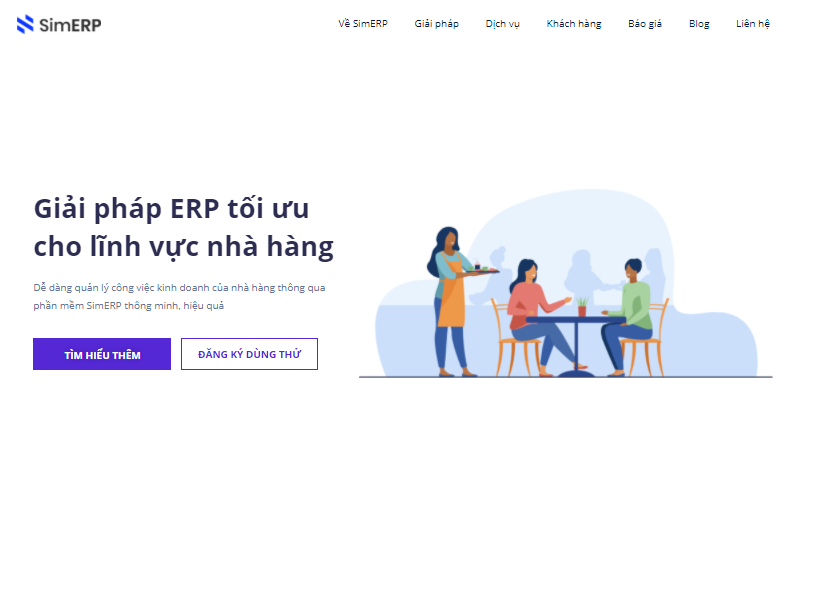
When does your restaurant system need an ERP?
– When your restaurant is having inventory problems.
– When you can't manage the quantities, purchasing times, receiving times, production times, batch numbers, and expiry dates of products
– When orders can't be handled promptly — for many reasons, delays in order information will reduce sales and leave customers dissatisfied with service quality.
– When production costs can't be optimized
Operating and production costs are expensive, exceed the budget, cause losses, and make the business's operations unsustainable.
Manage your restaurant chain more effectively with SimERP
- Mobile app for customers to order
A complete solution for omnichannel sales, including eCommerce, POS, and Call Center, making it easy and convenient for customers to access.
- Integration with counter printers and kitchen printers
SimERP's retail management system integrates with social networks such as Facebook/Instagram, helping businesses manage efficiently and consistently.
- Customer segmentation
SimERP helps businesses segment customers through the software's quick-search filter tool.
- Inventory optimization
Handling inventory is no easy task for businesses. Managing it well, with alignment across departments, helps administrators set appropriate strategies to increase profit and reduce inventory.
- Fast information flow
Order management staff don't always have time to meet the kitchen in person. SimERP lets order management staff send order information straight to the kitchen instantly.
- Process automation
Built on the open-source Odoo platform, it allows businesses to choose the processes that fit their operations rather than following a preset template imposed by the software. At the same time, it helps staff skip unnecessary steps and focus on customers' needs and preferences.
As such, restaurant and hotel accounting is a rather complicated job, and SimERP is the optimal choice for restaurants and hotels at the present time.
Related articles
Bài viết liên quan

25 tháng 10, 2026 · 3 phut doc
2024年网页设计趋势预测如何? | Wotech Electronics
关于 2024 年网页设计趋势——步入 2024 年,年初正是我们为新事物预留时间的时刻。这也非常适合设计师群体唤醒我们内心的"艺术之魂"。闲话不多说,快来和 Markdao 一起浏览 2024 年的 UX/UI 设计趋势吧,说不定您就能为自己接下来的网页设计项目"迸发"出一个绝妙的点子呢!

25 tháng 10, 2026 · 1 phut doc
什么是网站(Website)?网站的详细定义及其带来的商业价值
什么是网站(https://www.markdao.com.vn/blog/website-la-gi)——这个问题或许已经无需定义,因为在如今这个信息时代,网站对每一家企业而言都是不可或缺的组成部分。正是网站帮助用户更近距离地接触企业所提供的产品和服务,从而提升经营效益。此外,要在当今竞争如此激烈的环境中求发展,网站是一个重要因素,它将带你走向品牌与销量上的双重成功。

25 tháng 10, 2026 · 1 phut doc
什么是SEO标准网站?一场"打赢"Google SEO标准的战役 | Wotech Electronics
99%的用户在购买前会先搜索信息,73%的用户只会访问排名前10的网站,并认定它们是值得信赖的品牌……在数字营销爆发的时代,这些数字有力地印证了SEO标准网站的重要性。然而,许多人对什么是SEO标准网站(https://www.markdao.com.vn/blog/huong-dan-toi-uu-seo-website-chuan-seo-on-page)仍然相当模糊,并未真正理解。达到SE…