Guide to Basic Salary Calculation and Payment Methods in 2021 | Wotech Electronics
Vũ Khôi
Tác giả tại Wotech Electronics Blog
Guide to Basic Salary Calculation and Payment Methods in 2021
Vũ Khôi
Author at Wotech Electronics Blog
Salary is always a hot and closely watched issue at most companies today. Regardless of scale, a company's HR manager needs a firm grasp of the salary calculation rules and principles under Vietnamese law, along with a clear understanding of the different payment methods, in order to choose the right strategy for each business model. Follow along as we explore how salaries are calculated and the most common payment methods in Vietnam today.
Basic Salary Calculation in 2020
Basic salary is the wage agreed between the employer and the employee. Basic salary does not include allowances, bonuses, or other additional fees and benefits.
When determining basic salary, the business must base it on the minimum wage: for the public administration sector, the common base salary applies — currently 1,490,000 VND/month — under Decree 38/2019/NĐ-CP on the base salary of officials, civil servants, and armed forces personnel (issued May 9, 2019, effective from July 1, 2019).
For untrained workers, the basic salary must be no lower than the regional minimum wage, or at least 7% higher.
Regional Minimum Wage
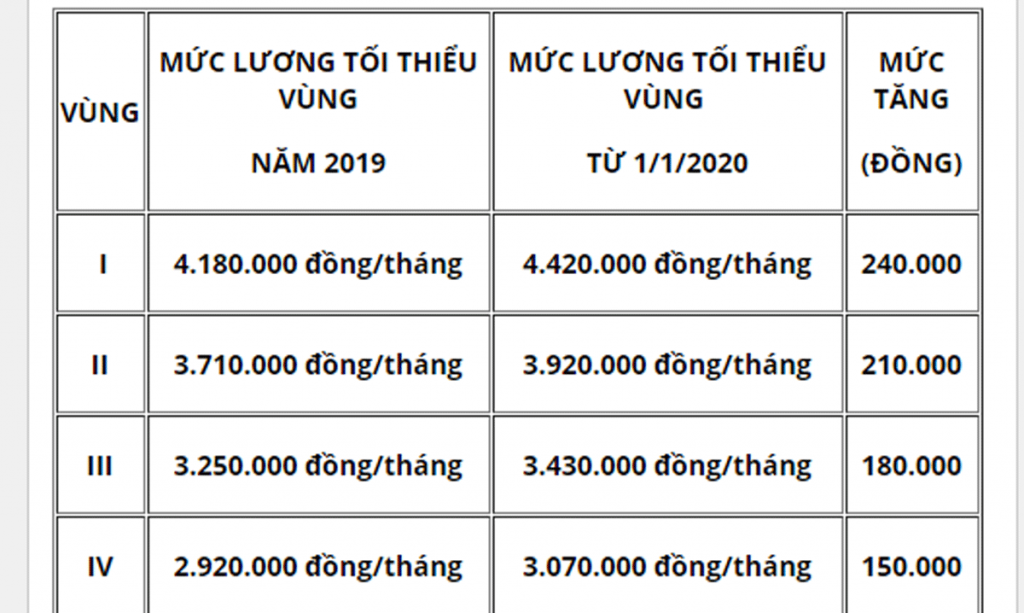
To avoid having their rights infringed due to a lack of legal knowledge, workers at non-state organizations and businesses need to equip themselves with essential information — especially knowledge related to wages. Below is the regional minimum wage applied to workers at non-state organizations and businesses throughout Vietnam:
-
Region 1 base salary: 4.18 million VND/month
-
Region 2 base salary: 3.71 million VND/month
-
Region 3 base salary: 3.25 million VND/month
-
Region 4 base salary: 2.92 million VND/month.
Basic Salary of Workers at Enterprises

When setting the basic salary, businesses must comply with the rule: they must not pay less than the regional minimum wage, and must add a further 7% for workers who have been trained at vocational level or higher.
Example: Hoàng Phúc Co., Ltd operates in Hanoi. When recruiting employees, it determines the basic salary as follows:
-
For workers without vocational training, such as guards or cleaners, the lowest wage paid for normal working conditions and a full month's working time is 4,420,000 VND.
-
For workers with vocational training, such as office staff or accountants, the lowest wage paid for normal working conditions and a full month's working time is: 4,420,000 + 4,420,000 × 7% = 4,729,400.
Basic Salary of Workers in State Agencies
Unlike workers at private organizations and businesses, for those working in state agencies — officials, public employees, and civil servants — the basic salary is calculated based on the base salary rate. The basic salary formula for workers in state agencies is:
Basic salary = Base salary rate × Salary coefficient
Example:
Mr. Phan Đình Dũng is an English teacher at Lam Sơn Secondary School in Ninh Bình city, receiving grade A2 pay with a salary coefficient of 6.04. His monthly basic salary is calculated as follows:
Basic salary = Base salary rate × Salary coefficient = 6.04 × 1,490,000 = 8,999,600
Using this formula, you can easily calculate your own basic salary.
Basic salary is the foundation, the core basis on which workers work and sustain their lives. In practice, companies may pay more than the basic salary or add various allowances, subsidies, or bonuses. The basic salary calculation above determines the minimum amount a company must pay — to be negotiated with the employee when signing the labor contract — and the state does not cap how much higher than the basic salary it may go. Typically, the basic salary is the amount used for insurance contributions. However, under the amended Social Insurance Law today, the salary used for insurance contributions also includes several other allowances, and it is the insurance law that caps the contribution level.
Example: Social insurance and health insurance must not exceed 20 times the common minimum wage (no more than 29,800,000), or the salary used for social insurance contributions must not exceed 20 times the regional minimum wage (for Region 1, no more than 88,400,000).
>> See more: How to Calculate Salaries for Tenured and Contract Teachers, and Maternity Leave Pay
How to Calculate Average Social Insurance Contributions for Pension Purposes

The average monthly salary used for social insurance contributions to calculate pensions for workers paid under the state scheme
Specifically, the average monthly salary for social insurance contributions (M) for employees who contributed under the state wage scheme for their entire contribution period is calculated as:
M = (Total monthly social insurance contributions of the last a years before leaving employment)/(a × 12)
The average monthly salary used for social insurance contributions to calculate pensions for workers paid under an employer-defined scheme
Under Clause 2, Article 62 of the Social Insurance Law, for workers whose entire social insurance contribution period falls under a wage scheme determined by the employer, the average monthly contribution salary is calculated based on the entire social insurance participation period.
Specifically, the average monthly social insurance contribution salary (M) for employees paid under an employer-determined scheme is calculated as:
M = (Total monthly social insurance contributions over the entire contribution period)/(Total number of contributing months)
For workers whose social insurance participation spans both the state wage scheme and an employer-defined scheme
Under Clause 3, Article 62 of the Social Insurance Law, for workers in this case, the average monthly social insurance contribution salary is calculated across the entire social insurance participation period under both the state wage scheme and the employer-defined scheme. The contribution periods paid under the state scheme and under the employer-defined scheme are each calculated according to the respective regulations. Specifically:
M = (Total monthly social insurance contributions under the state wage scheme + Total monthly social insurance contributions for the months contributed under the employer-defined wage scheme)/(Total number of contributing months)
Guide to Calculating Salaries

Bases for Salary Calculation
-
Labor contract
-
Timesheet
-
Product confirmation slips and work completion confirmation slips (in cases of piece-rate or lump-sum pay)
-
The company's salary and bonus regulations
-
The regional minimum wage
-
Contribution ratios on salary (to determine the amounts paid toward the various insurance schemes)
Common Payment Methods
Time-based pay (monthly, weekly, daily, or hourly) is the wage paid to employees on time-based pay, based on actual working time by month, week, day, or hour, specifically as follows:
-
Monthly pay is paid for a defined month of work according to the agreement between the two parties or on the basis of the labor contract.
-
Weekly pay is paid for a defined week of work according to the agreement between the two parties, or on the basis of monthly pay × 12 months ÷ 52 weeks.
-
Daily pay is paid for a defined day of work according to the agreement between the two parties, or on the basis of monthly pay divided by the number of working days in the month as prescribed by law that the company selects, with a maximum of 26 days.
-
Hourly pay is paid for a defined hour of work according to the agreement between the two parties, or on the basis of daily pay divided by the number of working hours in the day as prescribed in Article 104 of the Labor Code.
Piece-rate pay is the wage paid to workers on piece rates, based on the quantity of products completed and product quality according to labor norms and the assigned unit price per product.
Lump-sum pay is paid to workers on lump-sum rates, based on the volume of work, work quality, and the time allowed for completion.
Based on the nature of the work, production and business conditions, and the payment methods above, the employer can choose the payment method that ensures pay closely tracks work results, thereby encouraging employees to improve efficiency and productivity.
The choice or change of payment method must be clearly stated in the labor contract and the collective bargaining agreement.
Time-Based Salary Calculation
The daily-rate calculation is based on: monthly pay divided by the number of working days in the month — at the business's discretion, but by law no more than 26 days.
Under the rule above, there are two ways to calculate monthly pay:
Case 1:
Monthly pay = [(Salary + Allowances) / Number of statutory working days] × Actual number of working days
Where: Number of statutory working days = Days in the month − Days off.
Example: July 2020 has 31 days and 4 Sundays (employees get Sundays off) => The statutory number of working days is 27.
Case 2:
Instead of calculating how many standard working days each month has and dividing by that, there is a simpler, faster method: use a fixed standard number of working days as the divisor (usually 26 days). Specifically:
Monthly pay = [(Salary + Allowances)] / 26] × Actual number of working days
With the salary formula above, the owner can more easily calculate and track employee wages. However, depending on the nature of the business and the owner's requirements, the accountant may choose either of these two salary calculation methods when building the payroll.
>> See more: A Complete Guide to Calculating Worker Wages by Grade, Scheme, and Specialty Field
Piece-Rate Salary Calculation
This is a calculation based on the quantity and quality of products completed. Piece-rate pay is widely used in businesses today, especially those specializing in production and manufacturing. This payment method encourages workers to raise productivity and improve their craft and skills…
Piece-rate pay = Unit price per product × Quantity of products completed
Lump-Sum Salary Calculation
Lump-sum pay is calculated on the quantity, volume, and quality of work completed. This payment method can be based on time, per unit of product, or on revenue…
The key point in lump-sum pay is that the employer must determine the rate or contract price appropriately. In addition, the employer should set different levels of work completion, with a higher contract rate at each higher level — possibly with bonuses attached — to maximize employees' abilities and encourage them to achieve higher performance at work.
Lump-sum pay is based on:
-
The work subcontracting contract
-
The work acceptance record
Lump-sum pay = Lump-sum rate × Work completion percentage
How to Calculate Overtime Pay

Overtime is the time an employee works beyond normal working hours as prescribed by law, the internal labor regulations, or the collective bargaining agreement. Employees working overtime are entitled to overtime pay, calculated specifically as follows:
Overtime Shift Pay Calculation for Time-Based Employees
Overtime day-shift calculation:
Night-shift pay calculation:
Where:
– The actual hourly wage of a working day is determined by taking the actual wage for the job performed in the month in which the employee works overtime, divided by the actual number of working hours in the month (no more than 208 hours). For daily or weekly pay, the actual hourly wage is determined by taking the actual wage of that working day or week (excluding overtime pay and night-shift premium pay) divided by the actual hours worked in the day or week (no more than 8 hours/day, excluding overtime hours).
– The minimum of 150% applies to overtime hours on ordinary working days;
– The minimum of 200% applies to overtime hours on the weekly day off;
– The minimum of 300% applies to overtime hours on public holidays, New Year holidays, and paid days off — not yet counting the holiday pay for those days as prescribed by the Labor Code — in the case of employees paid by the day.
>> See more: Guide to Calculating Holiday Pay Under the Latest Provisions of the 2021 Labor Code
– The hourly wage for day shifts on an ordinary working day, a weekly day off, or a public holiday, New Year holiday, or paid day off is determined specifically as follows:
-
The day-shift hourly wage of an ordinary working day is calculated at a minimum of 100% of the actual hourly wage of an ordinary working day when the employee does not work the day shift overtime on that day; and at a minimum of 150% of the actual hourly wage of an ordinary working day when the employee does work day-shift overtime on that day.
-
The day-shift hourly wage of a weekly day off is calculated at a minimum of 200% of the actual hourly wage of an ordinary working day.
-
The day-shift hourly wage of a public holiday, New Year holiday, or paid day off is calculated at a minimum of 300% of the actual hourly wage of an ordinary working day.
Overtime Shift Pay Calculation for Piece-Rate Employees
Overtime day-shift calculation:
Night-shift pay calculation:
Where:
– The minimum of 150% applies to products made as overtime on ordinary working days;
– The minimum of 200% applies to products made as overtime on weekly days off;
– The minimum of 300% applies to products made as overtime on public holidays, New Year holidays, and paid days off.
– The piece-rate wage for day shifts on an ordinary working day, a weekly day off, or a public holiday, New Year holiday, or paid day off is determined specifically as follows:
-
The piece-rate unit price for the day shift of an ordinary working day is calculated at a minimum of 100% of the piece-rate unit price of an ordinary working day when the employee does not work overtime during the daytime of that day; and at a minimum of 150% of the piece-rate unit price of an ordinary working day when the employee does work overtime during the daytime of that day;
-
The piece-rate unit price for the day shift of a weekly day off is calculated at a minimum of 200% of the unit price of an ordinary working day.
-
The piece-rate unit price for the day shift of a public holiday, New Year holiday, or paid day off is calculated at a minimum of 300% of the unit price of an ordinary working day.
Conclusion
Salary calculation and payroll preparation are among the most important HR tasks in a business, directly affecting every employee. If that experience is unreliable, error-prone, or too time-consuming, it will surely create many thorny internal problems. We hope that through this article you now have a firm grasp of how salaries are calculated and the most common payment methods today. If you have any questions, leave a comment below this article and we'll answer you promptly!
Related Articles
Bài viết liên quan

25 tháng 10, 2026 · 3 phut doc
2024年网页设计趋势预测如何? | Wotech Electronics
关于 2024 年网页设计趋势——步入 2024 年,年初正是我们为新事物预留时间的时刻。这也非常适合设计师群体唤醒我们内心的"艺术之魂"。闲话不多说,快来和 Markdao 一起浏览 2024 年的 UX/UI 设计趋势吧,说不定您就能为自己接下来的网页设计项目"迸发"出一个绝妙的点子呢!

25 tháng 10, 2026 · 1 phut doc
什么是网站(Website)?网站的详细定义及其带来的商业价值
什么是网站(https://www.markdao.com.vn/blog/website-la-gi)——这个问题或许已经无需定义,因为在如今这个信息时代,网站对每一家企业而言都是不可或缺的组成部分。正是网站帮助用户更近距离地接触企业所提供的产品和服务,从而提升经营效益。此外,要在当今竞争如此激烈的环境中求发展,网站是一个重要因素,它将带你走向品牌与销量上的双重成功。

25 tháng 10, 2026 · 1 phut doc
什么是SEO标准网站?一场"打赢"Google SEO标准的战役 | Wotech Electronics
99%的用户在购买前会先搜索信息,73%的用户只会访问排名前10的网站,并认定它们是值得信赖的品牌……在数字营销爆发的时代,这些数字有力地印证了SEO标准网站的重要性。然而,许多人对什么是SEO标准网站(https://www.markdao.com.vn/blog/huong-dan-toi-uu-seo-website-chuan-seo-on-page)仍然相当模糊,并未真正理解。达到SE…