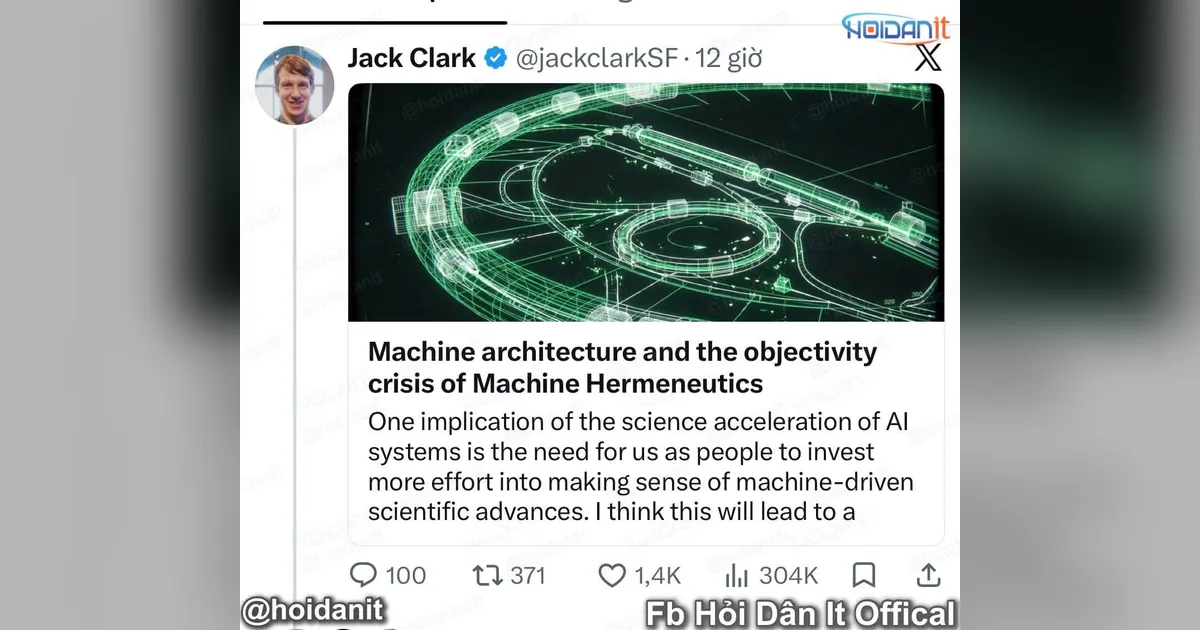
The Objectivity Crisis: When AI Creates the Discovery, Explains It, and Verifies It — Who Is Verifying Whom?
Vũ Khôi
Tác giả tại Wotech Electronics Blog
The Objectivity Crisis: When AI Creates the Discovery, Explains It, and Verifies It — Who Is Verifying Whom?
Just hours after share 150 went live, Vu sent another post about the same Jack Clark story — but this time, the best part isn't the claim that "the singularity has begun". It's a phrase share 150 only managed to mention in passing, in the title of Clark's X post: "Objectivity Crisis". This article stands on its own because its second half is an entirely new angle: AI creates the discovery, AI builds the tool to explain it, AI provides the method to verify it — and humans rely on everything AI provides to decide whether AI's discovery is trustworthy. So who is actually verifying whom?
Quick answer: This is the same Jack Clark (Anthropic co-founder) story as share 150 — the Per Jacobsson Lecture at the IMF in Bangkok on October 17, 2026, the declaration that the singularity began in 2026, the prospect of 10 million human scientists coordinating 1 billion AI scientists, the forecast of US GDP rising about 50% in 4 years based on an internal Anthropic model (his own forecast, unverified, no consensus). The new part of this post lies in two places: first, the full translation of the fictional short story in Import AI issue 482 — the memoir of a Machine Hermeneutics investigator in 2033, with details share 150 didn't tell (the building is a giant model of a proposed "Upgrade Device"; investigators once became electrons inside 3D transistors, became qubits inside nauseatingly spinning spheres, once walked nearly 10 km through corridors simulating plasma flow inside a fusion reactor; and the strange feeling that while devoting all their effort to understanding machine-made products, they were also being taught to think like machines). Second — and more important — the concept of the "Objectivity Crisis" the post's author draws out: AI creates the discovery, AI builds the explanation tool, AI provides the verification method, and humans rely on everything AI provides to decide whether the discovery is trustworthy. The author connects it straight to everyday work: in vibe coding, AI designs the architecture, AI writes the code, AI writes the unit tests, AI reviews the code, AI fixes the bugs it created itself — humans see green tests, skim once, and press Merge. AI takes 5 minutes to write a feature, but a developer may take 5 hours to really understand it. The most expensive resource in the AI era may no longer be the ability to create code, but the ability to understand what AI creates — and the post's closing question is worth every programmer asking themselves: "Humans still keep the right to press the button. But do humans still really keep control?"
Machine Hermeneutics — as Clark uses it — is the new intellectual field devoted to interpreting and decoding knowledge created by machines. The "Objectivity Crisis" is the phrase the post's author uses to name the situation: when the entire chain of creating, explaining and verifying a discovery is performed by AI, where does the objectivity of that verification lie?
The same story, a new angle
The first half of this post overlaps share 150 — the same Per Jacobsson Lecture, the same definition of the singularity (AI-driven progress outpacing humans' ability to track and understand it), the same 2026 marker, the same prospect of 10 million human scientists coordinating 1 billion AI scientists, the same forecast of US GDP rising about 50% in 4 years on an internal Anthropic model. This post also states the same boundary: these are Jack Clark's own definition and forecast, not a conclusion the scientific community has agreed on or numbers that have already happened.
The account @kimmonismus later quoted the exact line "The singularity which has already begun" and commented that no one denies it anymore.
Since share 150 covered that part in full, this article only summarizes it as background — and spends most of its length on the two things share 150 didn't have: the translated short story and the "objectivity crisis" concept.
The translated short story: memoir of an investigator in 2033
This post translates the full fictional short story in Import AI issue 482 — told as the memoir of a senior Machine Hermeneutics investigator in 2033. Share 150 summarized the story's frame; this translation shows far more vivid details:
The story opens with Winston Churchill's 1943 line: "We shape our buildings; thereafter they shape us."
The building in the story is a giant model representing a proposed "Upgrade Device". A small group of humans — the finest individuals of their species — walk around it with the task of understanding the building and explaining the science it represents. Only after completing that task may the device be put into use. That is the requirement of the Sentience Treaty: any new machine-designed knowledge or device must be fully explained by humans before machines may use it.
In the early years, this "proof of concept" process was mostly a matter of time: machines did scientific research and brought new understanding to the world; humans studied, learned, and produced explanations others could read and understand. But as machines grew more advanced, the work became harder: machines invented new ideas, used those ideas to design new experimental devices, then used those devices as the foundation for further discoveries. To keep up, humans had to understand every link in the chain of invention, and how the whole chain worked.
From this, Didactic Architecture was born: giant architectural works designed to help Machine Hermeneutics experts better understand, conceptually, what machines had created. The early versions were crude — barely more than 3D-printed objects placed inside houses. But exposure to them proved able to accelerate human understanding: groups that experienced the buildings showed clear improvement in TTHUE (Time-to-Human-Understandable-Explanation) compared to groups that didn't.
Then the story tells specific experiences — and this is where the translation makes the prospect feel realer than any summary:
- All of them once became electrons, appearing and disappearing inside 3D transistors.
- They once became qubits, placed inside spheres spinning so fast it was nauseating, their states uncertain until fixed as up or down at the moment an answer was given.
- They once placed their hands on surfaces designed to reproduce the texture and arrangement of new heat shields and solar panels.
- Once, the narrator walked six miles — nearly 10 km — through corridors designed to simulate the path of a plasma stream inside a fusion reactor. Instead of magnets, winds from every direction constantly pushed him toward the center of the passageways.
But this building is bigger than any they had seen — filled with ideas from many earlier machine inventions. As night fell, the group gathered in the entrance hall for a meager dinner served on a low table — and realized they were whispering to each other, though no one had asked them to. Then a strange feeling appeared: the building seemed to be doing something far beyond teaching them. Inside the different rooms, something else was also being conveyed — something about understanding the minds behind the concepts the building was trying to explain.
The story's closing line is the most memorable — and the bridge to the second part of the post:
"Perhaps, in devoting all our effort to understanding the products machines create, we are also being taught to think like them. And to behave like them."
The "Objectivity Crisis"
This is the part the post's author finds most worth thinking about — and the part share 150 didn't explore.
Imagine this chain:
- AI creates a discovery.
- AI builds the tool to explain the discovery.
- AI provides the method for humans to verify the discovery.
- And finally, humans rely on everything AI provides to decide whether AI's discovery is trustworthy.
So who is actually verifying whom?
This question is sharper than "is the AI right". It asks about the structure of verification: when the verifier only has tools created by the very thing being verified, what does "independent verification" even mean? It's the same question earlier Wotech articles asked from many angles: share 144 (every proof must pass Lean 4 and an independent blind audit — AI is not allowed to declare itself right), share 149 (acceptance with real evidence: a real DB query, a real API test — not AI's word), share 137 ("don't loop on confidence, loop on evidence"). What's new here is that Clark — through the post author's pen — points out that even the "evidence" can be produced by AI, and then the verification loop closes from the inside.
No need to wait until 2033: vibe coding every day
The post's author doesn't leave this question in 2033. He connects it straight to everyday work — and this passage is probably why the post gets shared so much:
Look at how we vibe code every day:
- AI designs the architecture.
- AI writes the code.
- AI writes the unit tests.
- AI reviews the code.
- AI fixes the bugs it created itself.
- Humans see green tests, skim once, and press Merge.
A few weeks later, production breaks. The whole team looks at the codebase and discovers no one really understands why the system was designed that way.
AI can take 5 minutes to write a feature, but a developer can take 5 hours to really understand it. As the speed of code creation increases dozens of times over, humans' ability to read, understand and verify it hasn't necessarily increased at all.
This is the miniature version of the "objectivity crisis": tests written by AI to verify code written by AI; reviews done by AI to evaluate code written by AI; and humans approving based on signals AI itself generated. The difference from the fictional story: in the story, at least there is a treaty requiring humans to understand before use. In everyday work, there is no treaty — only the Merge button.
The most expensive resource is no longer creating code
The post closes with a forecast the author finds scarier than "AI will replace programmers":
Perhaps the most expensive resource in the AI era will no longer be the ability to create code. It will be the ability to understand what AI creates.
We used to worry AI would make programmers lose their jobs. But there's another prospect: programmers keep their jobs, keep their salaries, keep sitting in front of screens every day — only their work gradually becomes approving things they no longer have the ability to understand deeply.
Humans still keep the right to press the button. But do humans still really keep control?
The closing question for readers is a self-check anyone can do tonight: look back at your last 10 AI-written pull requests — how many do you really understand, and how many were merged just because they ran correctly?
Apply it now
- Self-check your last 10 AI-written PRs: how many do you really understand, how many were merged just because "it ran fine"? The second number is the level of "objectivity crisis" in your own work — and it can be measured tonight, no need to wait until 2033.
- Don't let AI verify itself: tests written by AI to verify code written by AI are not independent verification — write at least one test yourself from the business requirement (without looking at the AI's code first), or review by running the real behavior instead of just reading code. This is the everyday version of the "blind audit" in share 144 and "acceptance with evidence" in share 149.
- Set an "understand before merging" limit: if you can't explain why a piece of AI-written code works, don't merge — ask the AI to explain it, read it again, or ask for a simpler rewrite until you understand. The Merge button is the last boundary humans still hold; don't press it blindly.
- Shorten your own "5 hours to understand 5 minutes of code": after AI finishes a feature, spend 15 minutes restating it in your own words: what the feature does, what steps the data goes through, what will break first when something fails. Those 15 minutes are your own TTHUE — and they're far cheaper than a night rescuing production.
- Read forecasts as forecasts: the "GDP up 50% in 4 years" figure and the "10 million scientists coordinating 1 billion AI scientists" prospect are Clark's own forecasts from an internal Anthropic model — the original post says so, and share 150 recorded that boundary. Don't use them as established facts to decide anything.
Frequently asked questions
1. How does this article differ from share 150? The same Jack Clark story (IMF lecture October 17, 2026, singularity begun in 2026, 10 million scientists coordinating 1 billion AI scientists, GDP +50%). Share 150 covered that part in full. This article stands alone because its second half is entirely new: the full translation of the Import AI 482 short story (the 2033 investigator's memoir, the Sentience Treaty, Didactic Architecture, TTHUE, the 10 km plasma-corridor walk) and the "Objectivity Crisis" concept — AI creating, explaining and verifying its own discoveries — connected to everyday vibe coding.
2. What does "Objectivity Crisis" mean? It's the situation the post's author names: AI creates the discovery, AI builds the tool to explain it, AI provides the verification method, and humans rely on everything AI provides to decide whether the discovery is trustworthy. The core question: when the verifier only has tools created by the very thing being verified, what does "independent verification" even mean?
3. Is the short story in Import AI 482 real? No — it's fiction written by Clark, told as the memoir of a Machine Hermeneutics investigator in 2033. The details (Sentience Treaty, Didactic Architecture, TTHUE, the 10 km plasma walk, becoming electrons/qubits) are all imagined. The Churchill quote from 1943 at the story's opening is real.
4. How does vibe coding relate to the "objectivity crisis"? It's the everyday miniature version: AI designs the architecture, writes the code, writes the unit tests, reviews the code, fixes the bugs it created itself — humans see green tests and press Merge. Tests written by AI to verify code written by AI are not independent verification. AI takes 5 minutes to write a feature; a developer may take 5 hours to understand it.
5. So what should programmers do? According to the post: keep the ability to understand — self-check your last 10 AI-written PRs, don't let AI verify itself (write tests from business requirements, run real behavior), set an "understand before merging" limit, and shorten understanding time by restating each feature in your own words. The most expensive resource in the AI era is no longer creating code, but understanding what AI creates.
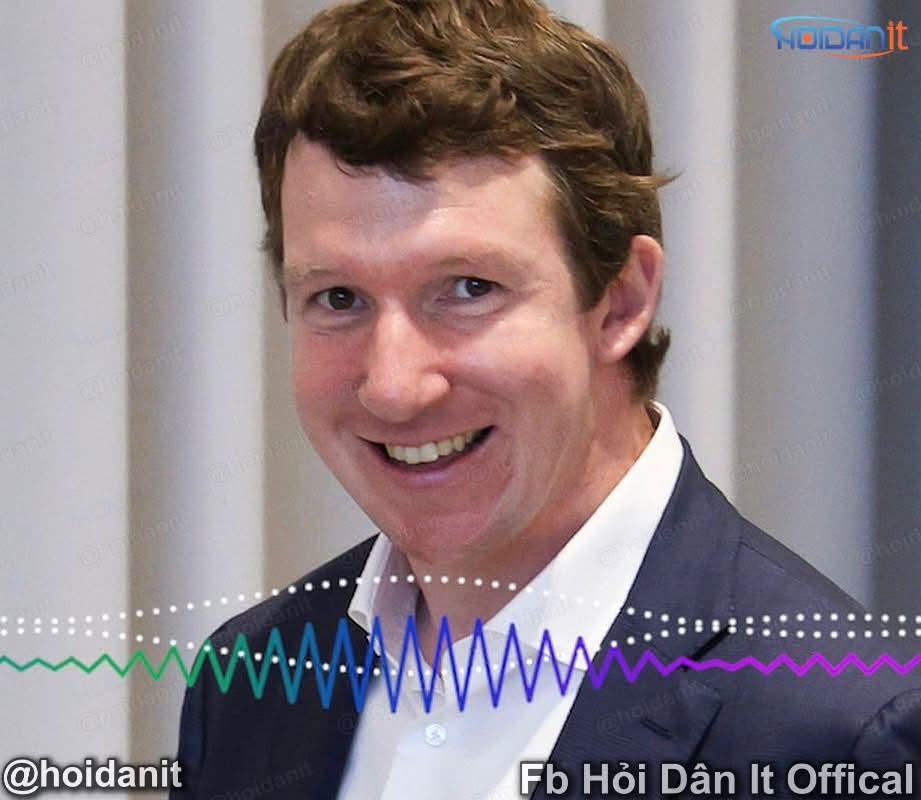
Source: Facebook post by the page "Hỏi Dân it Offical" (November 28, 2026), summarizing and translating Jack Clark's (Anthropic co-founder) short story in Import AI issue 482, with the post author's analysis of the "Objectivity Crisis" and vibe coding. The first half of the post (IMF lecture, singularity, 10 million/1 billion scientists, GDP +50%) overlaps share 150 and is summarized briefly here — see share 150 for the full version, including verification via the IMF (F&D, November 20, 2026) and Import AI issues 477/480. The fictional-story details are recorded as the post's translation describes them. The cover is the screenshot of Clark's X post attached to the post; the human/machine-hand illustration and Clark's portrait are kept as mid-body images.
Bài viết liên quan

28 tháng 11, 2026 · 14 phut doc
Claude Code's Creator Hasn't Written a Single Line of Code by Hand in 2026, Record 150 Pull Requests a Day: 16 Lessons for Building Products in the AI Era
While many programmers are still debating whether AI writes code as well as humans, the creator of Claude Code has moved to an entirely different stage: he no longer writes code directly. Boris Chern…

28 tháng 11, 2026 · 13 phut doc
As AI Reshapes IT, What Value Should Tech People Keep and Develop?
A business manager who also works in HR has written a long post about the 2026 wave of IT layoffs, along with a question many in the industry are probably asking themselves: if AI can do the job inst…

28 tháng 11, 2026 · 17 phut doc
History Is Repeating Itself, Only Much Faster This Time: Young People Lose the First Rung, Tiny Companies Earn Hundreds of Millions
Entry-level job postings in the US fell 35% in just 18 months. Youth aged 15–24 in Canada face 13.7% unemployment, double the general rate. Meanwhile, there are companies with only a handful of peopl…