
What Is Personal Income Tax Withholding? Rules, Purpose, and Meaning of Withholding Tax at Source
Vũ Khôi
Tác giả tại Wotech Electronics Blog
What Is Personal Income Tax Withholding? Rules, Purpose, and Meaning of Withholding Tax at Source
Vũ Khôi
Author at Wotech Electronics Blog
Every individual covered by the law's provisions must pay personal income tax (PIT) to the State Budget. However, not every case involves individuals paying directly — payment is completed through the tax withholding method. So what is PIT withholding? And who performs it? To answer these questions, let's explore this with SimERP in the article below.
What is personal income tax withholding?
Personal income tax withholding is the activity performed by individuals or businesses obligated to pay wages or income to workers, in which the corresponding PIT amount is deducted from the worker's salary before payment is made.

Subjects in this PIT withholding case are issued PIT withholding certificates; specifically, the subjects issued certificates include:
- Individuals who directly request a PIT withholding certificate will be issued one by the business.
Note: If there is no request, the managing business will not issue one.
- In cases where an individual authorizes the business to finalize their PIT, the managing business is not permitted to issue a PIT withholding certificate.
However, there are some exceptions: for people without a labor contract with the business, or with contracts of less than 3 months' duration, the managing business is not entitled to issue a fixed PIT withholding certificate and can only issue a separate certificate for each withholding.
Alternatively, the managing business may issue a single PIT withholding certificate that can be used multiple times within one tax period.
For individuals with labor contracts longer than 3 months, the managing business must issue the individual one certificate per tax period.
PIT withholding rules
First, for the income of non-resident individuals
Organizations, individuals, and managing businesses that pay taxable income to non-resident individuals are responsible for withholding PIT before paying the income.
Second, for the income of resident individuals
Income from wages or salaries
For resident individuals signing labor contracts of three months or longer, the organization, individual, or managing business will withhold tax under the Partial Progressive Tax Schedule, including cases where an individual signs contracts of three months or longer at multiple places.
For resident individuals who signed labor contracts of three months or longer but stopped working before the contract ended, the organization, individual, or managing business paying the income still withholds personal income tax under the Partial Progressive Tax Schedule.
For foreign individuals coming to work in Vietnam, the organization, individual, or managing business paying income bases the withholding on the taxpayer's actual working time in Vietnam. This duration is stated in the Contract or the dispatch document, and is used to provisionally withhold tax under the Partial Progressive Schedule (for individuals working 183 days or more in Vietnam within the tax year) or under the Full Tax Schedule (for individuals working fewer than 183 days in Vietnam within the tax year).
Insurance companies and pension fund management companies are responsible for withholding PIT on the accumulated amounts used to purchase non-compulsory insurance and contributions to voluntary pension funds, as guided in Clause 6, Article 7 of this Circular.
Income from insurance agency, lottery, and multi-level sales activities
Lottery companies, insurance businesses, and multi-level sales businesses that pay income to individuals working as lottery or insurance agents or participating in multi-level sales networks are responsible for withholding PIT before paying income to the individual.
Income from capital investment
Organizations, individuals, and managing businesses paying income from capital investment are responsible for withholding PIT before paying income to the individual, except where the individual has already self-declared the tax.
Income from securities transfers
All securities transfers are subject to tax withholding at a rate of 0.1% on the transfer price before payment is made to the transferor.
Income from the transfer of capital contributions by non-resident individuals
Organizations, individuals, and managing businesses receiving transfers of capital contributions from non-resident individuals are responsible for withholding PIT at a rate of 0.1% on the value of the transferred capital contribution.
Income from winnings
The organization paying the prize is responsible for withholding PIT before paying the winners.
Income from royalties or franchising activities
Organizations, individuals, and managing businesses paying income from royalties or franchising are responsible for withholding PIT before paying the income. The tax withheld is determined on the portion of income exceeding 10 million VND per transfer contract, multiplied by the 5% rate. For large-value contracts paid in multiple installments, on the first payment the organization, individual, or managing business paying the income deducts 10 million VND from the payment value; the remainder is multiplied by the 5% rate for tax withholding. Subsequent payments are subject to PIT withholding calculated on the total amount of each payment.
PIT withholding rates

Organizations, individuals, and managing businesses that pay salaries, remuneration, or other payments to resident individuals without a contract, or with labor contracts under three months, whose total income is 2,000,000 VND or more per payment, must withhold tax at 10% of the income before paying it to the worker.
Withholding personal income tax at source

Withholding PIT at source is stipulated in Article 28, Decree 65/2013/ND-CP. Under this provision, withholding PIT at source is when an organization, individual, or managing business paying income deducts the amount payable from the actual income of the individual taxpayer before paying the income.
PIT withheld at source is a form of income tax that the tax authority collects by directly deducting it from the money the income payer gives to the income recipient.
The responsibility for withholding PIT when paying income to individuals at an enterprise is stipulated in Clause 1, Article 31 of Decree 65/2013/ND-CP. Accordingly, when the business owner pays wages to workers, they do not hand over the full salary stated in the labor contract but must retain part of that salary to hand over to the tax authority. This is the salary tax that must be paid, because that worker has an income source from wages. In this case, that salary tax exists in the form of tax withheld at source.
Purpose and meaning

Applying PIT withholding at source creates many advantages for tax collection and contributes to managing tax payment effectively, minimizing tax evasion by those subject to PIT. This is the greatest purpose of applying personal income tax withholding at source.
For domestic individuals with income from multiple places, tax payment and tax finalization are handled as follows: monthly income tax is withheld directly at each place of income payment, and at year's end the taxpayer declares and finalizes at their last workplace of the year. This method makes tax collection easier and faster, more convenient for both the tax authority and those obligated to pay tax.
Example: When a publishing house pays an author royalties, it does not hand over the full amount stated in the contract; instead, the publisher retains part of it to pay to the tax authority — that is the royalty tax the author must pay because the author's income is the royalty. This is a form of PIT withheld at source.
If an individual has income from many sources but PIT withholding at source is not applied, it is very difficult for the tax authority to know whether that individual has committed fraud in declaring and paying tax. For this reason, applying PIT withholding at source is an extremely effective way to limit tax evasion by workers.
If an individual does not yet qualify to pay PIT but tax is still withheld, that individual will be refunded the tax.
Rules for withholding PIT at source

PIT withholding at source applies to the following cases:
-
Seasonal workers, collaborators, or workers with labor contracts under 3 months whose monthly salary is less than 2,000,000 VND are not subject to 10% PIT withholding.
-
The individuals above, if earning more than 2,000,000 VND/month, must have 10% PIT withheld.
-
Seasonal workers, collaborators, or workers with labor contracts under 3 months who have a personal tax code, have income from only one place with an actual take-home amount below the tax threshold, and make a commitment on form 02/CK-TNCN are not subject to 10% PIT withholding.
-
Individuals with labor contracts longer than 3 months have PIT withheld under the partial progressive tax schedule.
-
Individuals earning wage or salary income who are non-residents have 20% withheld on their total wage or salary income.
What is a PIT withholding certificate?
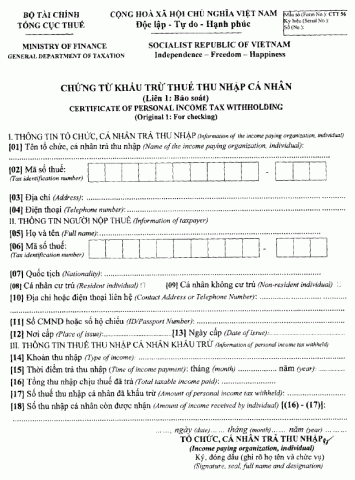
A PIT withholding certificate is a written confirmation issued by the organization, individual, or managing business paying income, confirming the deduction of the tax payable from the individual taxpayer's income before payment, at the request of the person whose tax was withheld.
Who receives a PIT withholding certificate?
Under the provisions of Clause 2, Article 25 of Circular 111/2013/TT-BTC:
Individuals who request a PIT withholding certificate must be issued one by the business.
If an individual does not request a PIT withholding certificate, no certificate needs to be issued.
If the individual authorizes the business to finalize the tax, the business does not issue a PIT withholding certificate.

Example 1: Mr. A signed a long-term labor contract with company B from April 2017 to the end of March 2018. Each month Mr. A had to pay personal income tax, and the managing business withheld his PIT. If Mr. A is among those who must finalize tax directly with the tax authority and requests the business to issue a withholding certificate, then:
-
The business will issue a PIT withholding table reflecting the tax withheld from April 2017 to the end of December 2017.
-
The business will issue a PIT withholding certificate reflecting the tax withheld from January 2018 to the end of March 2018.
Example 2: Mr. C signed a long-term labor contract with company D from April 2017 to the end of March 2018. Each month Mr. C had to pay PIT, and the managing business withheld his PIT.
If Mr. C authorizes the managing business to finalize his PIT, the business does not have to issue a PIT withholding certificate.
If Mr. C finalizes his own PIT but does not request a withholding certificate from the managing business, the business does not have to issue one for Mr. C.
Cases where personal income tax is not withheld
Point i, Clause 1, Article 25 of Circular 111/2013/TT-BTC stipulates that workers with labor contracts under 3 months and total monthly income of 2,000,000 VND or more must have 10% of their income withheld as tax.
However, if the worker's only income is of the type subject to the 10% withholding above, and their estimated total taxable income after the family deduction has not reached the tax threshold, that individual makes a commitment on form 02/CK-TNCN (under Circular 92/2015/TT-BTC) and sends it to the organization or individual paying income, as the basis for provisionally not withholding PIT.
PIT withholding for dependents

The deductions from taxable income before determining chargeable income from wages, salaries, and business activities include: insurance contributions; family deductions; voluntary pension funds; and humanitarian, charitable, and education-promotion contributions as stipulated in Article 9 of Circular 111/2013/TT-BTC and Article 15 of Circular 92/2015/TT-BTC.
In this article, SimERP will explore the family deduction under the law, specifically the family deduction for dependents.
For resident individuals who have income from both business activities and wages or salaries, the family deduction is calculated once against the total income from business activities and from wages or salaries.
The family deduction amounts are specifically stipulated as follows:
-
For the taxpayer: 9 million VND per month, equivalent to 108 million VND per year.
-
For each dependent: 3.6 million VND per month, equivalent to 43.2 million VND per year.
The taxpayer is entitled to the family deduction for dependents if the taxpayer has registered for tax and been issued a tax code.
When the taxpayer registers the family deduction for dependents, the tax authority will issue a tax code for the dependent, and the deduction is provisionally calculated from the year of registration onward.
If the taxpayer did not apply the family deduction for dependents during the tax year, the deduction for dependents is calculated starting from the month the support obligation arose, when the taxpayer finalizes their tax and has registered the family deduction for dependents.
Each dependent may only have the family deduction applied once, to one taxpayer, in a tax year. Where multiple taxpayers share a dependent they must support, the taxpayers agree among themselves to register the deduction with one taxpayer.
Conclusion
Having explored the basic information about the PIT withholding method, we hope you now understand the issue better and have the most complete overview of it. If you have any further questions related to this article, leave a question below to get the earliest answer from SimERP. See you in SimERP's next articles!
Related articles
Bài viết liên quan

25 tháng 10, 2026 · 3 phut doc
2024年网页设计趋势预测如何? | Wotech Electronics
关于 2024 年网页设计趋势——步入 2024 年,年初正是我们为新事物预留时间的时刻。这也非常适合设计师群体唤醒我们内心的"艺术之魂"。闲话不多说,快来和 Markdao 一起浏览 2024 年的 UX/UI 设计趋势吧,说不定您就能为自己接下来的网页设计项目"迸发"出一个绝妙的点子呢!

25 tháng 10, 2026 · 1 phut doc
什么是网站(Website)?网站的详细定义及其带来的商业价值
什么是网站(https://www.markdao.com.vn/blog/website-la-gi)——这个问题或许已经无需定义,因为在如今这个信息时代,网站对每一家企业而言都是不可或缺的组成部分。正是网站帮助用户更近距离地接触企业所提供的产品和服务,从而提升经营效益。此外,要在当今竞争如此激烈的环境中求发展,网站是一个重要因素,它将带你走向品牌与销量上的双重成功。

25 tháng 10, 2026 · 1 phut doc
什么是SEO标准网站?一场"打赢"Google SEO标准的战役 | Wotech Electronics
99%的用户在购买前会先搜索信息,73%的用户只会访问排名前10的网站,并认定它们是值得信赖的品牌……在数字营销爆发的时代,这些数字有力地印证了SEO标准网站的重要性。然而,许多人对什么是SEO标准网站(https://www.markdao.com.vn/blog/huong-dan-toi-uu-seo-website-chuan-seo-on-page)仍然相当模糊,并未真正理解。达到SE…