
What Is Customer Behavior Research? What Methods Are There? | Wotech Electronics
Vũ Khôi
Tác giả tại Wotech Electronics Blog
What Is Customer Behavior Research? What Methods Are There?
Vũ Khôi
Author at Wotech Electronics Blog
The development of the digital technology era has made it easier for businesses to apply scientific and technological advances to improve the customer experience, increase sales and reduce costs more effectively. The biggest challenge, however, is an increasingly fierce competitive environment, which requires businesses to promptly grasp consumer needs and behavior in order to find suitable solutions that raise their competitiveness. That is why researching customer behavior is an indispensable activity in any effective business strategy.
What is customer behavior research?
Customer behavior includes customers' psychology — their thoughts, feelings and reactions to products/services — and all of the customer's activities during the consumption process, such as the decision to buy, use or stop using a product.
Customer behavior research covers all of an individual's behaviors related to decision-making, which are mutable and therefore subject to many different influencing factors, whether internal or from the external environment — such as advertising, recommendations from people who have experienced the product/service, pricing information, new trends and more.
These factors can determine consumer activities across the customer experience journey map below.
Customer experience journey map
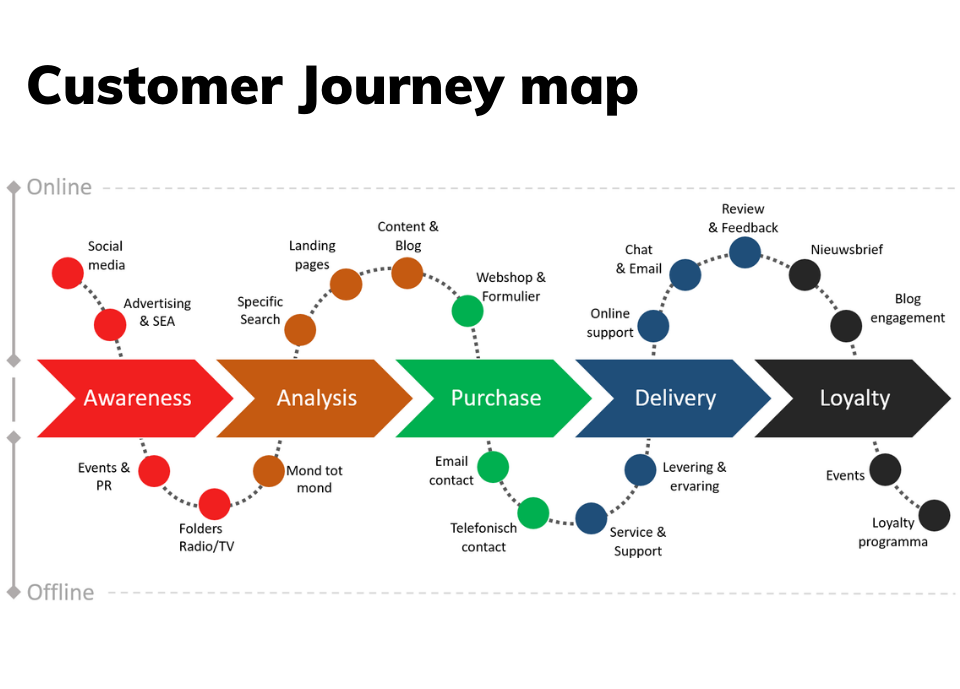
The customer experience map above is divided into 5 stages as follows:
Need recognition
The customer's buying journey begins when they develop a need related to a product/service. When the desire reaches a certain peak, the customer forms a motive that drives action to satisfy their wish.
Information search
The customer searches for information about products/services that meet their needs from many different sources, such as personal sources (reviews from others, recommendations from family), experiential sources (distilled from the customer's own experience), and commercial sources (advertising, product information, website news, etc.).
Evaluation of alternatives
In the customer journey, this is the stage where they weigh and evaluate products from different brands to choose the one that suits them best.
Purchase decision and purchase action
Making the decision to buy and carrying out the purchase. At this stage, 2 main factors influence customer behavior: the attitudes of others and unexpected situations.
Post-purchase reaction
This is the final stage of the customer experience model. At this stage, the customer's impressions and reactions to the product or service are formed and expressed, influencing their next purchasing decision.
Why research customer behavior?
In this era of integration, the market is increasingly competitive, customer needs constantly change, and customers have more choices to compare than ever. Researching customer behavior helps a business accurately understand customers' psychology, decisions and the factors influencing those decisions, and thereby build a customer experience that drives purchasing activity.
Some benefits of researching behavior and designing the customer experience:
Target the right potential customers
Identifying the right potential customers is a critical activity in any business, determining the effectiveness of marketing campaigns and business operations. To do this, beyond market research, you need to thoroughly research customer behavior to find the customer group whose needs, behavior and personality match your product's characteristics and your company's business goals.
Personalize the customer experience

Personalization is when a business uses the information collected from customers to create promotional campaigns aimed precisely at the target customer group.
Through customer behavior research, the business gains more information about its target customers and can easily segment them by needs, behavior and preferences, so it can build strategies that enhance the experience of each group. Especially in today's era of rapid development, when customer needs are ever higher and constantly changing, personalizing the customer experience helps the business attract customers, raise satisfaction and retain them effectively. This is also one of the most important customer experience strategies.
Optimize campaigns
The data collected through customer behavior research is a vital foundation for building effective marketing campaigns. By segmenting customers and delivering the message to the right audience at the right time, you increase your chances of reaching and engaging customers and improve conversion. In addition, knowing and clearly understanding the factors that influence purchasing decisions helps you predict well and plan adjustments to respond appropriately when customers change their purchasing decisions. From there, you can create a customer experience process that fits.
Retain customers effectively
By researching customer behavior, you learn what customers really do and don't want, so you can devise suitable solutions to remove obstacles in the purchasing process and encourage them to use your products/services. According to a study by Bain & Company, if you can raise your customer retention rate by 5%, your business's profits will increase by 25–95%.
Factors influencing customer behavior

One of the essential tasks in customer behavior research is identifying the factors that influence customers' consumption behavior. Consumer behavior is influenced by both internal factors and external factors, such as:
Cultural factors
-
Culture: a key factor to analyze in every market entry campaign targeting an unexplored market. Knowing the characteristics of each culture and choosing the one that fits the company's goals helps you deliver your campaign's message more effectively.
-
Subculture: groups of people who share a lifestyle, moral norms, patterns of behavior and so on, coexisting within one country. Identifying these cultural groups helps the business segment its customers and personalize better.
Social factors
-
Community: the promotion of products/services among a community by word of mouth. This method greatly influences customer behavior.
-
Social media: platforms where users connect with one another via the Internet. Through these channels, people can freely express their views and opinions, with large traffic and engagement. This is therefore a promising channel that businesses are emphasizing in customer behavior research.
-
Social class: the ranking of status among groups of people. People in different social classes will have different behaviors and needs regarding a product/service.
-
Family: each family member can, through words and actions, directly or indirectly influence a customer's behavior.
-
Status: customers tend to choose products/services that express their status in their various roles.
Personal factors

-
Age: at each different age, customers have different needs for products/services.
-
Gender: product consumption needs differ and align with each customer's gender.
-
Occupation: depending on the nature of their work, customers tend to consume suitable products.
-
Personality and appearance: each person's environment shapes a different personality, and so their shopping needs also differ. For example, a free-spirited person pays little attention to a product's price. In addition, appearance determines which products customers choose to suit their looks.
-
Lifestyle: this factor is formed from experiences, self-cultivated knowledge, and distilled personal character. Because each of its components differs from person to person, consumer behavior differs too.
Psychological factors
-
Motivation: the impulse that drives a customer to act once a need for a product/service has formed. The motivation may be to meet an essential need, a desire to express individuality, a wish to try a new experience, and so on — leading to actions in the purchasing process.
-
Perception: the customer's process of selecting information, comprising 3 states: selective attention (paying attention only to products/services the customer cares about), selective interpretation (decoding the information they previously received), and selective retention (remembering the good features of the products they use, while usually ignoring the good features of other products).
-
Learning: the things a person distills for themselves based on life experience.
-
Beliefs: the ways of thinking that guide all of a customer's own activities.
-
Attitudes: how one reacts to every experience and situation that occurs in life.
Methods for researching customer behavior

Customer behavior research is a process that must be planned carefully and in detail. To implement the plan effectively, choosing the right and suitable method is essential.
Qualitative customer behavior research methods
Qualitative research means asking in-depth, open-ended questions — from the brand to the customer — to dig deep into psychology and most truthfully reflect customers' feelings, wishes, motivations and behavior toward a product/service. After conducting it, you will be able to answer questions such as "Why did the customer choose this product or service?", "Which factors influence the customer's buying behavior?", and more.
This research method has 3 main forms:
Focus groups
A focus group is a group interview method that brings researchers together to discuss a set topic, usually with 6–10 people. The group runs smoothly under the supervision of a moderator, with the aim of producing opinions and solutions for a problem.
Using this method earns you many valuable opinions as well as useful advice. However, it incurs costs for inviting the researchers and organizing a meeting. Also, receiving contradictory opinions and heated debates is unavoidable if the moderator has no satisfactory way to handle them.
One-on-one interviews
In this method, researchers ask open-ended questions to customers to collect data from them. This gives you immediate survey feedback with high-value information.
However, this method demands a high level of expertise in framing questions that meet the research objectives. It is therefore time-consuming and labor-intensive for the business — you may even have to conduct interviews repeatedly with many subjects before obtaining the desired results.
Content and context analysis
Context analysis is when the researcher analyzes social life by decoding words and images from existing documents. This method is usually applied to social media — where users connect and interact with each other the most — from which conclusions about customer behavior are drawn.
This method is useful for collecting valuable information quickly. However, the market is always changing, and this method is not optimal for gathering information when the business's goal is to study customer behavior toward the specific products/services it offers.
Quantitative customer behavior research methods
This is the method of drawing conclusions about customer behavior by analyzing information in databases and figures collected from customers. These data can be gathered from 2 main sources:
Secondary data sources
These are readily available data sources you can find yourself, such as scientific research papers, report tables from the general statistics office, and the results of activities and studies by businesses and non-profit organizations.
Primary data sources
Primary data sources are analyses performed by the business itself through customer behavior surveys.
Some notes on creating customer surveys
-
Define a suitable number of objectives: customer needs and behavior are always changing, so cramming too many objectives into one study will cause errors in the data and produce unwanted results.
-
Design the survey to fit the target audience: the study's topic, as well as the target customer survey script, must be aligned with the goals the company has set. Identifying the right users to take the survey is therefore very important for collecting data on the correct research topic.
-
The survey should be concise, with simple, easy-to-understand language.
Conclusion: Customer behavior research helps a business identify the right target customers and run, evaluate and measure its marketing campaigns effectively. With the insights shared above, SimERP hopes you can design a research plan that fits your needs and business goals.
Related articles
Bài viết liên quan

25 tháng 10, 2026 · 3 phut doc
2024年网页设计趋势预测如何? | Wotech Electronics
关于 2024 年网页设计趋势——步入 2024 年,年初正是我们为新事物预留时间的时刻。这也非常适合设计师群体唤醒我们内心的"艺术之魂"。闲话不多说,快来和 Markdao 一起浏览 2024 年的 UX/UI 设计趋势吧,说不定您就能为自己接下来的网页设计项目"迸发"出一个绝妙的点子呢!

25 tháng 10, 2026 · 1 phut doc
什么是网站(Website)?网站的详细定义及其带来的商业价值
什么是网站(https://www.markdao.com.vn/blog/website-la-gi)——这个问题或许已经无需定义,因为在如今这个信息时代,网站对每一家企业而言都是不可或缺的组成部分。正是网站帮助用户更近距离地接触企业所提供的产品和服务,从而提升经营效益。此外,要在当今竞争如此激烈的环境中求发展,网站是一个重要因素,它将带你走向品牌与销量上的双重成功。

25 tháng 10, 2026 · 1 phut doc
什么是SEO标准网站?一场"打赢"Google SEO标准的战役 | Wotech Electronics
99%的用户在购买前会先搜索信息,73%的用户只会访问排名前10的网站,并认定它们是值得信赖的品牌……在数字营销爆发的时代,这些数字有力地印证了SEO标准网站的重要性。然而,许多人对什么是SEO标准网站(https://www.markdao.com.vn/blog/huong-dan-toi-uu-seo-website-chuan-seo-on-page)仍然相当模糊,并未真正理解。达到SE…