Customer Satisfaction Research: Role and Influencing Factors | Wotech Electronics
Vũ Khôi
Tác giả tại Wotech Electronics Blog
Customer Satisfaction Research: Role and Influencing Factors
Vũ Khôi
Author at Wotech Electronics Blog
Customer satisfaction is the term used to determine how satisfied customers are after purchasing a product/service. Information on customer satisfaction is drawn from customer satisfaction surveys, which can help a company fix its weaknesses or build on its strengths in the course of doing business. Profit is only the immediate goal a business pursues. Behind it, companies always strive to give customers a satisfying, fulfilling experience with their products/services. Because when customers are satisfied, they stay loyal and remain attached to that company's products/services for the long term. That is why customer satisfaction research is applied by all businesses, large, medium, and small — retailers, wholesalers, and so on. So what must a business do to research customer satisfaction effectively? In this article, SimERP will introduce everything you need to know when researching customer satisfaction.
Factors That Influence Customer Satisfaction
In customer satisfaction research, many factors influence customer satisfaction, and they fall into 3 categories:
Basic Factors
These are the fundamental elements that any product or service must have; they are regarded as the necessary — but not sufficient — condition for customer satisfaction. However, without them, discomfort and dissatisfaction can follow.
For example: in service companies, friendly staff attitudes are a basic factor directly affecting customer satisfaction. If staff are friendly and courteous, customers will be pleased and satisfied. But the opposite leaves customers annoyed and dissatisfied.
Performance Factors
Performance factors are the needs and wants customers state directly. If those wishes are fully met, customer satisfaction follows; if not, customers feel frustrated.
For example: in the same service company, if staff help wholeheartedly and answer every question a customer raises, customer satisfaction results, and so on.
Excitement Factors
This is considered the factor with the most powerful impact on customer satisfaction, because it can activate needs and wants customers did not know they had. And in a competitive market, companies usually push this factor to make themselves stand out against rivals. So pay attention to this factor in your customer satisfaction research.
For example: beyond advising customers fully on all their wishes, service companies often give gifts to customers who show interest in them.
3 Metrics for Evaluating Customer Satisfaction
In customer satisfaction research, organizations typically evaluate customer satisfaction using 3 metrics — the most prominent being Customer Satisfaction Score (CSAT), Customer Effort Score (CES), and Net Promoter Score (NPS):
Customer Satisfaction Score (CSAT)
CSAT is regarded as the simplest method today for surveying and measuring customer satisfaction. The CSAT score is measured with short questions. These appear at the end of a survey about customers' feedback toward the business, after purchase transactions, or when customers interact with the product or service.
Currently, most businesses apply one of these 2 scales to measure CSAT:
The 1-3 scale
This scale has 3 levels:
-
Level 1: Dissatisfied: customers who feel no goodwill toward your product/service; they are the customers who may rate your business poorly.
-
Level 2: Neutral: these are customers with no strong feelings — they neither like nor dislike your company. They could easily swap your product for a competitor's.
-
Level 3: Satisfied: customers with goodwill toward your company's product/service; they will keep supporting your product.
The 1-5 scale
This scale has 5 levels:
-
Level 1 – 1 point (Dissatisfied): when the customer's perception falls short of expectations. That is, the customer will not care about anything of your product/service and may leave your company without any impression — unless they have no other choice. In particular, the customer will have a poor impression and will not speak well of your company to others.
-
Level 2 – 2, 3, 4 points (Satisfied): when the customer's perception matches expectations. This is the mid-range score; most businesses achieve this level. Most customers are neutral in attitude — they are not yet loyal customers. They do not spread anything bad, but they don't speak well of your brand either; they are not loyal to your product. And they may switch to other products/services they feel are more beneficial.
-
Level 3 – 5 points (Very satisfied): when the customer's perception exceeds expectations. This is the highest level when evaluating customer satisfaction. Customers are certainly very happy with your company. They are the loyal customers, who will stay with your products/services for the long term and speak well of your brand to others.

Customer Effort Score (CES)
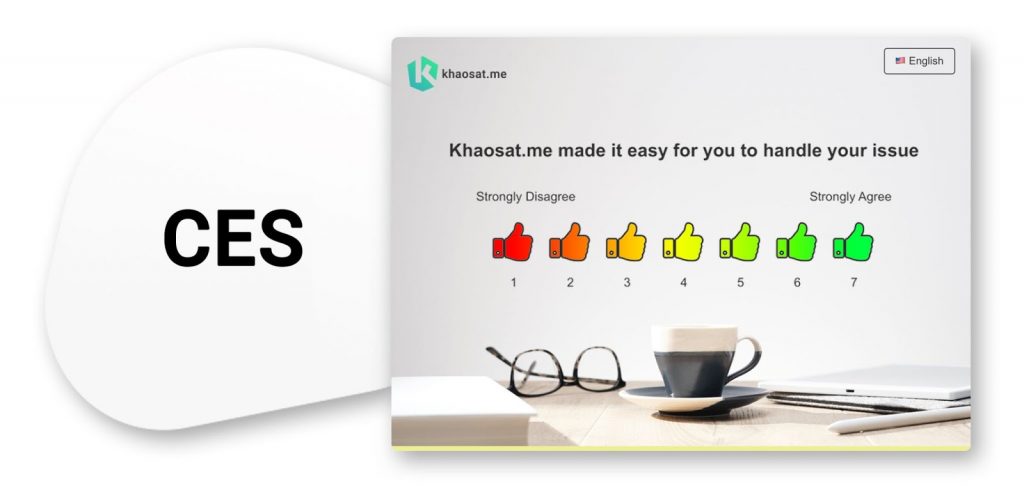
This is the metric used to measure the user's experience with a product or service. Customers rate their experience on a seven-point scale, from "Very difficult" to "Very easy." This determines the amount of effort needed to use the product or service and the likelihood they will keep paying for it. Based on this metric, the business can build convenience for customers, making it easier for them to access and use products and services.
In practice, if customers have a good experience using a product/service, they tend to come back and use it many more times. That is the real key to business in today's increasingly competitive environment.
CES is a measure from the customer's point of view and usually asks just one question: "How much effort did you have to put in to do A with our company?" On a scale from 1 to 7, level 1 corresponds to Very difficult, up to level 7, Very easy.
-
CES from 0-3: poor customer experience
-
CES from 4-5: average experience
-
CES from 6-7: good experience
You can refer to the sample survey from khaosat.me below:
Net Promoter Score (NPS)
This is the standard and metric for measuring customer satisfaction by gauging how likely they are to recommend the brand to friends and relatives. NPS is the standard companies use to measure, evaluate, and improve customer loyalty. If you always believe the concept of "loyal customer" is only relative, then finding and managing the NPS score is a powerful tool that helps the business increase competitiveness and keep customers coming back.
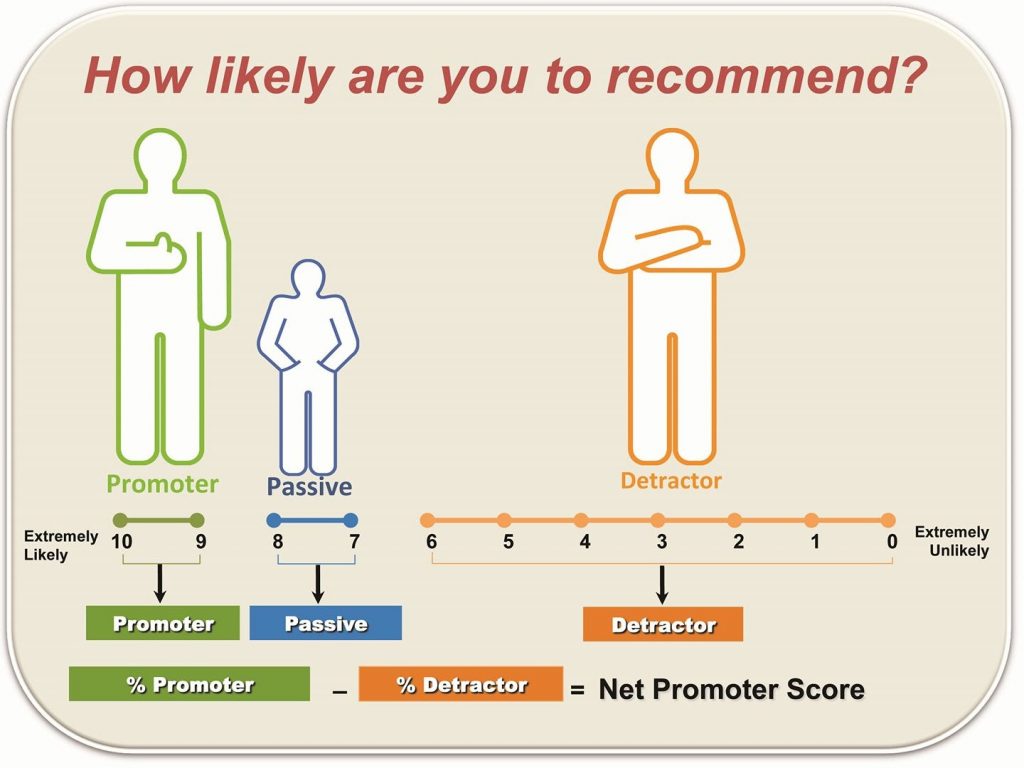
Survey your customers and ask them, "On a scale from 0 to 10, how likely are you to recommend us to a friend?"
Classify respondents by their score: 0-6 are Detractors, 7-8 are Passives, and 9-10 are Promoters.
Ignoring the Passives, subtract the percentage of Detractor responses from the percentage of Promoter responses to determine your Net Promoter Score. This score can range from -100 to 100.
To calculate your NPS, you must first survey your customers. NPS is the typical answer to the question "On a scale from 0 to 10, how likely are you to recommend us to a friend?"
The answers to this question can be classified into three groups:
-
Promoters: customers who answer the question with 9-10
-
Passives: customers who answer the question with 7-8
-
Detractors: customers who answer the question with 0-6
The Role of Customer Satisfaction in Business Operations
In business, customer satisfaction plays a very important role, and the ultimate goal of organizations is to earn it. A company will grow and increase revenue if it prioritizes customer satisfaction, while a company that does not will see no growth. When customer satisfaction is achieved, business organizations develop more easily, because:
Retaining Existing Customers Costs Less Than Attracting New Ones
For business organizations, attracting the attention of new customers is far more expensive than retaining existing ones. This is exactly why most organizations care more about their existing customers, and always build good, lasting relationships with customers who have bought once.
Customer Satisfaction Matters More Than Price
"The customer is king" — they always want to be treated as they deserve. Many customer satisfaction surveys show that many people tend to choose the products/services of companies that satisfy them, and they are willing to spend a larger sum to buy that product even when cheaper items of the same kind exist.

Customer Satisfaction Helps You Leave Competitors Far Behind
When you have customer satisfaction, you can stand firm in the market with ease. Because the longer customers stay satisfied, the more often they will return to use your services and products in the future and will always prefer your products/services over competitors'. Achieving customer satisfaction is also a step toward maintaining loyalty.
Customers Always Trust You and Negative Word of Mouth Diminishes
A business will find it very hard to grow if customers have no impression of your product — they may even say bad things about your company, which is very disadvantageous in business. Conversely, when customers feel satisfied with your product/service, they will say nice things about the company and can help you attract many more customers.
Some Measures to Enhance Customer Satisfaction
Treat All Customers Like VIPs:
Customers always want to feel respected and cherished when buying a product/service. Simply:
-
Thank customers for their interest in and choice of your product
-
Always be available and help every customer wholeheartedly
-
Keep your word
For example: at Thế Giới Di Động, staff greet you very warmly — with a slight bow — and advise customers with great enthusiasm.

Survey Customer Satisfaction
A customer satisfaction survey is the activity of re-checking the quality of the product/service through customers' attitudes, in order to gather their full comments and feedback so the business can adjust and manage its products/services in time. Customers also feel encouraged to contribute to the survey when they know the business values their opinions.
There are 2 forms of customer satisfaction survey: direct and indirect
-
Direct
-
Via email: after a customer completes a product/service transaction, some organizations survey customer satisfaction by sending an email with questions about their product/service.
-
While the user is in the app: satisfaction surveys are also carried out while the customer is using a service/feature of the product, such as apps like Zalo, TFlat, and so on.
-
Voluntary feedback: in addition, customers may voluntarily comment on and review products/services by rating them directly in the review section for customers, as on Shopee, Tiki, and more.
-
Indirect
-
Analysis and measurement: to know customer satisfaction precisely, businesses can now use measurement tools such as Google Analytics and Social Listening to track and evaluate customer behavior and how they interact with the website.
-
Covering all social media pages: through customers' evaluations and comments about their products/services on social media pages, organizations can also track customers' attitudes after using them.
Monitor Customer Attitudes Toward the Product on Social Media
Today, social media platforms keep growing and mobile usage keeps rising. Precisely because of this, some customers will complain via social media, leaving both negative and positive feedback about your products/services. So you need to monitor customer reviews regularly to win their satisfaction. This is also a way to increase the effectiveness of the customer satisfaction research process.
Conclusion
Above, we have introduced you to the basic concept of customer satisfaction research and its characteristics. We hope this article gives you a more multi-dimensional, detailed view of researching customer satisfaction and helps you do it well.
Related Articles
Bài viết liên quan

25 tháng 10, 2026 · 3 phut doc
2024年网页设计趋势预测如何? | Wotech Electronics
关于 2024 年网页设计趋势——步入 2024 年,年初正是我们为新事物预留时间的时刻。这也非常适合设计师群体唤醒我们内心的"艺术之魂"。闲话不多说,快来和 Markdao 一起浏览 2024 年的 UX/UI 设计趋势吧,说不定您就能为自己接下来的网页设计项目"迸发"出一个绝妙的点子呢!

25 tháng 10, 2026 · 1 phut doc
什么是网站(Website)?网站的详细定义及其带来的商业价值
什么是网站(https://www.markdao.com.vn/blog/website-la-gi)——这个问题或许已经无需定义,因为在如今这个信息时代,网站对每一家企业而言都是不可或缺的组成部分。正是网站帮助用户更近距离地接触企业所提供的产品和服务,从而提升经营效益。此外,要在当今竞争如此激烈的环境中求发展,网站是一个重要因素,它将带你走向品牌与销量上的双重成功。

25 tháng 10, 2026 · 1 phut doc
什么是SEO标准网站?一场"打赢"Google SEO标准的战役 | Wotech Electronics
99%的用户在购买前会先搜索信息,73%的用户只会访问排名前10的网站,并认定它们是值得信赖的品牌……在数字营销爆发的时代,这些数字有力地印证了SEO标准网站的重要性。然而,许多人对什么是SEO标准网站(https://www.markdao.com.vn/blog/huong-dan-toi-uu-seo-website-chuan-seo-on-page)仍然相当模糊,并未真正理解。达到SE…