
What Is Customer Segmentation? What Is It For? How Do You Do It? | Wotech Electronics
Vũ Khôi
Tác giả tại Wotech Electronics Blog
What Is Customer Segmentation? What Is It For? How Do You Do It?
Vũ Khôi
Author at Wotech Electronics Blog
Customer segmentation is one of the key activities in customer management. By identifying shared characteristics and grouping customers accordingly, businesses can deliver products/services to the right audience. So what is customer segmentation, and what are the effective ways to do it? Read on to find out.
What is customer segmentation?

Customer segmentation means dividing customers who have used, are using, or will use the products/services your business offers into smaller groups based on shared characteristics.
Segmenting potential customers plays an important role in a company's business operations, because the market is vast and customers' needs and buying habits keep changing in complex ways depending on age, lifestyle, demand, and more. This helps the business identify exactly which customers to serve and deliver personalized products/services suited to each group's needs.
Depending on the scale and nature of the business, each company will have different segmentation criteria. The more customer information you mine and hold, the more effective your segmentation becomes.
What is customer segmentation for?
With the large volume of customer information that needs managing, segmentation is the optimal way to save time and effort in customer management. Besides that, by dividing customers into appropriate customer segments, customer care plans and marketing strategies will be far more effective when aimed at the right target audience.
This has enormous significance for meeting customer needs well, enhancing the customer experience, retaining customers more effectively, and increasing the conversion rate into loyal customers. In addition, it helps the business optimize its investments and save costs in customer service.
Effective ways to segment customers in marketing
Given the benefits customer segmentation brings, what are the common segmentation methods businesses can apply? Below are 4 segmentation approaches SimERP suggests, based on customer characteristics.
Segmenting customers by age
Age is a common factor used in customer segmentation. Below are the age groups typically considered for marketing and advertising purposes:
-
Ages 12–17: Good at remembering advertised product brands, beginning to have aesthetic expectations of products. However, they are not yet mature buyers, easily follow trends, and partly depend on their family for money.
-
Ages 18–24: Students or recent graduates with low incomes, so demand is not yet high. However, they are very active on social media and want snacks, accessories, travel gear, fashion items, and mid-range or cheaper cosmetics.
-
Ages 25–30: Mostly settled in life with higher incomes; they want high-quality products, and married women shop for mother-and-baby products.
-
Ages 31–40: A high-income group with comfortable savings, so they shop more demandingly — wanting high-quality, premium goods and caring little about price.
-
Ages 41–50: A group with their own assets, less active on social media, with more shopping needs for their children.
-
Over 50: A high-income group with savings, personal assets, or grown-up children. They interact little on social media and mostly spend heavily on health care.
Segmenting customers by income

Depending on the type of product/service your business offers, customers can be segmented by income as follows:
-
Segmenting by the customer's monthly or annual income
-
Segmenting based on personal income or household income
-
Segmenting into high income and middle income
Accurate segmentation of potential customers helps you plan sensible customer care and introduce products suited to each audience. For example, what products should be offered or recommended to mid-range customers (average income) or premium customers (high income)? What customer care strategy fits each?
In addition, sensible segmentation helps the business receive feedback on products/services more accurately and effectively, helping managers make sound decisions about improving product/service quality.
Segmenting customers by personality
Depending on their living and educational environment, each person develops different personality traits as they grow up, with characteristics unique to them. This clearly affects their shopping behavior, requiring businesses to segment appropriately in order to sell more effectively.
Below are 4 common personality groups in business for your reference:
The Controller
Controllers are people with clear, serious life goals, competitive and decisive in everything. Because they constantly pursue success, they are quite perfectionist and demanding in their work. That is why, when choosing a product/service, they usually demand high quality and professionalism. However, they can also be quite generous spenders if you know how to advise and handle them skillfully.
Selling and providing effective care for Controllers:
-
Advise concisely: Controllers are quite strict about time, so don't offer generic comments — get straight to the point, briefly and clearly.
-
Show professionalism: Controllers are usually professional managers themselves, so they expect the same from you.
-
Show them the value: Don't just focus on introducing your product/service — show them what value it delivers and what problems it solves for them.
-
Offer praise: Controllers like being heard and appreciated, so don't dismiss their opinions — seek to understand and follow up on their concerns, then propose a solution that has both sides' agreement.
The Feeler
Feelers are people who tend to solve life's problems with emotion rather than reason. They are sensitive, sentimental, easily hurt, suspicious, and quick to lose trust in others. That is why what you need to do when facing this group of customers is build solid trust.
Unlike Controllers, Feelers usually make purchasing decisions based on impressions and intuition — and they will be bitterly disappointed if the product/service differs from what they were advised or advertised.
To sell effectively to Feelers, you need to do the following:
-
Work quickly: Feelers are easily disappointed if you don't answer their questions promptly or deliver late, and so on.
-
Always listen: Because they lean toward emotion, Feelers always want someone to sincerely listen to their concerns.
-
Provide a sense of safety: Avoid mentioning risks or shortcomings of using the product/service when advising Feelers, as this gives them a feeling of insecurity in their purchase. Instead, focus on the benefits delivered.
-
Create interest: Rather than a long-winded product introduction that bores them, advise briefly, stay on point, and make it appealing.
The Thinker

This is a rather shy, introverted group, without strong opinions and somewhat distant from others. They usually pay close attention to detail, are pragmatic, and like stability and certainty. They have a passion for logical things and always want to fully understand a problem by analyzing its underlying principles and structures.
Therefore, Thinkers are usually very careful, preferring to think and rely on highly accurate, verified information before making any purchase decision. As a result, they typically research thoroughly, ask many questions, and consider multiple options before acquiring a product.
To advise and care for Thinkers well, here's what you need to do:
-
Communicate gently and slowly: Because they are rather reserved, you need to be patient in providing complete, easy-to-understand information in a gentle way to build interest and friendliness.
-
Listen more: They are rather averse to communicating, so create opportunities for them to express themselves more.
-
Provide accurate information: Thinkers hate false information or having things hidden from them, so provide plenty of detailed information with concrete supporting figures whenever they ask.
-
Give them time to think: Don't rush them into buying or demand an immediate answer — this only makes them uncomfortable and insecure about the purchase.
The Entertainer
This is an outgoing customer group, skilled at communicating and building relationships with everyone. They like talking more than listening, and are the type to put people above tasks when solving problems. With their dynamic, fun-loving personality, they dislike being constrained by rules and discipline or taking part in boring activities.
When selling to this group, you need to:
-
Create a cheerful vibe for the conversation: Instead of stiffly introducing the product, create a fun atmosphere and chat in an engaging way to stimulate their participation.
-
Avoid numbers: This customer group dislikes figures or complex specifications — what they need is simplicity, clarity, and fun.
-
Listen sincerely: Don't ignore them or try to interrupt while they are speaking; instead, let them be the center of the conversation and listen more.
-
Be sincere and straightforward: Excessive flattery and over-the-top product hype will make them suspicious and abandon the product.
-
Have good communication skills: Robotic conversation will make them lose interest in buying — create inspiration, read their mood well, and handle situations to persuade them in the best way.
Segmenting customers by financial tier
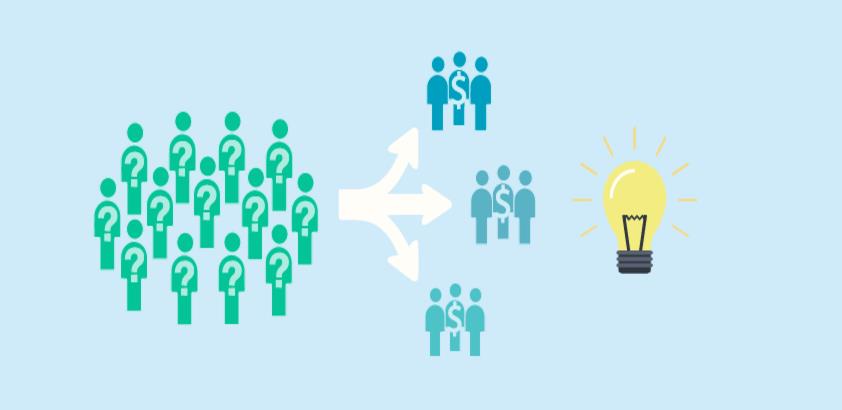
Besides segmenting customers by income, segmenting by financial tier is also an approach worth considering. Below are the 3 financial tiers you should pay attention to:
-
Dependent finances: At this level, people are financially dependent on family or relatives. They may be fully dependent or partly dependent thanks to personal income. They have little demand for luxury products — mostly essential goods for daily life.
-
Independent finances: This group has stable employment, personal savings or assets, and is no longer financially dependent on anyone. They have high purchasing demand to satisfy their personal needs.
-
Financial freedom: This group earns income from profitable investments; they are wealthy and don't hesitate to spend large sums on luxury products and high-quality services to express their status.
Conclusion: Choosing the right segmentation method helps the business save time and money compared with ineffective advertising campaigns aimed at the wrong audience. Through the article above, SimERP hopes every business will find a way of segmenting customers suited to its nature and business goals.
Related articles
Bài viết liên quan

25 tháng 10, 2026 · 3 phut doc
2024年网页设计趋势预测如何? | Wotech Electronics
关于 2024 年网页设计趋势——步入 2024 年,年初正是我们为新事物预留时间的时刻。这也非常适合设计师群体唤醒我们内心的"艺术之魂"。闲话不多说,快来和 Markdao 一起浏览 2024 年的 UX/UI 设计趋势吧,说不定您就能为自己接下来的网页设计项目"迸发"出一个绝妙的点子呢!

25 tháng 10, 2026 · 1 phut doc
什么是网站(Website)?网站的详细定义及其带来的商业价值
什么是网站(https://www.markdao.com.vn/blog/website-la-gi)——这个问题或许已经无需定义,因为在如今这个信息时代,网站对每一家企业而言都是不可或缺的组成部分。正是网站帮助用户更近距离地接触企业所提供的产品和服务,从而提升经营效益。此外,要在当今竞争如此激烈的环境中求发展,网站是一个重要因素,它将带你走向品牌与销量上的双重成功。

25 tháng 10, 2026 · 1 phut doc
什么是SEO标准网站?一场"打赢"Google SEO标准的战役 | Wotech Electronics
99%的用户在购买前会先搜索信息,73%的用户只会访问排名前10的网站,并认定它们是值得信赖的品牌……在数字营销爆发的时代,这些数字有力地印证了SEO标准网站的重要性。然而,许多人对什么是SEO标准网站(https://www.markdao.com.vn/blog/huong-dan-toi-uu-seo-website-chuan-seo-on-page)仍然相当模糊,并未真正理解。达到SE…