
What Is On-Page SEO? How to Optimize On-Page SEO Most Effectively
Vũ Khôi
Tác giả tại Wotech Electronics Blog
What Is On-Page SEO? How to Optimize On-Page SEO Most Effectively
Vũ Khôi
Author at Wotech Electronics Blog
What Is On-Page SEO? The Question That Stumps Many Businesses Entering the World of SEO for the First Time
On-page SEO is defined as the set of tasks and actions that SEO practitioners perform to optimize directly on web pages so they rank higher on the results table returned by search engines, thereby helping the website attract more traffic and reach more suitable customers from organic search (as opposed to paid search). This work includes optimizing HTML code, creating and enriching website content, and restructuring the site's content to best fit users.
So What Is the Difference Between Off-Page SEO and On-Page SEO?
What are the roles of off-page SEO and on-page SEO? Generally speaking, on-page SEO is the area responsible for the content and HTML source code of the target page. In contrast to on-page, off-page SEO is responsible for building and optimizing external factors that influence the website, such as links (backlinks), interactions, and shares on social media, etc.
Both on-page and off-page SEO play their part in improving a website's rankings. A website that does well on off-page SEO but is not optimized on-page still cannot achieve high rankings as quickly and easily as one optimized on both fronts. So, understand that knowing the differences between the two types of SEO helps us learn how to balance them within a single optimization strategy for any website — because, obviously, among the hundreds of millions of websites on the Internet, no two are alike.
A Checklist of What to Do When Optimizing On-Page SEO
Over the past few years, the on-page rules in the SEO industry have changed a great deal as Google keeps releasing additional search algorithms aimed at delivering the most optimal search results for users. Google's algorithms are becoming ever more sophisticated, with more factors — spanning more aspects — added to how Google indexes and ranks your website. So what factors should you pay attention to when doing on-page SEO?
So What Is the Secret to Successfully Running an On-Page SEO Project?
To run an on-page SEO strategy successfully, we will offer just one answer: Put the interests of users/website visitors first. Many components of a web page directly affect how the search engine crawls (indexes) and ranks the site, as well as the visitor experience. That is why on-page SEO today is no longer just about optimizing the website to be pleasing to search engines — what matters is keeping users on your site for as long as possible and encouraging them to interact with it as much as possible.
Page Titles and What to Watch Out for When Optimizing On-Page SEO
What is the function of the page title in on-page SEO? The page title (also known as the Title Tag) is one of the most important factors to pay attention to when optimizing on-page. The Title Tag is the shortened text that appears at the top of the browser tab, to the right of the site's logo. It is also the title of the search result that Google displays on the SERPs. Social networks also use the Title Tag as the name of the post when someone shares your page's URL to their feed. Because of this constant presence and prominent placement, this text carries great SEO value and is one of the most important SEO ranking factors.
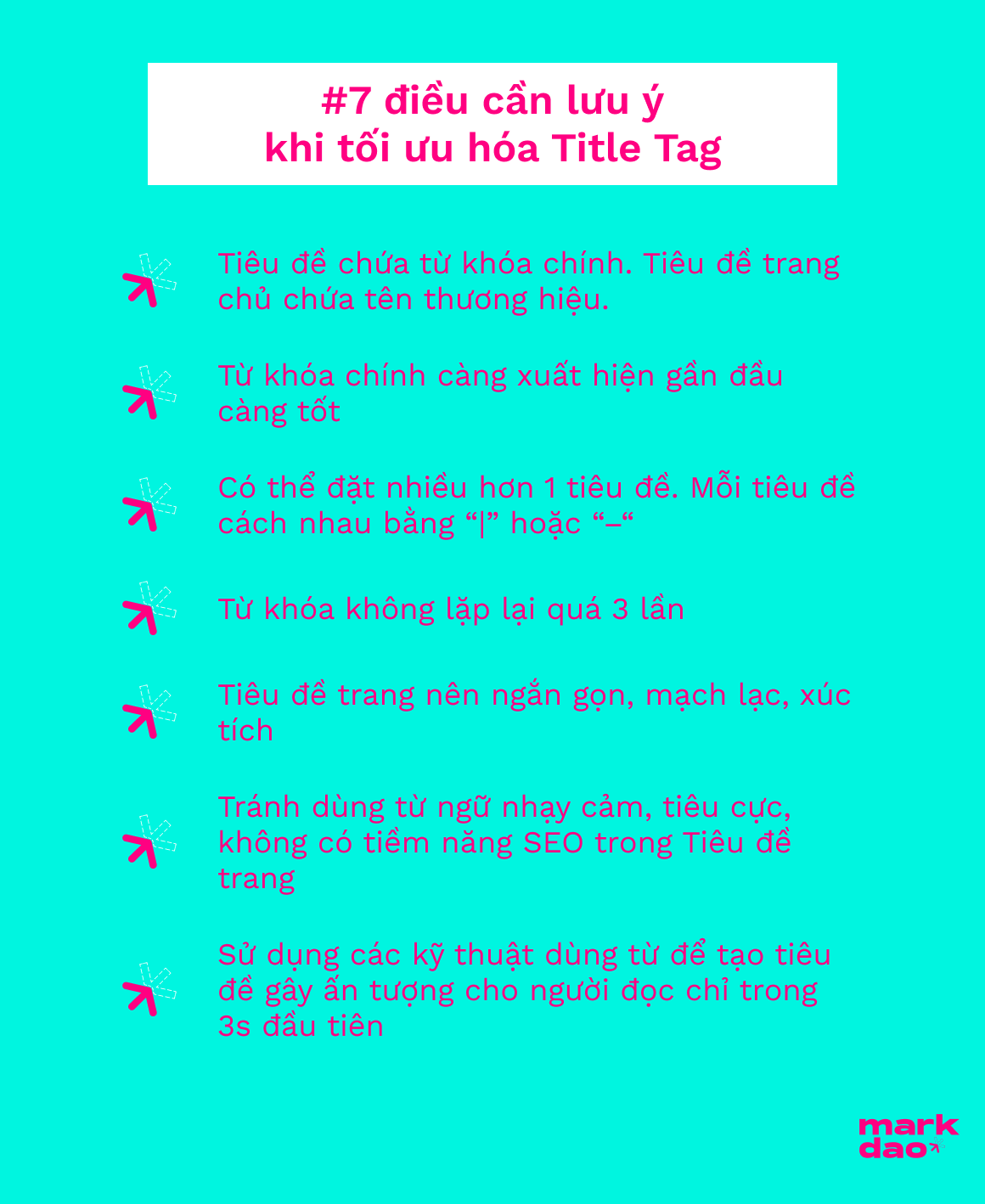
A few tips for perfecting the page title when doing on-page SEO? Catch up on them with Markdao right away!
-
The page title must contain the main keyword. Also, if it is the page title for the homepage, it must contain the brand name.
-
The main keyword should be positioned as close to the beginning as possible
-
The keyword may be repeated, but no more than 3 times
-
You can have more than 1 title. Each title should be separated by the "|" or "–" symbol
-
The optimal length for a page title is around 50–60 characters
-
The page title should be short, coherent, and concise
-
Avoid using sensitive or negative words with no SEO potential in the page title
-
Use wordplay techniques to create a title that makes an impression on readers within the first 3 seconds
What Are the Content Standards Required in On-Page SEO?
What factors matter when optimizing on-page SEO? Content is one of the most important factors affecting the progress and success of your on-page optimization strategy. Make sure the content on your website contains the target keywords and is relevant to them. Keywords should be spread evenly throughout the article, and the length of the article should be relatively substantial (over 600 words). This will help the website attract more clicks, and users will also stay on the page longer — both of which are additional ranking factors in on-page optimization.
Beyond keywords, the coherence of the content you publish (including the text, images, and videos you post on the site) also affects how Google ranks your website. If you want your website to attract users, the content must be easy to read and understand, fresh, trend-aware, and timely. Most importantly, remember you are writing content for users to read, not for search engines. If you cannot update your website content weekly, try to do it monthly, or at worst quarterly.
The Role and Meaning of Keywords in On-Page SEO
What is one of the influences on on-page SEO? Since 2018, thanks to advances in artificial intelligence (AI), Google has become "smart" enough to understand the relationships between synonyms and words semantically related to the target keyword. Now, a search engine results page (SERP) can still display pages that do not contain the keyword or phrase from the search query in their titles or meta tags. Overall, this update has had a fairly significant impact on keywords in SEO. Of course, keywords still play an important role and building a keyword plan remains necessary. But you no longer have to obsess over matching your keyword set down to the exact character.
Standards for Creating the Perfect URL for Your Website When Doing On-Page SEO
What can SEO practitioners do to create the perfect URL string when doing on-page SEO? When writing URL strings, they must be short, concise, and readable. When analyzing the standard length of URLs, Ahrefs (today's largest website analytics tool) found that shorter URLs tend to help websites rank better. Their report also concluded that URL strings with fewer subfolders score higher with Google. One tip you can apply: if you have two pages displaying nearly the same content or information, set up a 301 redirect or canonical tag (rel=canonical) to the stronger page. This avoids duplicate content and tells Google which page to rank.
What Role Does User Experience Play in On-Page SEO?
What factors deliver a satisfying user experience once you have optimized your on-page SEO? Have you ever clicked on a result recommended by Google and waited a very long time while the page still hadn't finished loading? What would you do next? Most likely you would hit back and pick another result, right? Plenty of other users would do the same!
Have you ever clicked on a result recommended by Google and waited a very long time while the page still hadn't finished loading? What would you do next? Most likely you would hit back and pick another result, right? Plenty of other users would do the same! So what do we mean by raising this case when discussing on-page SEO? It is that page load speed in particular, and user experience in general, are extremely important when you do on-page optimization. In addition, building a website layout compatible with many screen sizes and device types, and updating the site's structure (flow) to be logical so users can easily navigate as they wish, are also areas receiving great attention at this time.
In short, the factors we covered above all affect user experience to varying degrees, and all are recognized as top criteria Google uses to evaluate a website. Making it easy and simple for visitors to get the information they want from the "services" the website can provide is becoming one of the leading trends in the SEO industry.
Related Articles
Bài viết liên quan

25 tháng 10, 2026 · 3 phut doc
2024年网页设计趋势预测如何? | Wotech Electronics
关于 2024 年网页设计趋势——步入 2024 年,年初正是我们为新事物预留时间的时刻。这也非常适合设计师群体唤醒我们内心的"艺术之魂"。闲话不多说,快来和 Markdao 一起浏览 2024 年的 UX/UI 设计趋势吧,说不定您就能为自己接下来的网页设计项目"迸发"出一个绝妙的点子呢!

25 tháng 10, 2026 · 1 phut doc
什么是网站(Website)?网站的详细定义及其带来的商业价值
什么是网站(https://www.markdao.com.vn/blog/website-la-gi)——这个问题或许已经无需定义,因为在如今这个信息时代,网站对每一家企业而言都是不可或缺的组成部分。正是网站帮助用户更近距离地接触企业所提供的产品和服务,从而提升经营效益。此外,要在当今竞争如此激烈的环境中求发展,网站是一个重要因素,它将带你走向品牌与销量上的双重成功。

25 tháng 10, 2026 · 1 phut doc
什么是SEO标准网站?一场"打赢"Google SEO标准的战役 | Wotech Electronics
99%的用户在购买前会先搜索信息,73%的用户只会访问排名前10的网站,并认定它们是值得信赖的品牌……在数字营销爆发的时代,这些数字有力地印证了SEO标准网站的重要性。然而,许多人对什么是SEO标准网站(https://www.markdao.com.vn/blog/huong-dan-toi-uu-seo-website-chuan-seo-on-page)仍然相当模糊,并未真正理解。达到SE…