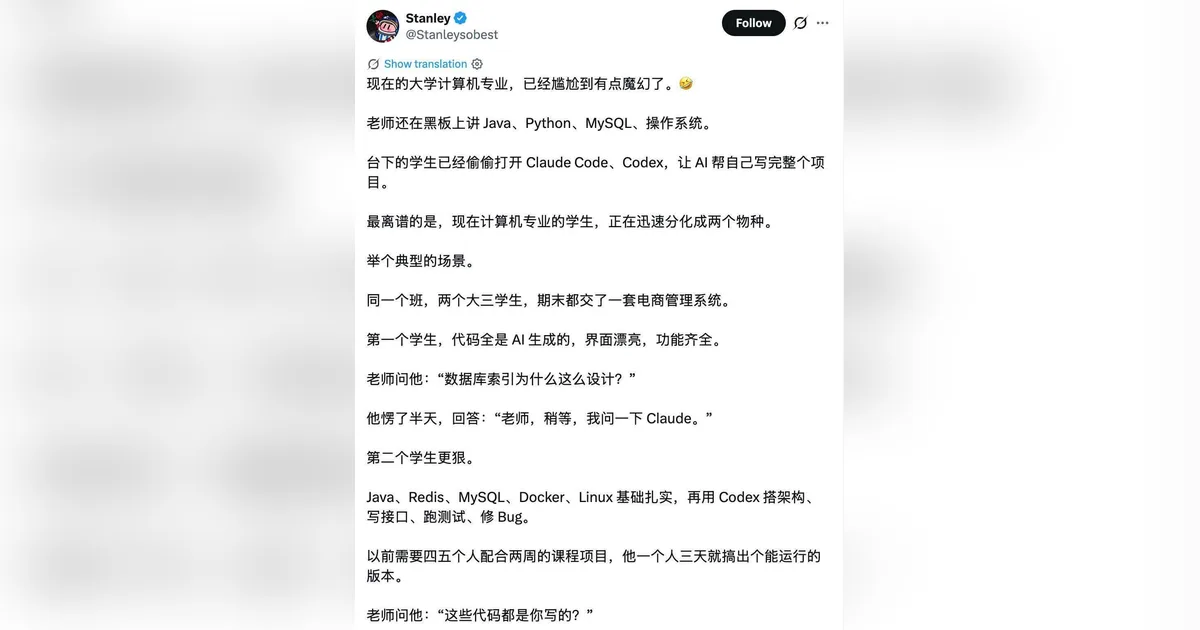
Computer Science Students Are Splitting in Two: Those Who Operate AI and Those Who Depend on It
Vũ Khôi
Tác giả tại Wotech Electronics Blog
Computer Science Students Are Splitting in Two: Those Who Operate AI and Those Who Depend on It
A post on X by the account @Stanleysobest is spreading fast through the programming community, via a write-up from the Hỏi Dân IT Official page: a third-year computer science student submits a final project, the teacher asks "Why did you design the database like this?", and the student replies "Wait, let me ask Claude." This illustrative situation — retold by the X post's author — opens a bigger story: same major, same AI use, same degree, but real ability can differ enormously.
Quick answer: The X post tells an illustrative story: two third-year students submit the same final project, an e-commerce management system. The first student had AI generate almost all the source code — a beautiful interface, complete features — but when the teacher asked why the database index was designed that way, he froze and replied "Wait, let me ask Claude." The second student had solid Java, Redis, MySQL, Docker, and Linux fundamentals, and used Codex to help design the architecture, write APIs, run tests, and fix bugs — a project that used to take 4–5 people two weeks, he finished a working version of in three days, and insisted he understood why every line of code was there. Using the same AI, one became someone who operates the tool, the other someone who depends on it. The write-up argues AI does not make learning programming meaningless; it is changing how good people are distinguished — and asks whether students should be allowed to use AI in projects and exams, or whether the first 1–2 years should still require hand-coding to build foundations.
A capstone project is a large assignment concluding a course or a stage of study, in which students must build a complete software product — like the e-commerce management system in the illustrative story — to demonstrate integrated knowledge.
The same assignment, two completely different students
While lecturers still teach Java, Python, MySQL, and operating systems, many students below have already opened Claude Code and Codex to let AI write almost their entire project. The X post offers an illustrative story of two third-year students submitting the same e-commerce management system:
- The first student: almost all code generated by AI. Beautiful interface, complete features, smooth demo. The lecturer asked: "Why did you design the database index like this?" He froze for a few seconds, then replied: "Wait a moment, teacher, let me ask Claude."
- The second student: also used AI, even more. But he had solid Java, Redis, MySQL, Docker, and Linux fundamentals, then used Codex to help design the architecture, write APIs, run tests, and fix bugs. A project that used to take 4–5 people two weeks, he finished a working version of in just three days. The lecturer asked: "So did you write all this code yourself?" He replied: "No. But I understand why every line of code is there."
| First student | Second student | |
|---|---|---|
| Fundamentals | Not demonstrated — could not explain his own design | Solid Java, Redis, MySQL, Docker, Linux |
| How AI was used | AI generated almost all the code | Codex assisted architecture, APIs, tests, bug fixes |
| Submitted product | Beautiful interface, complete features, smooth demo | Working version in 3 days (work that used to take 4–5 people, 2 weeks) |
| When asked "why" | "Wait, let me ask Claude" | "I understand why every line is there" |
| Role with the tool | Someone who depends on the tool | Someone who operates the tool |
The difference, according to the write-up, is not who uses AI more — the second student used AI even more. The difference is that one understands what he built, while the other merely owns a working product he cannot explain.
What problem are universities facing?
Previously, IT students were usually assessed on their ability to write programs themselves, solve algorithms, and complete projects. Now AI can generate a fairly complete application from a few prompts. So if two students submit equally working projects, how do you know who is actually good?
That is also why seemingly simple questions like "Why choose this database structure?", "What if the system has a million users?" or "What if Redis fails?" become important, according to the write-up. AI can write code very fast, but the person whose name is on the product is still responsible when it runs wrong.
In fact, according to the write-up, some universities have started bringing AI into their training programs instead of trying to ban students from using it. The reason: when they go to work, companies do not just need people who type code fast — they need people who understand requirements, evaluate solutions, check results, and handle situations AI has not solved.
How is AI changing the way good people are distinguished?
Previously, a programmer might spend days completing repetitive code. Now Claude Code or Codex can help do that work much faster. The saved time can go to studying architecture, optimizing performance, testing, and solving more complex problems.
But precisely because code is generated so easily, learners easily skip the most important stage: understanding what they are building. One person can create 10 AI projects in a month and still not know what to do when the application hits a production bug. Another does just one project, but understands the data flow, database design, deployment, and the technical decisions behind it. Only at interviews or in real work does the difference start to show.
The write-up jokes that in a few years, fresher interviews may no longer make candidates write CRUD from scratch: just hand them an AI-generated project and ask them to explain the architecture, find bugs, optimize the database, and deploy to a server — whoever can do it gets hired. And it leaves open the question for the community: should IT students now be allowed to use Claude Code and Codex in projects and exams? Or should at least the first 1–2 years still require hand-coding to build foundations?
Frequently asked questions
1. Is the two-student story a real event? According to the write-up's note, it is an illustrative situation retold by the X post's author, not a verified event. Its value lies in the reality it reflects, as the write-up frames it.
2. How do the two students differ? Both use AI, but the first cannot explain his own database design ("Wait, let me ask Claude"), while the second has solid Java, Redis, MySQL, Docker, and Linux fundamentals and understands every line of code AI helped generate.
3. Why is it hard for universities to assess students in the AI era? Because AI can generate a fairly complete application from a few prompts, two students submitting equally working projects may not have equal ability. According to the write-up, "why" questions — about database structure, load capacity, failure handling — become important to tell them apart.
4. Should students be banned from using AI? According to the write-up, some universities have brought AI into their training programs instead of banning it, because companies need people who understand requirements, evaluate solutions, and handle situations AI has not solved — not just fast typists. The write-up leaves open whether the first 1–2 years should require hand-coding to build foundations.
5. Does AI make learning programming meaningless? According to the write-up, no — AI is changing how good people are distinguished. Repetitive code is generated faster, and the saved time goes to architecture, performance, testing, and complex problems; but learners must still understand what they build, or they will not cope when the application hits a production bug.
Source: write-up by the Hỏi Dân IT Official page (17/11/2026), retelling the X post by @Stanleysobest (illustrative situation); credit: Alan Dao. The interpretations in this article belong to the post's author and have not been independently verified by Wotech.
Bài viết liên quan

18 tháng 11, 2026 · 6 phut doc
FPT Software Chairwoman: US Clients No Longer Want to Pay by the Hour, Company Shifts to Outcome-Based Pricing
Artificial intelligence is forcing FPT Software to transform its traditional software outsourcing model: large clients in the US now apply 100% outcome-based payment, and the company expects the Time…

18 tháng 11, 2026 · 6 phut doc
Meta Expands Muse to Australia: The 6th Country, Real-Time Voice, and Local App Integrations
On 17/11/2026, Meta expanded Muse to Australia — the 6th officially supported country, just over 2 months after its US launch. According to a post by Hồ Hoàng Tiến (18/11/2026), the notable point is …

18 tháng 11, 2026 · 7 phut doc
AI Agent Costs Grow With the Square of Steps: 4 Layers to Cut Token Spend Before Switching to a Cheaper Model
You don't pay for answers — you pay for how many times you re-ask the same thing. That is the central argument of Hoang Viet AI in a post in the comailo group (18/11/2026): an agent running 40 steps,…