
The General Ledger: Meaning, Characteristics, and Common Account Ledger Types | Wotech Electronics
Vũ Khôi
Tác giả tại Wotech Electronics Blog
The General Ledger: Meaning, Characteristics, and Common Account Ledger Types
Vũ Khôi
Author at Wotech Electronics Blog
The general ledger is a familiar term for accountants because of its indispensable role for a business. So in this article, we will explore what a general ledger is and what it means for a business, then look at the most common ledger formats and answer the question every accountant will wonder about at some point: "What does the general ledger contain, and how do you record entries in it?"
What is the general ledger?
"What is the accounting general ledger?" — a question accountants will ask when they first encounter the concept. The general ledger, also known as the ledger in English, is an accounting book that consolidates the economic and financial transactions arising during an accounting period by accounting account (assets, liabilities, owner's equity, revenue, production and business expenses, other income, etc.). Each of the accounts above is allocated one or more consecutive pages in the general ledger, enough to record entries for one accounting period (month, quarter, year). In short, the accounting general ledger is a consolidated accounting book — the place where a business's entire transaction history is recorded by each type of account.
The accounting data in the general ledger is aggregated and the books closed at the end of the period, reflecting the business's assets, capital, and operations. That data is also compared with statistical figures to check for discrepancies, giving a more comprehensive and accurate picture of the business.
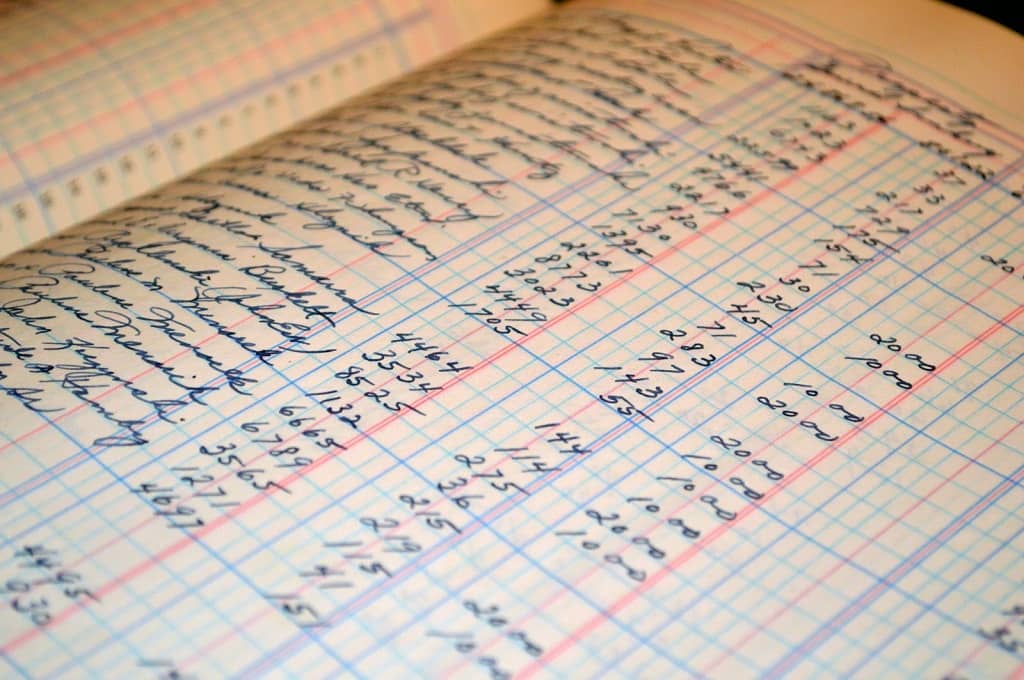
Characteristics of the general ledger
When starting to work with the general ledger, accountants need to grasp its typical characteristics in order to do the job correctly:
-
Each account may be allocated one or more consecutive pages in the general ledger, enough to record entries for one accounting period.
-
The general ledger is opened for each account in the full set of accounts used by the business.
-
All opening balances, closing balances, and movements of the account being tracked are recorded in the account ledger.
-
The information in the general ledger is systematized by the entity or account for which the ledger is opened.
-
The general ledger is regarded as a statistical history of the business's development, because it records and can be opened for every type of account.
The meaning of the general ledger
So what does keeping a general ledger mean for a business? Before taking on any task, we need to understand how it affects the overall picture. Specifically, the general ledger has the following meanings:
-
The basis for preparing financial statements as required by law.
-
It allows comparison of business performance — that is, the company's profits or losses. From there, the business and other stakeholders can work out the next steps to grow.
-
The basis for making future decisions for the business, through: the general ledger shows the company's profit/loss situation; it uncovers unusual receipts and payments; it is transparent — real figures on revenue or losses; and it is easy to look up and cross-check for verification.
Common types of general ledgers
This article covers the different types of general ledgers listed below. Although their creation and classification all serve the same general purpose — helping accountants systematize transactions as effectively as possible — each company will choose the ledger format that suits it based on its conditions, scale, and characteristics.
– The general journal accounting form
– The journal – ledger accounting form
– Computer-based accounting
– The journal-voucher accounting form
– The bookkeeping-voucher accounting form
Among the forms listed above, the most widely used common ledger formats are the account ledger under the general journal form and the journal-voucher form of accounting.
Types of accounts in the general ledger
As mentioned earlier in this article, a general ledger can be created for every type of account a business has. However, to answer the reader's question more clearly about which account ledgers to print, this article summarizes the account types below, along with examples of some common general ledgers for each specific account type.
Under Circular 133, accounting accounts can be divided into 9 classes, distributed as follows:
-
Assets: Cash — account 111 ledger, also known as the cash ledger. Raw materials and supplies — the account 152 ledger.
-
Liabilities
-
Owner's equity
-
Revenue: Revenue from sales of goods and service provision — the account 511 ledger
-
Production and business expenses: Cost of goods sold — the account 632 ledger
-
Other income
-
Other expenses
-
Determination of business results: Determination of business results — the account 911 ledger
>>>> See also: How to keep a general ledger under the general journal and journal-ledger forms per Circular 200
The general ledger recording process
After covering the most complete basic information about the general ledger, this article will walk the reader through the bookkeeping-voucher ledger. How does recording the general ledger under the general journal differ from the journal-voucher method? Is writing the account 632 ledger the same as the account 511 ledger? This article guides readers through the process of recording the general ledger and bookkeeping vouchers under the 2 most common forms: the general journal ledger and the journal-voucher ledger.
Recording the general ledger under the general journal form
-
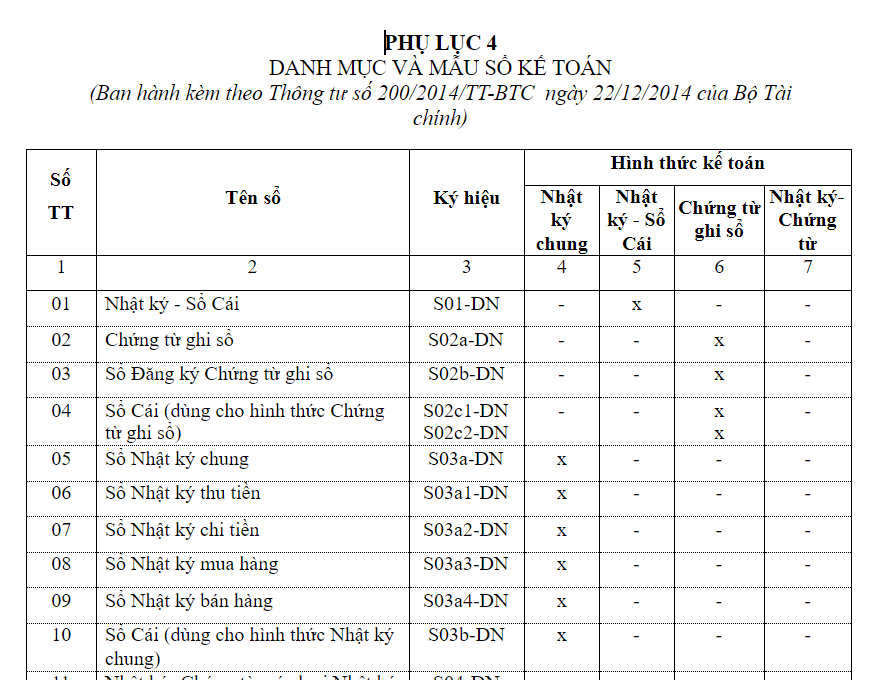
The General Ledger is standardized according to the form issued in this regime and consists of: Column A: the date the entry is recorded. Columns B, C: the basis for the entry — the number and date the accountant prepared the accounting voucher. Column D: the content of the transaction. Column E: the corresponding page number in the General Journal where this transaction was recorded. Column G: the corresponding line number in the General Journal where this transaction was recorded. Column H: the numbers of the accounts related to the transaction originating from this General Ledger page (debit account first, credit account after). Columns 1, 2: the amounts arising on the debit or credit side of the account for each economic transaction.
-
At the beginning of the month, the accountant tracks and records the account's opening balance on the top line, in the balance column (debit or credit).
-
At the end of the month, the accountant totals the entries on both the debit and credit sides to derive the balance, and accumulates quarterly entry totals for each account as the basis for preparing the balance sheet and financial statements.
Recording the general ledger under the journal-voucher form
-
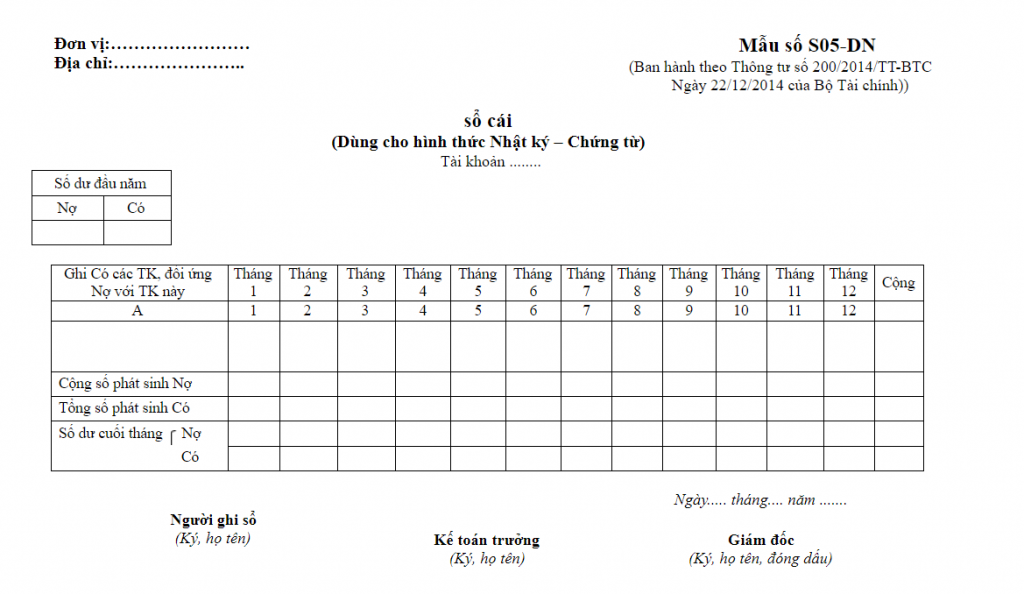
The Journal – Voucher form of accounting consists of the following accounting books: Journal-vouchers; listing sheets; the General Ledger; and detailed accounting books or cards. The sequence of bookkeeping under the Journal – Voucher form of accounting.
-
Daily: take the data from the accounting vouchers (already checked) and record it in the Journal-vouchers. It may also be recorded in the relevant listing sheets and detailed ledgers. For production and business costs that arise more than once or are of an allocation nature, the original vouchers need to be gathered and classified in allocation tables. The resulting figures from the allocation table are then recorded in the relevant listing sheets and Journal-vouchers. For Journal-vouchers recorded on the basis of listing sheets and detailed ledgers, use the totals of the listing sheet or detailed ledger, and at the end of the month transfer the figures into the Journal-vouchers.
-
At the end of each month, the accountant closes the books: the Journal-voucher figures are totaled, then checked and cross-referenced against other records such as accounting ledgers and cards, and the relevant detailed summary tables. The totals from the Journal-vouchers are then recorded directly into the General Ledger. In addition, vouchers related to ledgers and cards are recorded directly in the relevant ledger or card. Detailed summary tables for each account are prepared at the end of the month based on the figures of the detailed accounting ledgers and cards. The financial statements are prepared on the basis of the general ledger figures and the line items in the Journal-vouchers, listing sheets, and summary tables.
To serve the purpose of understanding the general ledger, this article has laid out the definition and characteristics of the general ledger as well as what keeping one means. Going deeper, readers now understand the classification and the process of recording the general ledger, with concrete examples. Readers can note down these points and the links to sample forms on how to keep the ledger as a handy tool for writing up the general ledger with ease. We hope accountants in particular and readers in general have gained a more concrete perspective on the general ledger.
Related Articles
Bài viết liên quan

25 tháng 10, 2026 · 3 phut doc
2024年网页设计趋势预测如何? | Wotech Electronics
关于 2024 年网页设计趋势——步入 2024 年,年初正是我们为新事物预留时间的时刻。这也非常适合设计师群体唤醒我们内心的"艺术之魂"。闲话不多说,快来和 Markdao 一起浏览 2024 年的 UX/UI 设计趋势吧,说不定您就能为自己接下来的网页设计项目"迸发"出一个绝妙的点子呢!

25 tháng 10, 2026 · 1 phut doc
什么是网站(Website)?网站的详细定义及其带来的商业价值
什么是网站(https://www.markdao.com.vn/blog/website-la-gi)——这个问题或许已经无需定义,因为在如今这个信息时代,网站对每一家企业而言都是不可或缺的组成部分。正是网站帮助用户更近距离地接触企业所提供的产品和服务,从而提升经营效益。此外,要在当今竞争如此激烈的环境中求发展,网站是一个重要因素,它将带你走向品牌与销量上的双重成功。

25 tháng 10, 2026 · 1 phut doc
什么是SEO标准网站?一场"打赢"Google SEO标准的战役 | Wotech Electronics
99%的用户在购买前会先搜索信息,73%的用户只会访问排名前10的网站,并认定它们是值得信赖的品牌……在数字营销爆发的时代,这些数字有力地印证了SEO标准网站的重要性。然而,许多人对什么是SEO标准网站(https://www.markdao.com.vn/blog/huong-dan-toi-uu-seo-website-chuan-seo-on-page)仍然相当模糊,并未真正理解。达到SE…