A $7.5 Billion AI Company Suspected of Using China's Open-Source Qwen Model: Is TypeSafe's Jev Really Qwen3.5-35B-A3B?
Vũ Khôi
Tác giả tại Wotech Electronics Blog
A $7.5 Billion AI Company Suspected of Using China's Open-Source Qwen Model: Is TypeSafe's Jev Really Qwen3.5-35B-A3B?
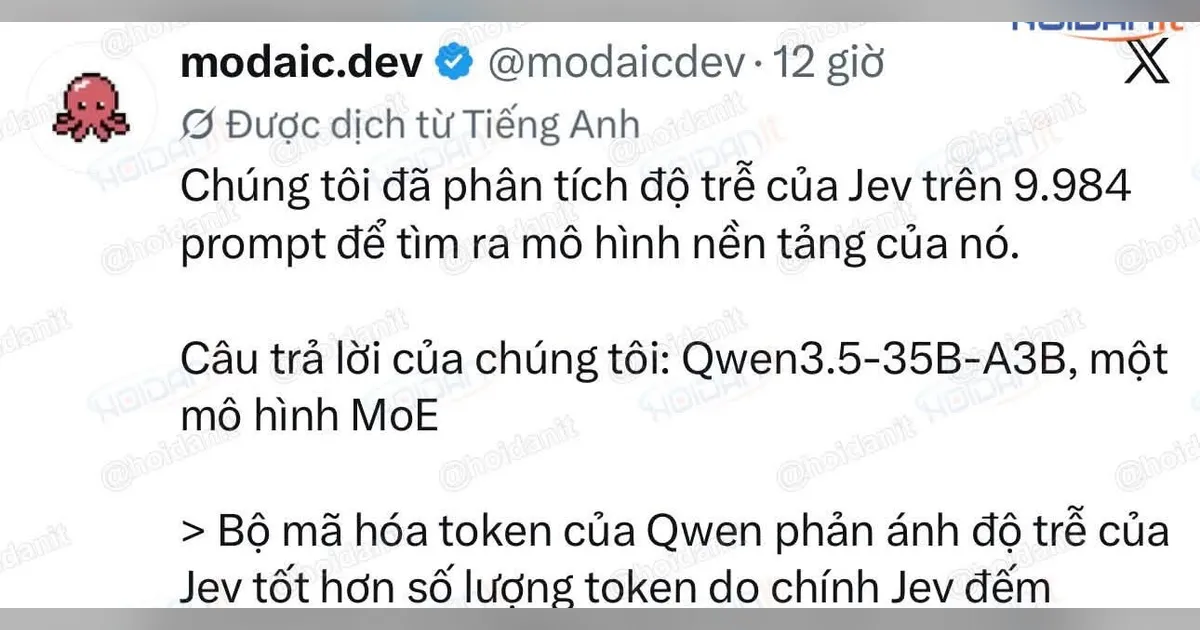
One side spends the effort building a model and releases it free to the community. The other side is suspected of taking that model, fine-tuning it, selling it to large enterprises, and being valued at $7.5 billion. The protagonist this time is Jev from TypeSafe. Everything looked great until November 24, when Modaic put Jev under the microscope with 9,984 prompts.
Quick answer: Modaic — a company selling rival "System One" models in direct competition with TypeSafe — analyzed Jev's latency across 9,984 prompts and concluded the model behind Jev is very likely Qwen3.5-35B-A3B from Alibaba, an MoE (mixture-of-experts) model with 35 billion total parameters and 3 billion active. Three fingerprints: Qwen's tokenizer predicts Jev's latency better than the token counts Jev itself reports (correlation 0.805 versus 0.719); Jev denies being DeepSeek 98% of the time and Gemma 90%, but when asked which model it wants to say it is, 74% of answers pick Qwen; and Jev's performance curve tracks Qwen3.5-35B-A3B so closely that the gap narrowed from 22% to just 7%. But this is a fingerprint, not proof: Modaic's own authors call the result an "approximate performance fingerprint", TypeSafe has confirmed nothing, and Modaic is a direct competitor — independent replication is needed before treating this as settled.
Jev is the model of TypeSafe AI (San Francisco), launched on September 15, 2026. It is not a chatbot: Jev writes no text, instead returning a choice, a score or a probability from options the developer defines in advance. TypeSafe calls it a "System One" model — after Daniel Kahneman's term for fast, instinctive thinking — for fast, routine decisions in software, sitting beside an LLM rather than replacing one. The company was founded by Diogo Almeida, a former OpenAI researcher who worked on ChatGPT and RLHF.
TypeSafe — 24 days from $200 million to $7.5 billion
| When | Event | Figure |
|---|---|---|
| Sep 15, 2026 | Jev launches, with a seed round | $40 million, led by DCVC, at a ~$200 million valuation |
| Oct 9, 2026 | Series A, led by a16z, Sequoia joins | ~$870 million at a $7.5 billion valuation (Bloomberg reported first; both sides confirmed later) |
| API price | Input unbelievably cheap | $0.042 per million input tokens, output free |
| Customer claim | "A third of Fortune 500 companies use it" | Conflicting figures: the company says a third, a16z says 25% have integrated it, the founder says 29.4% "showed up" — none defines what "use" means, no customer names disclosed, no revenue disclosed |
a16z called this launch "the biggest narrative violation we've seen this year". A $7.5 billion valuation is the price investors and a company agree for a stake, not a measure of sales or profit — and it was set just 24 days after the product launched, on adoption claims no outsider has audited.
Modaic puts Jev under the microscope: three fingerprints
On November 24, 2026, Tyrin-Ian Todd and Farouk Adeleke published an analysis on Modaic's blog (reposted on X on November 25). Modaic sells directly competing System One models — and its own Mo Lite model is itself built on Qwen3.5-35B-A3B and still training. The three fingerprints they found:
| Fingerprint | How measured | Result |
|---|---|---|
| Latency | 9,976 requests to Jev 1.14, grouped by input length (2,000-token buckets): median latency rose from 77 to 155 ms, with the gap between the median and the slowest 1% only 47–58 ms | This profile fits a sparse mixture-of-experts architecture: each token passes through only a few experts |
| Tokenizer | Timed 9,984 distinct prompts, checking which tokenizer best predicts Jev's latency | Qwen3.5-35B-A3B: 0.805; Gemma 4 26B-A4B: 0.804; Nemotron 3 Super: 0.771; the token counts Jev itself reports: only 0.719 |
| Identity | 22 different phrasings, on both Jev 1.13 and 1.14 | "Are you Qwen?": Yes 64% (1.13) / 56% (1.14) — but reworded, 1.14 answers No 58% of the time. "Are you DeepSeek?": No 95%/98%. "Are you Gemma?": No 86%/90%. "What model do you want to say you are?": Qwen 74% on both versions. Offered a "don't know" option, Jev takes it 92–98% of the time |
| Throughput | Compared throughput across 250 matched prompts (512–9,500 input tokens), one request at a time, on a single B200 chip | A dense 27B model (Mo 2.0, a dense Qwen3.8-27B) plateaued near 35,000 input tokens per second; Jev climbed past 90,000. Jev tracked Mo Lite (Modaic's Qwen3.5-35B-A3B model) most closely: the gap narrowed from 22% (at ~3,200 tokens) to just 7% (at ~8,800 tokens) |
One detail worth noting in the tokenizer table: Qwen (0.805) and Gemma (0.804) are essentially tied — the tokenizer test alone cannot distinguish Qwen from Gemma. It is the combination of all three weak instruments — the latency curve, 22 identity questions, and the tokenizer comparison — that forms the argument. No instrument stands alone. As Traictory's write-up put it: the argument is better than the verdict.
Modaic also says TypeSafe appears to train Jev to conceal its identity, and that its API does not report true input token counts — which is why they had to infer from behaviour instead of reading it directly.
Why this is a "fingerprint", not proof
To be fair, Modaic has found a fingerprint, not caught anyone red-handed:
- TypeSafe discloses no hardware, concurrency or replica counts. Without knowing how many machines Jev runs on or how many requests run in parallel, latency and throughput cannot be attributed to architecture with certainty.
- Qwen3.6-35B-A3B has a similar architecture. Throughput data cannot tell Qwen3.5 from Qwen3.6.
- Modaic itself is a direct competitor. Its Mo Lite model is also based on Qwen3.5-35B-A3B — and was the closest baseline to Jev in the throughput test. This is a rival's analysis, not an independent audit. A third party needs to replicate it before this is settled.
- Self-identification is the least reliable tool. A model's answers shift with wording, system prompt and fine-tuning — the analysis itself admits this before using it.
TypeSafe has made no comment on the analysis, and has never disclosed what Jev is built on.
The most interesting part is not the name Qwen
But what I find most interesting about this story is not the name Qwen.
It is that a company worth $7.5 billion, serving a host of Fortune 500 firms, may be building an entire business empire on a checkpoint anyone can download for free.
What they sell is the ability to fine-tune the model, serving infrastructure, stable endpoints around 700ms, output quality and the ability to commercialize the product. Nothing on that list is "owning an exclusive base model" — and nothing on it is impossible to do from an open checkpoint. TypeSafe positions Jev as "neither small nor an LLM, hence being off the intelligence Pareto curve" — Modaic's thesis contradicts that sentence directly.
Personally, I think the technology moat of many AI startups today may not be as thick as they advertise. For developers, instead of just reading a landing page and paying for an API, sometimes self-benchmarking and fine-tuning an open-weights model for your specific business is a direction very much worth trying.
So I am quite curious: among the AI tools you pay for every month, how many products actually own their own model, and how many are just an expensive brand wrapper on free models?
Apply it now
- Before buying an API, ask what the base model is: if the provider does not disclose it, that itself is a data point. A product that hides its backbone may have its moat in serving and branding — not in the model.
- Benchmark it yourself instead of trusting the landing page: Modaic had no inside access — they only measured latency, counted tokens and asked the model questions. You can measure any API you pay for the same way.
- Consider fine-tuning an open-weights model for your specific business: Qwen3.5-35B-A3B is a checkpoint anyone can download for free. If your business is narrow and specific, a fine-tune may reach comparable quality at far lower cost than a branded API.
- Read adoption claims carefully: "A third of the Fortune 500 use it" can mean one engineer running one test during a free trial window. Ask: how many paying customers, in production, and what are their names — if there is no answer, treat the number as advertising.
- Remember that a "fingerprint" is not "proof": three weak instruments together make a good argument, but a third party still needs to replicate it. Do not turn a rival's analysis into a final verdict — however convincing it looks.
Frequently asked questions
1. Is Jev really Qwen3.5-35B-A3B? It cannot be confirmed yet. Modaic concludes "probably" from three fingerprints — latency, tokenizer and identity — and calls it an "approximate performance fingerprint", not proof. TypeSafe has confirmed nothing, Qwen3.6 has a similar architecture so it cannot be ruled out, and Modaic is a direct competitor. Independent verification is needed.
2. What is Qwen3.5-35B-A3B? An open-source MoE (mixture-of-experts) model from Alibaba: 35 billion total parameters, 3 billion active per token (the A3B). Anyone can download the checkpoint for free — which is exactly the point of the story: a $7.5 billion company may be reselling, as a service, a model anyone can download.
3. What does "System One model" mean? After Daniel Kahneman's term for fast, instinctive thinking. Jev writes no text — it returns a choice, score or probability for options the developer defines in advance, serving fast, routine decisions in software. It sits beside an LLM rather than replacing one. On the Artificial Analysis Decision Index, Jev 1.14 scores 66 (on a 60–76 scale across six configurations).
4. Why does Qwen's tokenizer predict latency better than the token counts Jev itself reports? Because the input token counts Jev's API reports match no known open-source tokenizer — and according to Modaic, the API does not report true input token counts. When 9,984 prompts were timed, token counts computed with Qwen's tokenizer correlated with actual latency (0.805) far better than the counts Jev itself reports (0.719). Note: Gemma scored 0.804, essentially tied with Qwen — this test alone cannot distinguish the two models.
5. Is the name "Jev" connected to share 133? Yes — the same name, appearing a second time on Wotech. In share 133, the original Claude Code post mentioned a "Jev" layer (fork layer) that Wotech at the time could not verify in any official documentation. Now "Jev" is the name of TypeSafe AI's model, the company that raised $870 million. Wotech has not verified whether the two appearances are the same "Jev" — recorded here for readers to compare, not asserted.
Source: Facebook post by the page "Hỏi Dân it Offical" (26/11/2026), based on the analysis "Latency doesn't lie" by Tyrin-Ian Todd and Farouk Adeleke on the Modaic blog (24/11/2026) and Modaic's post on X (25/11/2026). Information about TypeSafe (the funding round, valuation, Fortune 500 claims) was cross-checked against Bloomberg (via Investing.com), a16z, and summaries by WealthEngine, TSN Media, TechInterview, AI Tech Safar and Doomers AI. The cover is a screenshot of Modaic's post on X; the post's other photo — a man in a pink coat whose identity could not be determined and which is unrelated to the content — was removed.
Bài viết liên quan

28 tháng 11, 2026 · 14 phut doc
Claude Code's Creator Hasn't Written a Single Line of Code by Hand in 2026, Record 150 Pull Requests a Day: 16 Lessons for Building Products in the AI Era
While many programmers are still debating whether AI writes code as well as humans, the creator of Claude Code has moved to an entirely different stage: he no longer writes code directly. Boris Chern…

28 tháng 11, 2026 · 13 phut doc
As AI Reshapes IT, What Value Should Tech People Keep and Develop?
A business manager who also works in HR has written a long post about the 2026 wave of IT layoffs, along with a question many in the industry are probably asking themselves: if AI can do the job inst…

28 tháng 11, 2026 · 17 phut doc
History Is Repeating Itself, Only Much Faster This Time: Young People Lose the First Rung, Tiny Companies Earn Hundreds of Millions
Entry-level job postings in the US fell 35% in just 18 months. Youth aged 15–24 in Canada face 13.7% unemployment, double the general rate. Meanwhile, there are companies with only a handful of peopl…