
What Are UR and DR? The Difference Between These 2 Important Scores | Wotech Electronics
Vũ Khôi
Tác giả tại Wotech Electronics Blog
What Are UR and DR? The Difference Between These 2 Important Scores
Vũ Khôi
Author at Wotech Electronics Blog
Attention, attention! There are lots of untold secrets here about URLs and Domains! If you want to optimize your website quickly and solidly, check this out before it's too late! In this article, we will:
-
Get acquainted with the concept of URL/URL Rating and tips for tapping the full potential of UR
-
Explore what a Domain and Domain Rating are, along with the tricks for conquering Domain Rating.
At the end of the article there is a short Q&A to help you resolve common questions about URL and Domain Rating.
URL and URL Rating: Do you already know everything about them?
Before "unlocking" the secrets of URL and UR, you need to arm yourself with basic knowledge of these two things. What are they? What role do they play for a website, and how do you optimize them?
What are URL and URL Rating? Why are these 2 factors important for a website?
URL stands for Uniform Resource Locator — a unified resource locator. In the simplest terms, a URL is a web address. A URL is a reference to a web resource that specifies its location on a computer network and the mechanism for retrieving it.
Meanwhile, URL Rating — abbreviated UR — is used to measure the backlink strength of a specific URL and that URL's likelihood of ranking high on Google. It uses a 100-point scale to score the criteria of a link. The higher the score, the stronger the website's backlink.
What UR doesn't tell you: 3 smart tips for using UR most effectively
If you are only just starting to learn about SEO and UR, you may miss some important information. So jot down these pointers of ours quickly:
-
First, UR is a page-level metric, while DR (Domain Rating — covered in the next section) is a domain-level metric. So if you put a web page into Ahrefs — one of the most popular and effective SEO analysis tools — the number you get belongs to the website itself.
-
Second, the UR scale is logarithmic, meaning it is far easier for a page to go from UR 20 to UR 30 than from UR 70 to UR 80.
-
Third, be honest! Because search engine algorithms can detect and cut out the "Linking Loop" — a link loop — a method of repeatedly exchanging ranking scores in a cycle between two websites. If you want to know more about the "Linking Loop", read more here!
What are Domain and Domain Rating? How is Domain Rating calculated?
A Domain, also called a domain name, is simply the name of the website. It is like a home address that lets satellites route you to the exact page you are looking for. A web server and a Domain are the two most basic conditions for a website to function normally. Without a Domain, to access a website you would have to enter the exact IP address of each server when searching for a website.
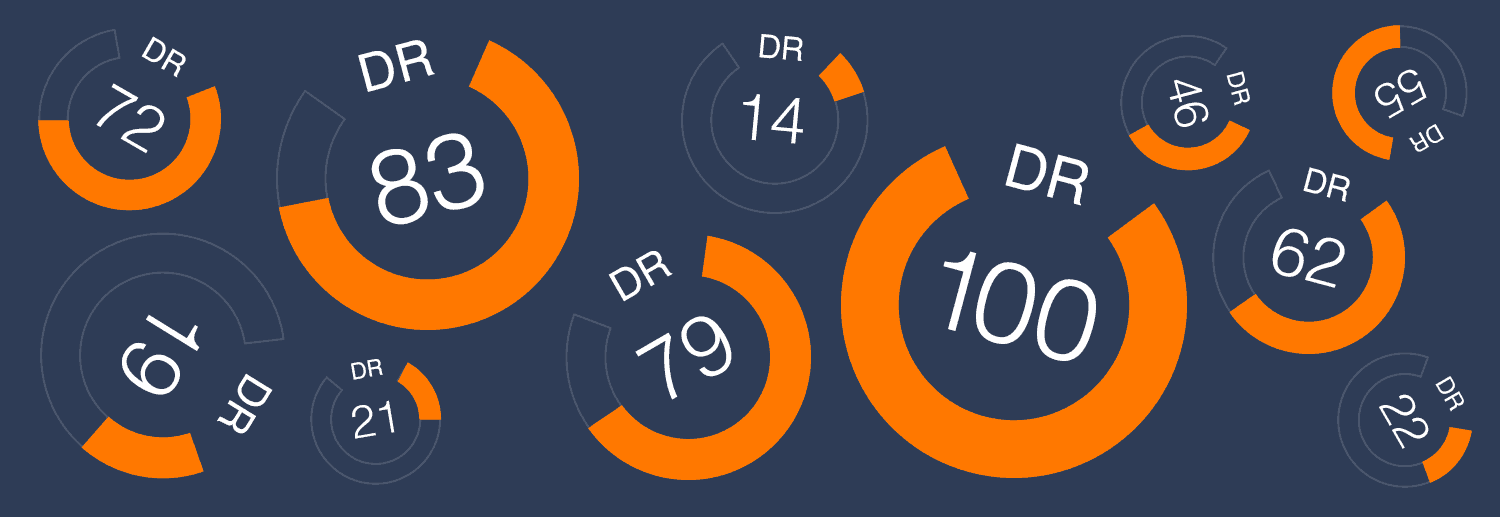
Meanwhile, Domain Rating shows a website's link popularity relative to other sites worldwide, on a scale from 0 to 100. Basically, it is a simpler version of Ahrefs Rating and can be considered an Off-page SEO activity.
To calculate DR, two sets of factors are typically considered:
-
Factor 1: If a domain's DR is higher, more "link juice" (a term for the power or value a website gains through external or internal links) will be converted into domain links.
-
Factor 2: In fact, a domain divides its rating equally among the domains it links to. For example, a domain with DR = 10 linking to three other domains can affect your website's DR more than a DR = 80 domain linking to a million other domains.
Combining the 2 factors above gives us the DR score for each domain. The final DR value is calculated by scaling the computed absolute value onto a 0-100 range.
The secret to mastering and leveraging Domain Rating for your purposes
In practice, we can still influence Domain Rating to some degree to bring the greatest possible benefit to a website. DR depends not only on the total number of high-DR websites linking to your page, but also on how many other websites those high-DR sites link to.
So treat DR as a yardstick for selecting websites for backlink building. To make the most of this, target backlinks specifically from high-DR websites, because they can carry more "weight."
A back-and-forth Q&A on URL Rating and Domain Rating
If you have many questions about UR and DR, you may well find the answers here! We not only untangle common doubts but also help you see through frequent misconceptions.
- Why should we use UR?
All the information in this article about UR may sound complex and hard to grasp. However, seriously consider the benefits UR brings.
No one knows exactly how PageRank is calculated except Google itself. But pages with high UR tend to rank higher in search results without paying for it. That is because the UR formula is based on the fundamental principles of page ranking, follows Google's standards closely, and is a sustainable way to assess a website's strength. So don't overlook UR!
- "Is UR the same as Google's PageRank?"
Basically, every comparison in the world is lopsided. Although they share some elements — counting links between pages, having a "damping factor," and crawling websites broadly and far afield — UR and PageRank are still different. No one can know Google's algorithms exactly. Basic tools like UR can only simulate how Google's algorithm — PageRank in this case — works and what it measures. That is precisely why UR and PageRank cannot be compared, given the difference in their complexity.

- Why is DR much higher or lower than UR for the same website?
Sounds illogical, right? However, if you run a website yourself, you will very likely run into this situation.
While both ratings are based on backlinks, DR is calculated at the domain level. This means it considers the quantity and quality of the domains linking to your entire website, whereas UR considers the same factors for individual pages. That is precisely why the DR and UR figures can differ greatly.
- Why does DR drop even when no backlinks are lost?
A website exists within the overall landscape of the Internet in general and search engines in particular. So a website's ranking and its accompanying metrics such as DR or UR are all affected relationally by that overall landscape. This situation can occur when other websites have gained a great many backlinks.
Put simply, when a website with DR 100 gains more backlinks, but the DR scale tops out at 100, the scale of other websites must be pushed down to compensate.
- Why is your website's DR lower than a competitor's even though you have more backlinks?
Actually, the answer is simple. DR considers not just the quantity but also the quality of backlinks. For example: if you have a link from a DR26 domain that links to 5 other domains, it will have more impact on your DR than a link from a DR73 domain that links to 5,000 other domains.
We hope this article has given you an overview of both UR and DR, helped you understand these two metrics better, and brought positive changes to your website!
Related Articles
Bài viết liên quan

25 tháng 10, 2026 · 3 phut doc
2024年网页设计趋势预测如何? | Wotech Electronics
关于 2024 年网页设计趋势——步入 2024 年,年初正是我们为新事物预留时间的时刻。这也非常适合设计师群体唤醒我们内心的"艺术之魂"。闲话不多说,快来和 Markdao 一起浏览 2024 年的 UX/UI 设计趋势吧,说不定您就能为自己接下来的网页设计项目"迸发"出一个绝妙的点子呢!

25 tháng 10, 2026 · 1 phut doc
什么是网站(Website)?网站的详细定义及其带来的商业价值
什么是网站(https://www.markdao.com.vn/blog/website-la-gi)——这个问题或许已经无需定义,因为在如今这个信息时代,网站对每一家企业而言都是不可或缺的组成部分。正是网站帮助用户更近距离地接触企业所提供的产品和服务,从而提升经营效益。此外,要在当今竞争如此激烈的环境中求发展,网站是一个重要因素,它将带你走向品牌与销量上的双重成功。

25 tháng 10, 2026 · 1 phut doc
什么是SEO标准网站?一场"打赢"Google SEO标准的战役 | Wotech Electronics
99%的用户在购买前会先搜索信息,73%的用户只会访问排名前10的网站,并认定它们是值得信赖的品牌……在数字营销爆发的时代,这些数字有力地印证了SEO标准网站的重要性。然而,许多人对什么是SEO标准网站(https://www.markdao.com.vn/blog/huong-dan-toi-uu-seo-website-chuan-seo-on-page)仍然相当模糊,并未真正理解。达到SE…