How Smart Will AI Get in the Next 10 Years? A Log-Perplexity Chart Forecasts 2027 to 2100
Vũ Khôi
Tác giả tại Wotech Electronics Blog
How Smart Will AI Get in the Next 10 Years? A Log-Perplexity Chart Forecasts 2027 to 2100
A chart is making some bold predictions about AI's development, from conversation and programming to scientific research and solving problems humans have not yet solved. The chart uses log-perplexity to illustrate the pace of progress, and offers two scenarios — optimistic and pessimistic — that are sometimes decades apart, and sometimes differ by "impossible".
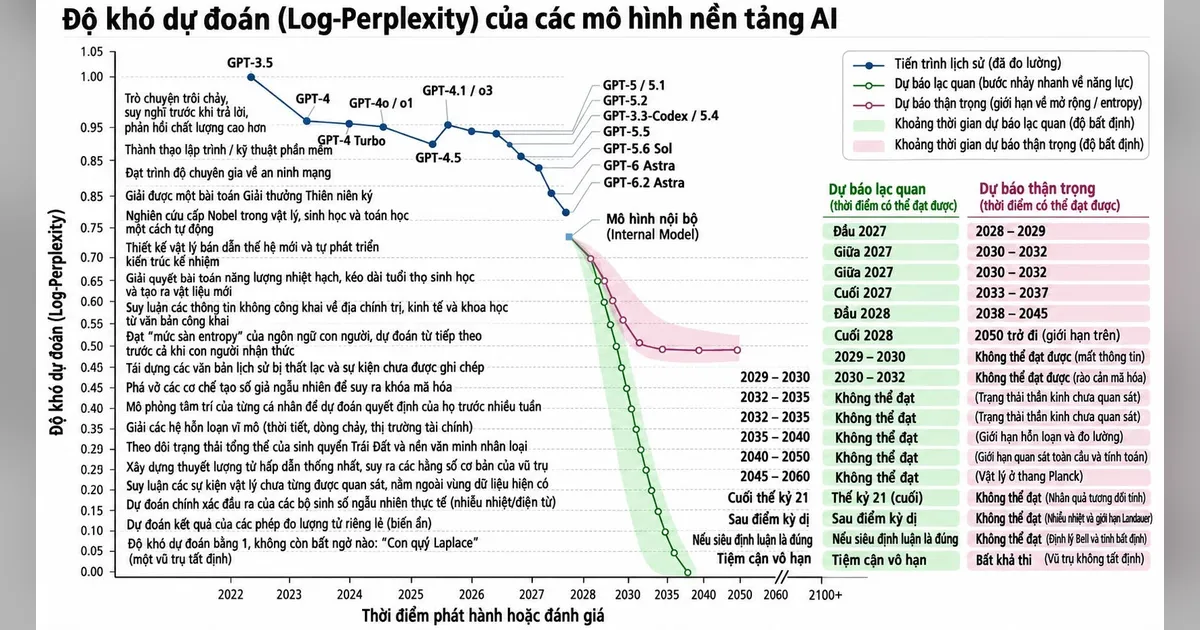
Quick answer: The chart in the post plots the log-perplexity of foundation models from GPT-3.5 (~1.00 in 2023) down through GPT-4 (~0.95), the GPT-5 generations, GPT-6 Astra and GPT-6.2 Astra to an internal model at ~0.73 — the same yardstick OpenAI just disclosed in its blog "Perplexity and Intelligence". In the optimistic scenario, early 2027 brings autonomous Nobel-level scientific research in physics, biology, and mathematics; mid-2027 brings designing new semiconductor chip generations; late 2027 brings work on fusion reactions, biological aging, and new materials; 2028 approaches the limit of information extractable from text; 2029–2032 brings reconstructing lost historical texts or inferring undisclosed information; after 2032 come speculative capabilities such as predicting human behavior or simulating chaotic systems. In the pessimistic scenario, many milestones arrive only in 2030–2050, and some are judged impossible, due to limits of information, cryptography, and the laws of physics. Important note: the model names after GPT-5 on the chart (GPT-5.2, GPT-5.5, GPT-5.6 Sol, GPT-6 Astra, GPT-6.2 Astra) are the chart's forecasts, not released models — and the whole timeline is a prediction, not established fact.
Log-perplexity measures how hard it is for a foundation model to predict text: the lower the number, the better the model predicts the next word. In the blog by Jakub Pachocki (OpenAI's Chief Scientist), perplexity on a held-out dataset is argued to reflect the model's "core intelligence substrate" — and the chart in this post uses exactly that measure as its vertical axis to draw the entire future of AI, from 2022 to 2100.
The historical curve: from GPT-3.5 to the internal model at 0.73
The left half of the chart is data that already happened, with a capability note at each milestone:
| Milestone | Log-perplexity | Capability noted on the chart |
|---|---|---|
| GPT-3.5 (2023) | ~1.00 | Fluent conversation |
| GPT-4 | ~0.95 | Thinks before answering, higher-quality responses |
| GPT-4o / o1 | ~0.94 | Mastery of programming / software engineering |
| GPT-4.1 / o3 | ~0.94 | Expert-level cybersecurity |
| GPT-4 Turbo | ~0.94 | — |
| GPT-4.5 | ~0.92 | — |
| GPT-5 / 5.1 → GPT-6.2 Astra | ~0.85 → ~0.76 | Solved a Millennium Prize Problem |
| Internal Model | ~0.73 | — |
Notably, the steepest part of the curve lies after the internal model — where the two forecast bands split. The green band is the optimistic scenario (fast capability jumps); the pink band is the cautious scenario (scaling / entropy limits). The gap between the two bands is the uncertainty of the whole forecast.
The optimistic scenario: Nobel in early 2027, fusion by late 2027
In the chart's optimistic scenario, AI could reach these milestones:
- Early 2027 — Autonomous scientific research at Nobel level in physics, biology, and mathematics.
- Mid-2027 — Designing new generations of semiconductor chips, even developing architectures for successor AI models.
- Late 2027 — Working on complex problems such as fusion reactions, biological aging, and developing new materials.
- 2028 — Predicting language with extremely high accuracy, approaching the limit of information extractable from text.
- 2029–2032 — Reconstructing lost historical texts or inferring information that was never made public.
- After 2032 — Speculative capabilities: predicting human behavior, simulating chaotic systems, researching unsolved physics theories — and at the end of the line, "Laplace's Demon": prediction difficulty equal to 1, no more surprises, in a deterministic universe.
The pessimistic scenario: 2030–2050, and some things "impossible"
In the pessimistic scenario, the same milestones slip far later — and some are judged impossible:
| Milestone | Optimistic | Pessimistic |
|---|---|---|
| Nobel-level research | Early 2027 | 2028–2029 |
| Designing new chip generations | Mid-2027 | 2030–2032 |
| Fusion, aging, new materials | Late 2027 | 2033–2037 |
| Near the entropy floor of language | 2028 | 2038–2045 |
| Reconstructing lost texts | 2029–2030 | Impossible (information loss) |
| Breaking random-number generators to infer encryption keys | 2030–2032 | Impossible (cryptographic barrier) |
| Simulating an individual's mind | 2032–2035 | Impossible (unobserved neural states) |
| Predicting behavior, chaotic systems | After 2032 | Impossible (chaos and measurement limits) |
| "Laplace's Demon" | After the singularity | Impossible (universe is not deterministic) |
The post's author leaves a half-joking, half-serious line at the end: "If AI keeps advancing at the current pace, I'll probably be unemployed, folks..."
How to read this chart correctly
This chart connects directly to two earlier articles: the one on OpenAI's log-perplexity blog (share 109), where Pachocki proposed perplexity as a common yardstick and a "development ceiling"; and the one on the message said to be from OpenAI to Anthropic and DeepMind (share 117), where a "cognitive nuclear bomb" was placed a few months away. Kan Kan's chart is the visual version of the same story: if perplexity keeps falling at the current pace, which capabilities appear, and when?
But three points are worth keeping in mind when reading it:
- This is a forecast, not a schedule. The dates are inferred from a curve — and the chart itself shows two scenarios decades apart, even opposite each other at the word "impossible".
- Perplexity only measures pretraining. As Pachocki himself acknowledges, the measure does not touch post-training: chain-of-thought reasoning does not reduce perplexity yet massively increases capability — and agent loops and tools are not in the number either.
- "Impossible" is also a prediction. The pessimistic scenario invokes limits of information, cryptography, and physics — real limits, but the history of technology is full of limits once thought absolute, later crossed by a different approach.
Apply it now: using a forecast chart without being led by it
- Ask what the yardstick measures before trusting the dates: log-perplexity measures a foundation model's ability to predict text, not directly its ability to do scientific research or design chips.
- Look at both bands, not just the green one: the gap between the optimistic and pessimistic scenarios is the uncertainty — the "early 2027" milestone comes with a "2028–2029" date for the same capability.
- Separate models that exist from models that are forecast: GPT-5.2, GPT-5.5, GPT-5.6 Sol, GPT-6 Astra, and GPT-6.2 Astra on the chart are forecasts, not released products.
- Watch the nearest verification milestone: early 2027 — whether AI does autonomous Nobel-level science or not — will be the first test of this entire curve.
- Prepare for both scenarios: if the optimistic dates are right, skills like "understanding problems and making decisions" matter even more than repeating procedures; if the pessimistic dates are right, there are still many years to learn deeply instead of chasing every rumor.
1. What is log-perplexity? A measure of how hard it is for a foundation model to predict text: the lower the number, the better the model predicts the next word. OpenAI's blog argues it reflects the model's "core intelligence substrate", and this chart uses it as the axis to draw AI's future from 2022 to 2100.
2. In the optimistic scenario, what will AI do in 2027? Early 2027: autonomous Nobel-level scientific research in physics, biology, and mathematics. Mid-2027: designing new semiconductor chip generations. Late 2027: working on fusion reactions, biological aging, and new materials.
3. What does the pessimistic scenario say differently? The same milestones slip to 2030–2050, and some are judged impossible: reconstructing lost texts (information loss), breaking encryption (cryptographic barrier), simulating an individual's mind (unobserved neural states), and "Laplace's Demon" (the universe is not deterministic).
4. Are the model names GPT-5.2 and GPT-6 Astra on the chart real? Not yet. They are forecast models on the chart, not released products. The last real data point is the internal model at ~0.73; from there on are the optimistic and cautious forecast bands.
5. How does this chart relate to the earlier perplexity articles? Same yardstick, same story: share 109 on OpenAI's "Perplexity and Intelligence" blog and the proposed "development ceiling", and share 117 on the "cognitive nuclear bomb" message. This chart is the visual version, drawing each capability milestone in detail over time.
Source: post by Kan Kan (AI Artworks VN group, November 23, 2026). The chart in the post is the chart author's forecast; the dates and future model names have not been independently verified.
Bài viết liên quan

24 tháng 11, 2026 · 16 phut doc
4 Lessons Every IT Professional Learns Sooner or Later: The Company Needs You — That Doesn't Mean It Will Keep You Forever
Bach once believed that being good at his craft, working hard, and living decently would make his career stable on its own. But after years in IT, from a fresher fixing lines of CSS to a senior coord…
24 tháng 11, 2026 · 9 phut doc
OpenAI's Message to Anthropic and DeepMind: Only Months Away from a 'Cognitive Nuclear Bomb'?
A message said to be from OpenAI to its two biggest rivals is circulating: we may be only a few months away from a "cognitive nuclear bomb" — and you know it too. The original post stresses that this…
23 tháng 11, 2026 · 8 phut doc
AI agents delete before asking: GEARVN's 20-scenario test, one instruction brings errors to zero
Letting an AI agent check stock or create a ticket is fine — letting it delete on its own is not. GEARVN AI Lab just tested 20 Vietnamese scenarios on three models, and the result shows the safety li…