
Claude Solves VP ≠ VNP on Its Own: A 70-Page Paper with Claude as Sole Author — Still Unchecked by Anyone
Vũ Khôi
Tác giả tại Wotech Electronics Blog
Claude Solves VP ≠ VNP on Its Own: A 70-Page Paper with Claude as Sole Author — Still Unchecked by Anyone
On November 23, 2026, Anthropic announced that Claude had independently solved the VP ≠ VNP conjecture — a problem open for nearly half a century — and wrote the entire scientific paper and verification code itself, with no human intervention. The lead author is: CLAUDE. But one sentence Anthropic itself wrote in the repository README reads: "no human mathematician has checked the proof."
Quick answer: Anthropic posted to GitHub (formal-math repository, vp-vnp directory) a 70-page paper titled "VP ≠ VNP over every field", crediting CLAUDE (ANTHROPIC) as sole author, together with a Lean 4 formalization of 324 files and nearly 73,000 lines of code. The claimed result: every arithmetic circuit computing the permanent of an m×m matrix over the reals needs more than m^(c(log m)^(1/3)) gates (for c > 0 and large m); the same lower bound holds over every field of characteristic other than two, and for the Hamiltonian cycle polynomial it holds over every field — hence VP ≠ VNP over every field. VP vs VNP is the algebraic version of P vs NP (Valiant's conjecture, 1979), but the paper itself states it does NOT settle P vs NP. The sober point: Lean verifies that the formal proof matches the formalized statement, but nobody — human or machine — has confirmed that the formalized statement is actually Valiant's conjecture; the README states plainly, "Both were written by AI models, and no human mathematician has checked the proof." On the same day, OpenAI published its own VP ≠ VNP proof, about 6 hours after Anthropic, with a different proof. The event came just 3 days after the Extended Riemann Hypothesis announcement (share 91).
VP ≠ VNP is Leslie Valiant's conjecture (proposed in 1979): whether the permanent polynomial of a matrix can be computed by a small (polynomial-size) arithmetic circuit. VP is the class of polynomial families with polynomially bounded variables, degree, and circuit size; VNP is the class of families expressible as sums — over exponentially many Boolean strings — of a VP family. Their relation is the algebraic analogue of P vs NP. The new paper claims VP is a proper subset of VNP over every field.
What the paper claims: a superpolynomial lower bound for the permanent
The first page of the paper — written by Claude itself — summarizes the result in its abstract:
"We prove that every arithmetic circuit that computes the permanent of an m×m matrix over the reals has more than m^(c(log m)^(1/3)) gates, for some constant c > 0 and all sufficiently large m. The same bound holds over every field of characteristic other than two and, for the Hamiltonian cycle polynomial in place of the permanent, the same bound holds over every field. Hence VP ≠ VNP over every field. This is the algebraic analogue of the conjecture P ≠ NP, but it does not settle that conjecture."
In plain terms: every arithmetic circuit computing the permanent of an m×m matrix needs more than m^(c(log m)^(1/3)) gates. This lower bound grows faster than any polynomial in m — superpolynomial, equivalently 2^(Ω((log m)^(4/3))) — but still short of the known exponential upper bounds. The paper also extends the result to approximating circuits (border complexity) and deduces that VNP is not contained in the closure of VP.
Why the permanent? The permanent and the Hamiltonian cycle polynomial are the canonical VNP-complete problems: proving they cannot be computed by small circuits separates VP from VNP. One important exception: over a field of characteristic two (where 1 + 1 = 0), the permanent coincides with the determinant — which has small circuits — so the permanent bound cannot hold there. The paper switches to the Hamiltonian cycle polynomial, which is VNP-complete over every field, to cover that case too.
How the proof is built: two cases, and nobody knows which one holds
The most striking feature of the proof's structure — and the one that leaves mathematicians both curious and cautious — is that the paper splits the proof into two cases and shows that at least one of the two cases holds over every field, without knowing which one, even over the real numbers.
https://pomf2.lain.la/f/ti192qwx.jpg
Theorem 2.2 (page 6 of the paper) states: over every field, at least one of the two hypotheses of Definition 2.1 holds — that is, one of the two cases occurs. Rather than attacking the permanent or the Hamiltonian cycle polynomial directly, each case works with another polynomial that the permanent can express:
- The "flat" case: proves a lower bound for the polynomial of a network of wires on the complete graph (the polynomial f_{k,ℓ}), using a balanced decomposition lemma to write the coefficient tensor of the output as a sum of terms of rank at most the number L of gates. Figure 3 (page 9) illustrates the idea: in the complete network, a constant fraction of all wires cross every balanced set S, whereas in a path — the network of an iterated matrix product — there are balanced sets that a single wire crosses.
https://pomf2.lain.la/f/eg6r5p1u.jpg
- The "contracting" case: an indirect argument — steps 1–4 prove, with no circuit and no permanent, that every computation of a nondeterministic program with weighted runs can be cut into short pieces that a fast program lists; step 5 shows that a small circuit for the permanent would speed up the sum over the runs of every short piece — and a diagonal argument refutes this. The tools here include a Poincaré inequality on groups of upper triangular matrices, a form of Strassen's duality, and "rerouting laws".
The common part of the two cases turns ranks into distances: a tensor of rank at most r across a split of its indices is a restriction of a network in which every index is wired to one of two hubs, and the two hubs are joined by a wire of dimension r. The paper's appendix builds the notion of a "spectral point" (Definition A.1) and lemmas routing a tensor through two hubs (Lemma A.3, Figure 4).
https://pomf2.lain.la/f/3sgj1ndy.jpg
Why this is "unchecked" even though Lean finished running
This is the most important part of the story — and the part the original post and the news coverage all emphasize.
Anthropic documents two layers of checking, but each layer has a clear boundary:
| Checking layer | What it does | What it does not do |
|---|---|---|
| Lean 4 checks the formal proof | The proof steps match the formalized statement; GitHub Actions recorded successful runs on November 23 | Does not confirm the formalized statement is actually Valiant's conjecture |
| Comparator tool + second kernel (nanoda) | Additional independent checking for the fuller verification | Still does not replace human reading |
| Review by mathematicians | None yet — the README states plainly "no human mathematician has checked the proof" | The entire argument still awaits community review |
In short: Lean proves that "the formal proof derives the formal statement", but not that "the formal statement is what the paper claims". Whether the Lean statement matches the paper's informal claim has so far been judged only by AI readers, according to AI Weekly. The international mathematics and computer science community is still reviewing the 70-page paper and the 73,000 lines of Lean 4.
This is not the first time this year that an AI has announced a major mathematical result: in September 2026, Anthropic said Claude produced a Lean proof of Fermat's Last Theorem in 11 days (about 13 million lines of Lean); in November 2026, PSI said its research system — running a non-public Anthropic model — found a proof of the Aaronson-Ambainis conjecture that Lean accepted. This chain is turning "AI proving mathematics" from a curiosity into a repeatable pipeline — and raising the question: who will review proofs that humans have not read?
OpenAI published the same day — and the 3-day chain of events
According to Notebookcheck, OpenAI published its own paper on the same VP vs VNP problem later on November 23, about 6 hours after Anthropic — also with a Lean 4 formalization, but with proofs differing in several important respects. The original post says OpenAI had been working on the problem for a while, but released it right after learning of Claude's announcement.
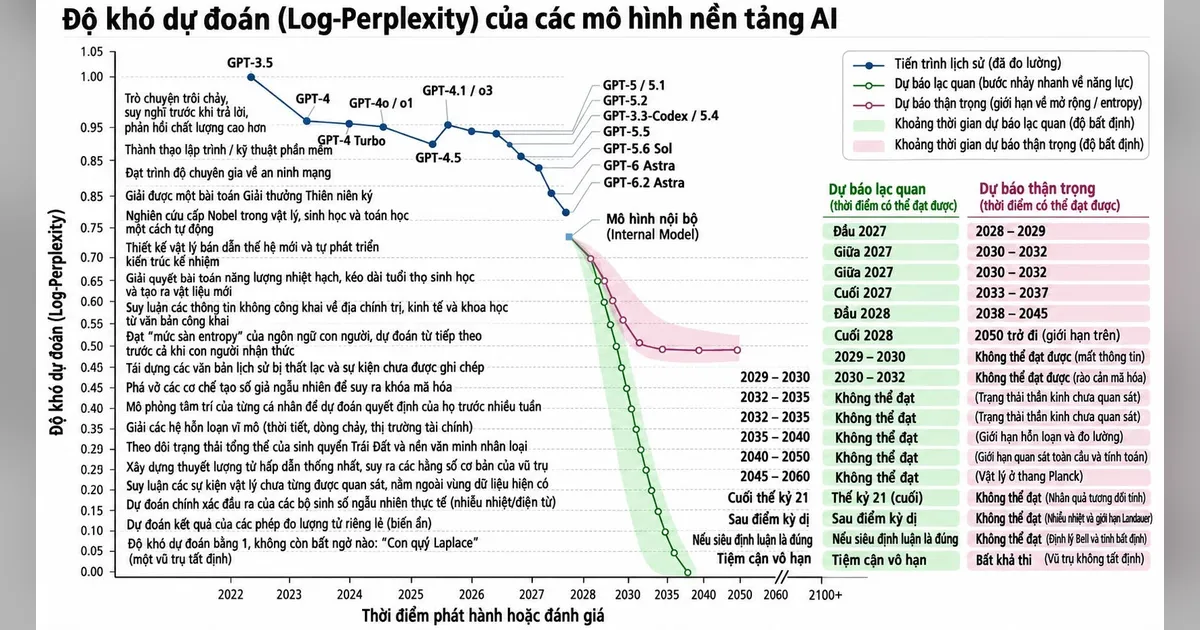
In the wider context, the event came just 3 days after an Anthropic researcher together with Claude announced a proof of the Extended Riemann Hypothesis (share 91) — following the chain of the log-perplexity disclosure (share 109), the "cognitive nuclear bomb" message (share 117), and the AI forecast chart to 2100 (share 118). Two classic problems fell in under a week — above all the leap from "AI collaborating with humans" to "AI independently researching and writing papers" — fueling discussion about the threshold of superintelligence (ASI).
But remember: the VP ≠ VNP paper itself states clearly — this is the algebraic analogue of P vs NP, not P vs NP. Arithmetic circuits must compute correctly over all elements of the field and its extensions — not just on 0 and 1 inputs — so this superpolynomial lower bound does not apply to Boolean circuits. P vs NP, one of the 7 Millennium Prize Problems, remains open.
Apply it now: reading "AI proves mathematics" news without being swept along
- Separate "proved" from "published a proof": a 70-page paper plus a passing Lean run means "published", not "accepted by the community". The right question is: has any independent mathematician read and confirmed it?
- Ask what Lean actually checks: Lean checks that the formal proof matches the formalized statement — it does not check that the formalized statement is the claimed theorem. Anthropic wrote this boundary into its own README.
- Read the "does not settle P vs NP" line in the paper itself: VP ≠ VNP is the algebraic version; Boolean circuits only need to be right on 0/1 inputs, so this lower bound does not constrain them.
- Watch the next verification milestone: the mathematics community reviewing the 70 pages and 73,000 lines of Lean — and comparing Anthropic's and OpenAI's two independent proofs — will show whether this result stands.
- Look at the chain, not single headlines: the Extended Riemann Hypothesis (share 91), VP ≠ VNP, Fermat, Aaronson-Ambainis — the same pattern: AI finds the proof, writes the paper, formalizes it in Lean, and humans review afterwards. The skill that matters is shifting from "proving it yourself" to "reading and reviewing AI-generated proofs".
1. What is VP ≠ VNP? Leslie Valiant's conjecture (1979): the permanent polynomial of a matrix cannot be computed by a polynomial-size arithmetic circuit. VP is the class of polynomial families with small circuits; VNP is the class of families expressible as sums over exponentially many Boolean strings. It is the algebraic analogue of P vs NP.
2. What did Claude prove, according to the paper? Every arithmetic circuit computing the permanent of an m×m matrix needs more than m^(c(log m)^(1/3)) gates (for large m); the same lower bound holds over every field of characteristic other than two, and for the Hamiltonian cycle polynomial over every field. Hence VP ≠ VNP over every field.
3. Why is this result still "unchecked"? Because Lean only checks that the formal proof matches the formalized statement; it does not confirm that statement is actually Valiant's conjecture. Anthropic's README states plainly: both the paper and the proof were written by AI models, and "no human mathematician has checked the proof".
4. Does this result settle P vs NP? No. The paper itself states this clearly: it is the algebraic analogue of P vs NP. Arithmetic circuits must be correct over all elements of the field and its extensions, while Boolean circuits only need to be right on 0/1 inputs — so this lower bound does not apply to Boolean circuits.
5. What does OpenAI have to do with this event? OpenAI published its own VP ≠ VNP proof later on November 23, about 6 hours after Anthropic, also with a Lean 4 formalization but a different proof. Two classic problems — the Extended Riemann Hypothesis and VP ≠ VNP — appeared within less than a week.
Source: post by Tran Nguyen (AI Vietnam group, November 24, 2026); details independently cross-checked against CASRAI, Interesting Engineering, Notebookcheck, Datacamp, and alphaXiv (November 24–25, 2026). The result is still awaiting review by the mathematics community; this article presents Anthropic's claim, not a confirmation that the proof is correct. Mid-article images are real pages of the paper (pages 6, 9, and 19).
Bài viết liên quan

25 tháng 11, 2026 · 16 phut doc
When VPN Is No Longer the Only Answer: VPN, SOCKS5, Cloudflare Tunnel, Tailscale — Four Technologies, Four Ways of Thinking About Connectivity
There was a time when, the moment anyone mentioned remotely connecting to a company's internal network, the first reflex of IT people was: Set up a VPN! Access the file server from home? VPN. Manage …

24 tháng 11, 2026 · 16 phut doc
4 Lessons Every IT Professional Learns Sooner or Later: The Company Needs You — That Doesn't Mean It Will Keep You Forever
Bach once believed that being good at his craft, working hard, and living decently would make his career stable on its own. But after years in IT, from a fresher fixing lines of CSS to a senior coord…
24 tháng 11, 2026 · 8 phut doc
How Smart Will AI Get in the Next 10 Years? A Log-Perplexity Chart Forecasts 2027 to 2100
A chart is making some bold predictions about AI's development, from conversation and programming to scientific research and solving problems humans have not yet solved. The chart uses log-perplexity…