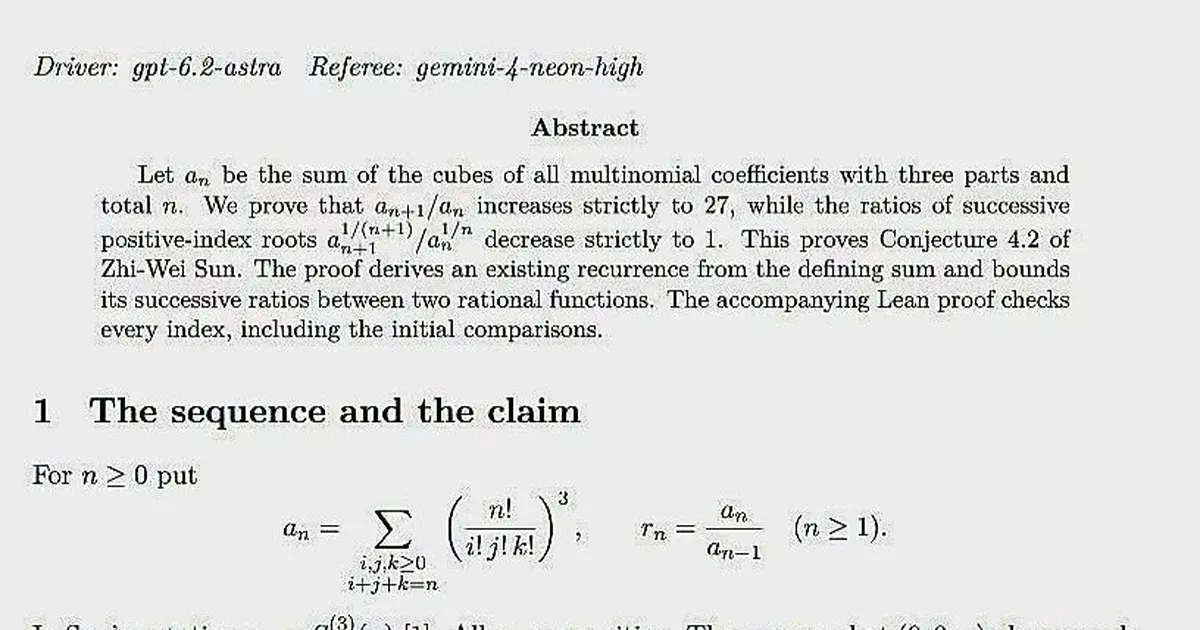
A Non-Mathematician Used AI to Solve 3 Open Math Conjectures in a Few Hours: What Matters Is Not the AI's Ability
Vũ Khôi
Tác giả tại Wotech Electronics Blog
A Non-Mathematician Used AI to Solve 3 Open Math Conjectures in a Few Hours: What Matters Is Not the AI's Ability
An account named Lumina has just shared results from using GPT-6.2 Astra to work on 3 open mathematical conjectures in just a few hours. Specifically, the system proved Conjecture 4.2 of Zhi-Wei Sun, proved Conjecture 5.2 of Benfield and Lippard, and found a counterexample disproving Conjecture 5.4 by the same two authors. Judged by results alone, that is already a notable achievement. But what makes this story worth thinking about is not the AI's ability.
Quick answer: Lumina (@LuminaBench on X) says they used GPT-6.2 Astra to solve 3 open math conjectures in a few hours: proving Zhi-Wei Sun's Conjecture 4.2 and Benfield & Lippard's Conjecture 5.2, and disproving their Conjecture 5.4 with a counterexample. Lumina's repository now holds 7 Lean-verified papers. The key point is not a powerful model, but the harness: every proof had to pass Lean 4, then be independently checked by blind audit from Gemini 4 Neon or Claude Opus 5.5, and cross-checked directly against the statements in the original arXiv papers — so the AI could not quietly rewrite the problem into an easier one and declare it solved. The boundary to state clearly: these are self-published results, not peer-reviewed, with no independent verification from the mathematical community yet; the repository's own README states that Lean verification is distinct from peer review and priority claims.
The harness — in this story — is the whole verification system built around the model: Lean 4 checking the validity of the mathematical proof, another model performing an independent blind audit, and the content cross-checked against the statements in the original arXiv papers. The first page of the paper on Sun's Conjecture 4.2 says it right at the top: "Driver: gpt-6.2-astra — Referee: gemini-4-neon-high". One model drives, one model referees. That is the structure of the whole project.
What are the 3 conjectures?
| Conjecture | Result according to Lumina | Content |
|---|---|---|
| Conjecture 4.2 of Zhi-Wei Sun | Proved | With a_n the sum of the cubes of multinomial coefficients with three parts totalling n: the ratio a_{n+1}/a_n increases strictly to 27, while the ratios of successive positive-index roots decrease strictly to 1 |
| Conjecture 5.2 of Benfield & Lippard | Proved | Proved all 4 cells of Table 8 under the parity conditions of Theorem 4.27 |
| Conjecture 5.4 of Benfield & Lippard | Disproved by counterexample | Both ways: (0, -2) has unbounded zero counts that never hit 2; a strictly positive family starting at (2, 8) that never exceeds 1 |
According to Lumina, the repository now holds 7 Lean-verified papers. Another interesting detail: according to the post, Lumina says they have no special mathematics background, having taken only a few mathematics courses at university. What made the difference was not only the model — it was the system built around it. The author also admits that building the harness for this process took an enormous amount of effort, especially because mathematical statements are very hard to handle.
Why is the checking method the real point?
An AI model can produce a solution that sounds very convincing. But a convincing solution is not the same as a correct one.
In this case, the results had to pass several layers of verification:
- Lean 4 checks the validity of the mathematical proof. The AI cannot rewrite the problem into an easier version and declare it solved. It must prove exactly the original mathematical statement. If the reasoning is wrong, Lean 4 rejects it.
- Other models perform an independent blind audit. Gemini 4 Neon or Claude Opus 5.5 re-check the proof without knowing the expected result in advance.
- The content is cross-checked against the statements in the original arXiv papers. To make sure what was proved is what the original authors actually stated — not a version made easier along the way.
In other words, the builder did not just ask the AI to solve the problem. They also designed a system tight enough to catch the AI when it makes a mistake. And that is the value of the harness.
This is the same lesson as share 139 (a harness of 3 agents around one prompt) and share 143 (the Lean kernel as the ultimate evaluator, which cannot be persuaded by words): do not let the model grade its own work.
The bigger picture: numbers that have been verified
Lumina's story does not stand alone. On Epoch AI's FrontierMath Erdős benchmark — 68 problems by Paul Erdős still open as of August 2026, each requiring the AI to write a complete proof in Lean — GPT-6.2 Astra solved 7 of 68 problems, each formally verified in Lean, including one for which no prior solution was known. The previous record was 3 of 68, held by GPT-6.1 Sol. GPT-6.2 Astra was released on November 17, 2026, and also leads the Epoch Capabilities Index at 174 points.
According to the post, on October 6 OpenAI also published more than 700 mathematics manuscripts, about 300 of which have proofs formalized in Lean. Wotech has not independently verified this figure, so it is recorded as the post states it. Similarly, the post says that in September, 25 Fields Medalists, including Terence Tao, signed a statement warning about the misalignment between AI companies' goals and the real needs of the mathematical community — Tao has also spoken about AI producing proofs that humans find very hard to read and understand. This information is likewise recorded as the post states it, not independently verified.
These two issues must be seen separately: a proof can be formally correct yet still too complex for humans to understand. It is the same with programming. An application that runs does not necessarily have good source code. A piece of code that passes every test is not necessarily easy to maintain, extend or hand over to someone else.
The other side of the story — read this before getting excited
Precisely because the post states its own boundaries, this article must state the rest:
- These are self-published results, not peer-reviewed. The "solved-conjectures" repository states its notes are unrefereed, and that computational checks and Lean verification are distinct from peer review and priority claims. As of writing, there is no independent verification from the mathematical community of these 3 new results.
- Being good at deduction is not the same as being good at invention. The TCSExam benchmark from Tsinghua University and Moonshot AI shows: GPT-6 Astra proved 70% of the Lean theorems it was given — but solved exactly 0 of the 30 open conjectures it was handed. Strong inside a known scaffold, weak where invention is needed. Lumina's three conjectures are small, specific problems — very different from a Millennium problem like share 143.
- "Formally correct" and "humanly understandable" are two different things. This is also Professor Ngô Bảo Châu's warning in share 125 (the "dinosaur graveyard"): proofs humans do not fully understand. Lean accepts the reasoning steps; it does not explain why they are true.
From mathematics to how we use AI every day
The post draws a principle that anyone using AI Agents at work will recognize: do not put all your trust in a model's answer — build a verification loop.
For programming, that loop can be:
- AI writes the code.
- Run tests to check behaviour.
- Compile and type-check to catch errors.
- Compare the result against the original requirements.
- If it fails, go back, fix and check again.
A model can write code very fast, but it is the verification steps that keep us from trusting a piece of code just because it looks plausible.
AI can help us produce results faster. But understanding those results, judging their quality and taking responsibility for them is another story.
Perhaps the question most worth thinking about is not which model is smarter, but: if tomorrow the familiar AI model were gone, would our working system still be able to verify results on its own? Or have we grown used to trusting answers that sound too plausible?
Apply it now
- Build the harness before trusting the model: for code, that is tests + compile + type check + comparing against requirements; for content, that is sources + cross-checking numbers. Without a verification loop, AI's speed only makes mistakes arrive faster.
- Separate the "driver" from the "referee": one model writes, another model (or a checking tool) grades — exactly the Driver/Referee structure in Lumina's paper. Do not let the same model write and then praise its own work.
- Cross-check against the original statement, not a summary: Lumina cross-checks against the original arXiv papers so the AI cannot make the problem easier. When you delegate work to AI, keep the original requirements for comparison instead of only reading what it returns.
- Distinguish "correct" from "understandable": a Lean-accepted proof, a piece of code that passes every test, can still be something nobody can maintain. The quality of a result is not in the PASS stamp.
- Read the source's own self-limits: Lumina's repository labels itself "unrefereed" — Lean verification is not peer review. Before sharing a shocking result, read where its own author limited it.
Frequently asked questions
1. Did Lumina really solve 3 open math conjectures? According to Lumina's own statements on X and the github.com/LuminaBench/solved-conjectures repository: they proved Sun's Conjecture 4.2 and Benfield & Lippard's 5.2, and disproved 5.4 with a counterexample, all through Lean 4 and blind audit. But these are self-published results, not peer-reviewed, and there is no independent verification from the mathematical community yet. Read them as claims with machine-checkable evidence attached — not as conclusions the community has confirmed.
2. What is a blind audit, and why does it matter? It is an audit in which the checker does not know the expected result in advance: Gemini 4 Neon or Claude Opus 5.5 re-checks the proof and compares it against the original arXiv statements. It matters because it blocks the two most common ways AI cheats: rewriting the problem to make it easier, and grading its own work.
3. How strong is GPT-6.2 Astra at mathematics? On Epoch AI's FrontierMath Erdős (68 open Erdős problems), GPT-6.2 Astra solved 7 of 68, against a previous record of 3 of 68 — confirmed by Epoch AI. But on Tsinghua and Moonshot AI's TCSExam, GPT-6 Astra proved 70% of the Lean theorems it was given yet solved none of the 30 open conjectures. Strong at deduction inside a known scaffold, not yet strong at invention.
4. How is a harness different from a good prompt? A good prompt helps a model answer better in one shot. A harness is the whole system around the model: who writes, who grades, with what tools, cross-checked against what, and what happens when it fails. In this story, the harness is Lean 4 + blind audit + arXiv cross-checking — and it, not the model name, is what makes the results trustworthy.
5. How does this article relate to earlier math articles on Wotech? The same series: share 91 (the original 17-million-line Riemann proof), share 143 (the shortened 76,000-line edition and independent verification), share 125 (Professor Ngô Bảo Châu's warning about proofs humans do not fully understand). This article is the next chapter of the same question — this time not a large research group, but a non-mathematician with a tight enough harness: Lean 4 + blind audit. And the same boundary: formally correct is not yet community-confirmed.
Source: Facebook post by the page "Học lập trình cho người mới bắt đầu" (28/11/2026), summarizing Lumina's (@LuminaBench) posts on X and the github.com/LuminaBench/solved-conjectures repository. FrontierMath Erdős figures were cross-checked against Epoch AI; TCSExam results against coverage of the Tsinghua/Moonshot AI benchmark. OpenAI's 700 mathematics manuscripts and the statement by 25 Fields Medalists are recorded as the post states them, not independently verified. The cover is the first page of the paper on Sun's Conjecture 4.2, attached to the post.
Bài viết liên quan

28 tháng 11, 2026 · 11 phut doc
76,000-Line Riemann Hypothesis Proof Passes Independent Verification: MIT and Waterloo Confirm 794 of 794 Modules
A 76,000-line Lean proof of the Riemann Hypothesis has just passed independent verification carried out by professors at MIT and the University of Waterloo. All 794 modules were accepted, not one rej…

27 tháng 11, 2026 · 10 phut doc
Antigravity + Gemini 4 Neon Handbook: 7 Levels of Using AI Agents, From One Chat Box to a Whole Team Working for Days
Codila, an AI researcher and software engineer on X, just wrote a very long guide to Google Antigravity running Gemini 4 Neon. Phong Ho's post summarizes the parts you can follow right away — and the…

27 tháng 11, 2026 · 10 phut doc
Company Fires 2 Engineers on $160,000 Salaries, Makes a $26,000 Employee Do All Three Jobs With Claude Code
Two engineers earning over $160,000 a year were let go. The company kept one employee on $26,000, gave him Claude Code, and expected him to cover the work of all three. Headcount costs fell sharply. …