
76,000-Line Riemann Hypothesis Proof Passes Independent Verification: MIT and Waterloo Confirm 794 of 794 Modules
Vũ Khôi
Tác giả tại Wotech Electronics Blog
76,000-Line Riemann Hypothesis Proof Passes Independent Verification: MIT and Waterloo Confirm 794 of 794 Modules
A 76,000-line Lean proof of the Riemann Hypothesis has just passed independent verification carried out by professors at MIT and the University of Waterloo. All 794 modules were accepted, not one rejected. Notably, this is the same proof that caused controversy for its scale of 17.4 million lines of code, before Claude compressed it to under 1% of its original size.
Quick answer: On November 25, 2026, Anthropic researcher Luke Sernau posted to GitHub two shorter rewrites of the Alpöge–Claude proof: a "readable" edition of about 300,000 lines (803 modules, with a reading guide) and a "compact" edition of about 76,000 lines (794 modules). Both prove the same five theorems as the original. Independent verification: Professor Andrew Sutherland (MIT) ran a sandboxed
lake comparator --paranoidand confirmed "Your solution is okay!" for both editions on November 26; Professor Michael Rubinstein (Waterloo) confirmed the compact edition compiled all 794 of 794 modules, with kernel replay accepting 794 and rejecting 0, six independent type-checking kernels all passing, and no extra axioms beyond Lean's three standard axioms. But the Riemann Hypothesis is still not officially solved: no mathematician has read the whole proof, there is no refereed paper, and the Clay Mathematics Institute has not recognized it or awarded the $1 million prize.
The Riemann Hypothesis concerns where the zeros of the zeta function lie — and through that, how prime numbers are distributed — a problem that has challenged humanity's best minds for 167 years, with a $1 million prize from the Clay Mathematics Institute. This proof also covers the GRH (Generalized Riemann Hypothesis) for Dirichlet L-functions, a family extending the zeta function.
From 17.4 million lines to 76,000 lines
| Original (Nov 20, 2026) | Compact edition (Nov 25, 2026) | Readable edition (Nov 25, 2026) | |
|---|---|---|---|
| Author | Levent Alpöge, with Claude | Luke Sernau, with Anthropic colleagues and Claude | Same as the compact edition |
| Size | 17,374,215 lines, 175,187 files | About 76,000 lines of code, 794 modules | About 300,000 lines of code, 803 modules, with a reading guide |
| Platform | Lean 4 | Lean v4.35.0, Mathlib commit 56a00585, pinned commit 72fead10 | Same as the compact edition |
When the first proof was published, many doubted its real value. 17.4 million lines of AI-assisted code. Who would read it all? Who would audit it? How could anyone know it contained no errors humans had not spotted? Some even argued it was just a mountain of messy AI-generated code.
But Claude did something remarkable: it compressed the proof to about 76,000 lines — roughly 228 times smaller (a 99.56% cut) than the original — while it still passed the mathematical checkers. As Sernau describes it, the method was: unroll definitions into a very long, flattened proof, simplify it, then re-abstract it into a structured project. The repository's README states plainly: the Lean text and documents in the project were written by Claude (AI), under the direction of Anthropic colleagues; the work keeps Alpöge's method, but many steps are proved by other arguments.

Independent verification by MIT and Waterloo: 794 of 794 modules accepted
The verification was carried out by Professor Andrew Sutherland at MIT and Professor Michael Rubinstein at the University of Waterloo. The recorded results:
| Check | Performed by | Result |
|---|---|---|
| Full compile (Lean v4.35.0, Mathlib 56a00585) | Sutherland (MIT, sandboxed); Rubinstein (Waterloo, compact only); Sho Sonoda | Both editions compile with no errors |
| Kernel replay of every module (leanchecker) | Sutherland; Rubinstein (compact only) | Readable 803 of 803, compact 794 of 794 accepted |
Sandboxed lake comparator --paranoid |
Sutherland | "Your solution is okay!" for both editions, November 26 |
| 6 independent type-checking kernels | Rubinstein (Waterloo) | Lean default, Lean paranoid, nanoda, lean4lean, con-leche, con-ron — all accepted |
| Axioms used | — | Only Lean's three standard axioms: propext, Classical.choice, Quot.sound |
| Theorem statements | — | The Statements.lean file imports only Mathlib, identical to the statements checked for the original on November 20–21 |

At Waterloo, according to the post, Claude Code also helped coordinate the verification. And the story has not stopped: on November 27, Sutherland reported that the paranoid Comparator had accepted a Lean equivalence between the Riemann Hypothesis and Schoenfeld's explicit bound, derived using the compact edition — the shortened proof is already being used to derive new results.
For IT readers, imagine a codebase solving a problem nearly two centuries old, run through a battery of independent checking systems, and every one of them returning PASS.
Why is this time different from other AI claims of solving hard math problems?
Usually, when an AI produces a mathematical solution, we still face the question: is the AI fabricating an argument that merely sounds convincing?
But with Lean 4, AI cannot use language skills to persuade the checker that it is right. Every step of reasoning must follow the logical and mathematical rules defined in the system. No matter how good an argument sounds, it cannot replace a valid proof step.
Instead of asking humans to trust Claude's answer, researchers can use independent checkers to verify the proof. AI finds the solution. Computers verify. Humans study the result.
This is the same lesson as share 139: do not let an agent grade its own work — let an independent testing system that cannot be persuaded by words do it. The Lean kernel is the ultimate evaluator: it does not read prose, it runs every step.
What has not been proven — the important boundary
Passing formal verification is a major milestone, but the work still needs to be studied, reviewed and broadly accepted by the mathematical community. The Clay Mathematics Institute has not officially recognized the solution or awarded the $1 million prize. These points must be stated clearly, because the repository's README and independent sources all emphasize them:
- No mathematician has read the whole proof. The README states the code has passed machine checks only, that no mathematician has read it through, and that no paper comes with it.
- The machine accepts the theorems, not the "reasons". Lean confirms the statements follow the rules, but does not explain why they are true. Rubinstein posted a 265-page working draft explaining the proof for the zeta function (using Claude, Codex and Gemini as study aids) — but its key step reduces to thirteen numbered hypotheses, "none of which is proved outright" in the text itself, according to his own page.
- The community is now working on it. On November 24, three mathematicians — Anurag Sahay, Will Sawin and Lior Silberman — proposed the G.R.H. Polymath project to coordinate work on Alpöge's Lean proof, build a human-readable account of RH and GRH, and explore the mathematics behind the argument.
- The original was certified too. On November 21, the Lean FRO and the Mathlib Initiative certified that the original November 20 release's statement and proof are correct, and independent checks since then have passed.
In other words: computers have confirmed the reasoning steps are valid. Humans are still in the process of understanding what they mean — and whether the argument is correct in the sense the mathematical community requires.
A new method of scientific discovery is forming
What impresses the post's author most is not exactly the Riemann Hypothesis or the $1 million prize. It is how AI is joining the process of creating new knowledge:
- Exploring millions of different solution directions.
- Building proofs of enormous scale.
- Using verification systems to confirm validity.
- Removing redundant parts and simplifying results so humans can study them.
Imagine that in the future, a mathematician could mobilize hundreds of AI agents at once to study a problem many generations of scientists have failed to solve. Each agent tries a different approach. Wrong solutions are discarded. Valid solutions are developed and optimized further.
If this process truly works at scale, the speed of humanity's scientific discovery could change completely.
And the question the post leaves behind is also the biggest question of the whole Riemann series on Wotech (shares 91, 104, 125 and this one): for thousands of years, humans discovered knowledge, while machines were built to support humans. But if one day AI finds solutions the best human minds never thought of, verified by computers as valid, while humans need years to understand them… Will the future of science be humans using AI to discover knowledge, or humans studying knowledge discovered by AI?
Apply it now
- Do not claim "Riemann is solved" when sharing this news: what happened is that independent formal verification passed — there is no community recognition or Clay Institute award yet. Stating the boundary correctly is how you keep credibility.
- If you want to read the proof, start with Statements.lean: that file defines exactly what the machine checks certify — the repository's README advises reading it first.
- Apply the "AI finds, machines check, humans study" model to your own work: this is the mathematical version of the independent evaluator in share 139 — AI output is only trustworthy when a checker that cannot be persuaded by prose verifies it.
- Follow G.R.H. Polymath rather than just the news: that is where the mathematical community is doing the real work on the proof — the final verdict will come from there, not from a post.
- Remember that "machine-accepted" is not "human-understood": 76,000 lines is still far too much to read in one sitting — the 300,000-line readable edition with its reading guide is the entry point for anyone who wants to understand the argument.
Frequently asked questions
1. Has the Riemann Hypothesis officially been solved? Not yet. The compact 76,000-line edition has passed independent formal verification (MIT and Waterloo, 794 of 794 modules, 6 kernels), and the original November 20 release was certified by the Lean FRO and the Mathlib Initiative as correct in statement and proof. But no mathematician has read the whole proof, there is no refereed paper, and the Clay Mathematics Institute has not recognized it or awarded the $1 million prize. The mathematical community — through the G.R.H. Polymath project — is still studying it.
2. How is 76,000 lines different from 17.4 million lines? The same five theorems, the same Alpöge method, but rewritten: the compact edition (~76,000 lines, 794 modules) and the readable edition (~300,000 lines, 803 modules, with a reading guide), posted November 25 by Luke Sernau with Anthropic colleagues and Claude. The shortening method: unroll definitions into a very long flattened proof, simplify it, then re-abstract — about 228 times smaller (a 99.56% cut).
3. What does "6 independent kernels" mean? Six separate type-checking programs all ran on the proof: Lean default, Lean paranoid, nanoda, lean4lean, con-leche and con-ron. All six accepted the solution. Using multiple independent kernels rules out the possibility that a single bug in one checker skews the result.
4. Why is Lean 4 more trustworthy than AI's words? Because Lean's kernel does not listen to arguments in language — it checks every step of reasoning against defined logical and mathematical rules. No matter how good an argument sounds, it cannot replace a valid proof step. That is why the post says: AI finds the solution, computers verify, humans study the result.
5. How does this article relate to earlier Riemann articles on Wotech? The same story, a new development: share 91 covered the original 17-million-line proof (November 23); share 104 covered Alexandr Wang on superintelligence and this problem; share 125 covered Professor Ngô Bảo Châu's warning about a "dinosaur graveyard" — proofs humans do not fully understand. This article is the next chapter: the shortened 76,000-line edition and independent verification — new evidence for exactly the question Professor Châu raised.
Source: Facebook post by the page "Hỏi Dân it Offical" (27/11/2026), based on Luke Sernau's GitHub release lsernau/grh-lean (25/11/2026), Michael Rubinstein's verification page at the University of Waterloo, and Andrew Sutherland's MIT verification log. Additionally cross-checked with TechTimes, the riemannhypothesissolved.com status page (updated 28/11/2026) and maccus.fr. The cover is a screenshot of Waterloo's verification page; the mid-body images are photos attached to the post and the multi-kernel check log.
Bài viết liên quan
28 tháng 11, 2026 · 11 phut doc
A Non-Mathematician Used AI to Solve 3 Open Math Conjectures in a Few Hours: What Matters Is Not the AI's Ability
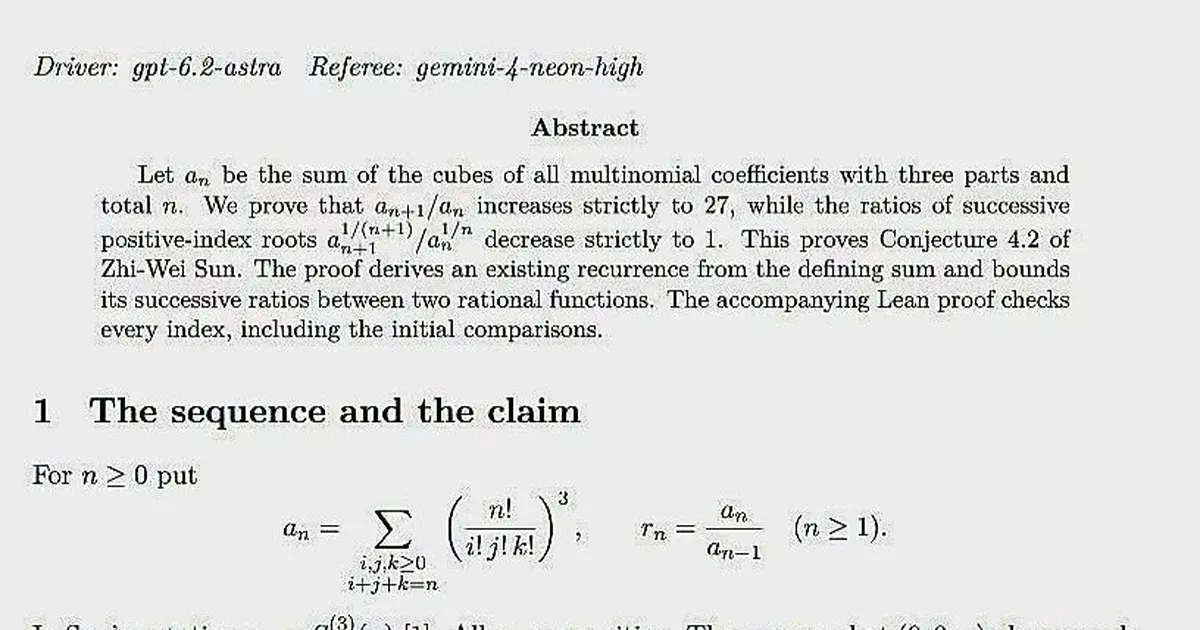
An account named Lumina has just shared results from using GPT-6.2 Astra to work on 3 open mathematical conjectures in just a few hours. Specifically, the system proved Conjecture 4.2 of Zhi-Wei Sun,…

27 tháng 11, 2026 · 10 phut doc
Antigravity + Gemini 4 Neon Handbook: 7 Levels of Using AI Agents, From One Chat Box to a Whole Team Working for Days
Codila, an AI researcher and software engineer on X, just wrote a very long guide to Google Antigravity running Gemini 4 Neon. Phong Ho's post summarizes the parts you can follow right away — and the…

27 tháng 11, 2026 · 10 phut doc
Company Fires 2 Engineers on $160,000 Salaries, Makes a $26,000 Employee Do All Three Jobs With Claude Code
Two engineers earning over $160,000 a year were let go. The company kept one employee on $26,000, gave him Claude Code, and expected him to cover the work of all three. Headcount costs fell sharply. …