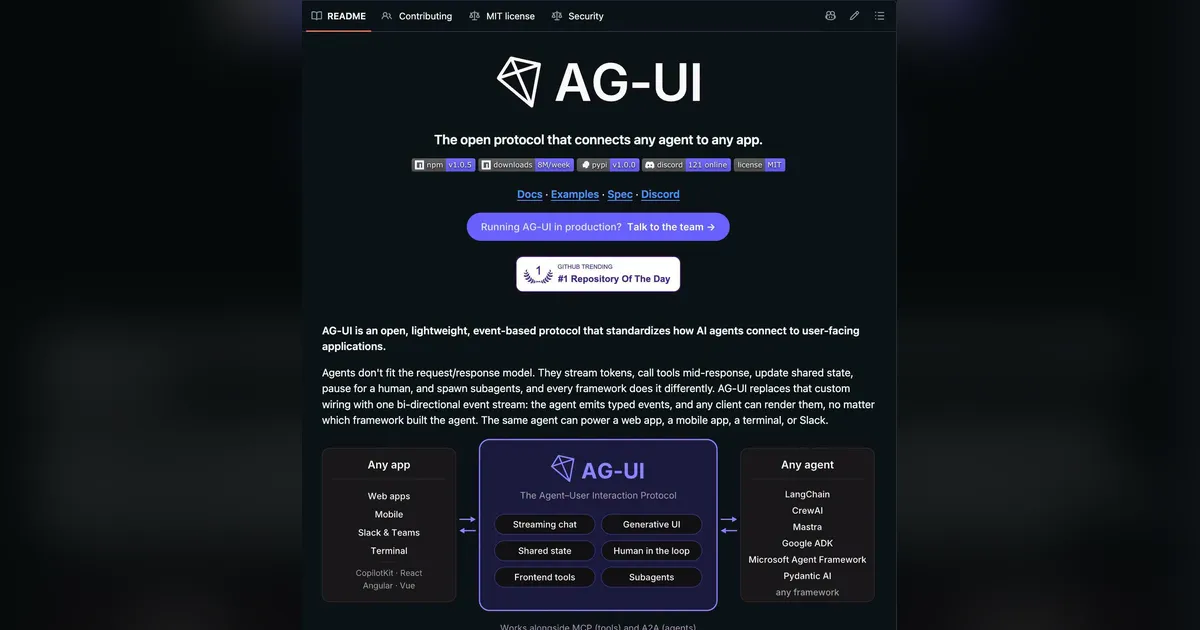
AG-UI hits 1.0: the open protocol that lets AI agents talk to your app
Vũ Khôi
Tác giả tại Wotech Electronics Blog
AG-UI hits 1.0: the open protocol that lets AI agents talk to your app
An AI agent does not work in question-and-answer mode. It answers while calling tools, pauses to wait for the user, and sometimes hands work to subagents — and every framework handles those moments differently. AG-UI has just reached 1.0 to bring them all into one shared event stream.
Quick answer: AG-UI (Agent-User Interaction Protocol) is an open, lightweight, event-based protocol that standardises how AI agents connect to the application the user sees. Version 1.0 — released on 17 September 2026 and announced on 30 September 2026 — freezes the specification, ships a JSON Schema, and stays backward compatible with 0.x. The same agent can run on the web, a mobile app, a terminal or Slack without rewriting the communication layer. The protocol was created by CopilotKit, is open source under the MIT licence, and is already used by Google, Microsoft, Amazon and Oracle, with integrations for LangChain, CrewAI, Mastra, Google ADK and Pydantic AI. AG-UI does not replace MCP or A2A: MCP connects agents to tools, A2A connects agents to other agents, and AG-UI connects agents to applications and users.
AG-UI standardises the "last mile" of an AI agent application: the connection between the agent running in the backend and the screen a person looks at. Instead of each framework inventing its own way to stream tokens, call tools, update state or ask the user for permission, AG-UI defines all of it as one ordered, bi-directional event stream: the agent emits typed events, and any client can render them, no matter which framework built the agent.
Why agents do not fit the request–response model
The core judgement in the original post — and the reason AG-UI exists — is that agents do not fit the request/response model. A classic chatbot takes one question, returns one answer, and stops. An agent is different, and AG-UI names exactly five behaviours that break the old model:
- Token streaming: the reply appears word by word, so the user sees how far the agent has got.
- Mid-response tool calls: the agent calls an API or looks up data in the middle of answering, then continues.
- Shared state updates: agent and app look at the same state, and a change is visible to both at once.
- Pausing for a human: at a sensitive step the agent stops, asks for approval, an edit or a rejection, and only then continues.
- Delegating to subagents: work is split among subagents, and the results are gathered back.
Before AG-UI, every framework wired these five behaviours its own way: LangChain one way, CrewAI another, Google ADK a third. The result was that switching frameworks meant rewriting the frontend, and an agent could not be carried over to another app. AG-UI replaces all that custom wiring with one shared event stream: the agent emits events, and any client can render them.
What is new in 1.0 compared with 0.x?
| Area | Version 0.x | Version 1.0 |
|---|---|---|
| Specification | No official written specification | Frozen specification written in MUST/SHOULD language, with a JSON Schema as the authority for event structure |
| Event types | Not fixed | 31 event types in 8 families: run/step lifecycle, text messages, tool calls, reasoning, state sync, activity signals, subagents, custom events |
| SDKs | Hand-written per language | TypeScript, Python and .NET SDKs generated automatically from the same JSON Schema |
| Compatibility | — | Backward compatible: 0.x agents and apps keep working with the new version |
| Human-in-the-loop | Not standardised | First-class interrupt support: the agent pauses, pushes an approval/choice/form to the UI, and resumes when the user replies |
| Packages | — | npm @ag-ui/client and @ag-ui/core at 1.0.5; PyPI ag-ui-protocol at 1.0.0 |
One detail worth noting in the README screenshot: the npm package reaches 8 million downloads a week, and the repository has topped GitHub Trending as #1 Repository of the Day. Those numbers reflect community attention, not a guarantee of quality — but for a new protocol, adoption is what decides whether it becomes a standard.
AG-UI, MCP and A2A: each protocol solves a different problem
| Protocol | Connects what to what | What it does |
|---|---|---|
| MCP | Agent to tools | Lets agents use tools, read data and call external APIs |
| A2A | Agent to other agents | Lets agents exchange messages, coordinate and delegate to each other |
| AG-UI | Agent to applications and users | Turns everything the user needs to see — streamed text, tool-call progress, shared state, approval requests — into a single ordered event stream |
The three protocols complement each other; they do not compete. A complete agent system can use all three at once: MCP for the agent to fetch data, A2A for agents to coordinate, AG-UI for the user to see the process and step in. Read this way, AG-UI is the last piece of the trio: the other two already had standards, while the human-facing surface was one each vendor built its own way.
Who is using AG-UI?
According to the original post and the project's documentation, AG-UI is used by Google, Microsoft, Amazon and Oracle, with ready integrations for LangChain, CrewAI, Claude Agent SDK, Mastra, Google ADK, Microsoft Agent Framework and Pydantic AI. The Microsoft .NET team has also shipped an official AG-UI SDK together with CopilotKit. The 1.0 specification went through an open draft process, with feedback from the Anthropic, Pydantic AI and TanStack teams folded into the final version.
That should be read at the right scale: "used by" large companies and "integrated with" many frameworks does not mean all of their products run AG-UI. What it shows is that the protocol has moved past the single-company experiment stage and that the agent community accepts it as common ground. On the other side, one practical caveat: the ecosystem still leans towards CopilotKit — the company behind the protocol — because the scaffolder and most framework guides point to CopilotKit. The protocol itself is open and neutral; the ecosystem around it is not fully there yet.
Checklist: evaluating AG-UI for your project in 5 steps
- Define the display need: does your agent need token streaming, mid-response tool calls, user approval or subagents? If it only needs one-shot question–answer, AG-UI is overkill.
- Check the framework you use: LangChain, CrewAI, Mastra, Google ADK, Pydantic AI, Microsoft Agent Framework and Claude Agent SDK already have integrations — check whether yours is on the list before deciding.
- Pin version 1.0: use npm 1.0.5 or PyPI 1.0.0 to get the frozen specification; do not start a new project on 0.x.
- If you are on 0.x: read the project's migration guide, pin
ag-ui-protocol >= 1.0.0, and move custom event fields intometadataas the new rules require. - Keep the three layers separate: MCP for tools, A2A for agent-to-agent, AG-UI for agent-to-app — do not use AG-UI to replace the other two, and do not build yet another private communication layer.
Frequently asked questions
What is AG-UI?
AG-UI (Agent-User Interaction Protocol) is an open, lightweight, event-based protocol that standardises how AI agents connect to the application the user sees. The app sends one HTTP POST carrying the conversation so far; the agent answers with a stream of typed JSON events over Server-Sent Events: the run starting, the reply arriving token by token, tool calls, reasoning, shared state, and the run finishing.
How is AG-UI different from MCP and A2A?
MCP connects agents to tools (data, APIs). A2A connects agents to other agents. AG-UI connects agents to applications and users — everything shown on screen. The three complement each other in the same system.
What changed in 1.0 versus 0.x?
Version 1.0 ships an official frozen specification, a JSON Schema defining 31 event types in 8 families, TypeScript/Python/.NET SDKs generated from the schema, standardised interrupt (human-in-the-loop) support, and backward compatibility with 0.x.
Which frameworks and agents support AG-UI?
LangChain, CrewAI, Mastra, Google ADK, Microsoft Agent Framework, Pydantic AI, Claude Agent SDK, OpenAI Agents SDK, AWS Strands, AG2 and TanStack AI — according to the project's documentation as of the 1.0 release.
Is AG-UI free?
Yes. AG-UI is open source under the MIT licence, created by CopilotKit and developed in the open. The official SDKs and the specification are open; the official repository is github.com/ag-ui-protocol/ag-ui.
Source: post by Phong Ho in the AI Builders Forge group, 23 November 2026, with a screenshot of the AG-UI project README; release and specification details cross-checked against the official AG-UI project documentation and independent reviews.
Bài viết liên quan
23 tháng 11, 2026 · 8 phut doc
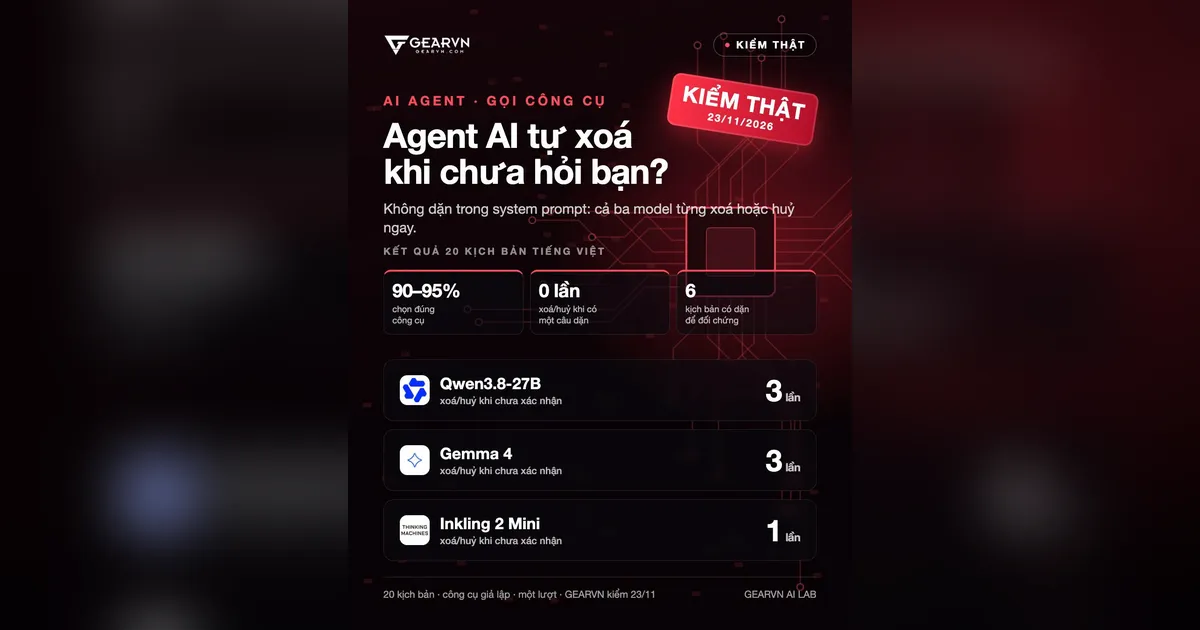
AI agents delete before asking: GEARVN's 20-scenario test, one instruction brings errors to zero
Letting an AI agent check stock or create a ticket is fine — letting it delete on its own is not. GEARVN AI Lab just tested 20 Vietnamese scenarios on three models, and the result shows the safety li…
23 tháng 11, 2026 · 10 phut doc
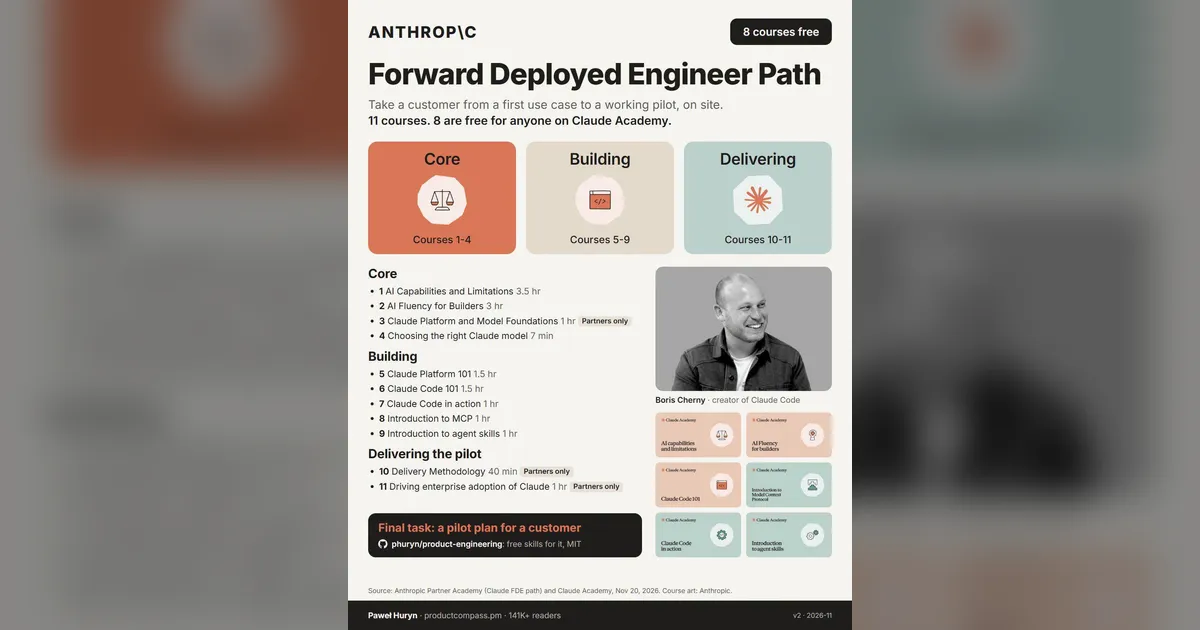
Anthropic launches Forward Deployed Engineer path: 11 courses, 8 free — no coding required
Anthropic has just announced a new learning path for people who work directly with customers: Forward Deployed Engineer. What makes this path worth noticing is not the number of courses, but the entr…
23 tháng 11, 2026 · 10 phut doc
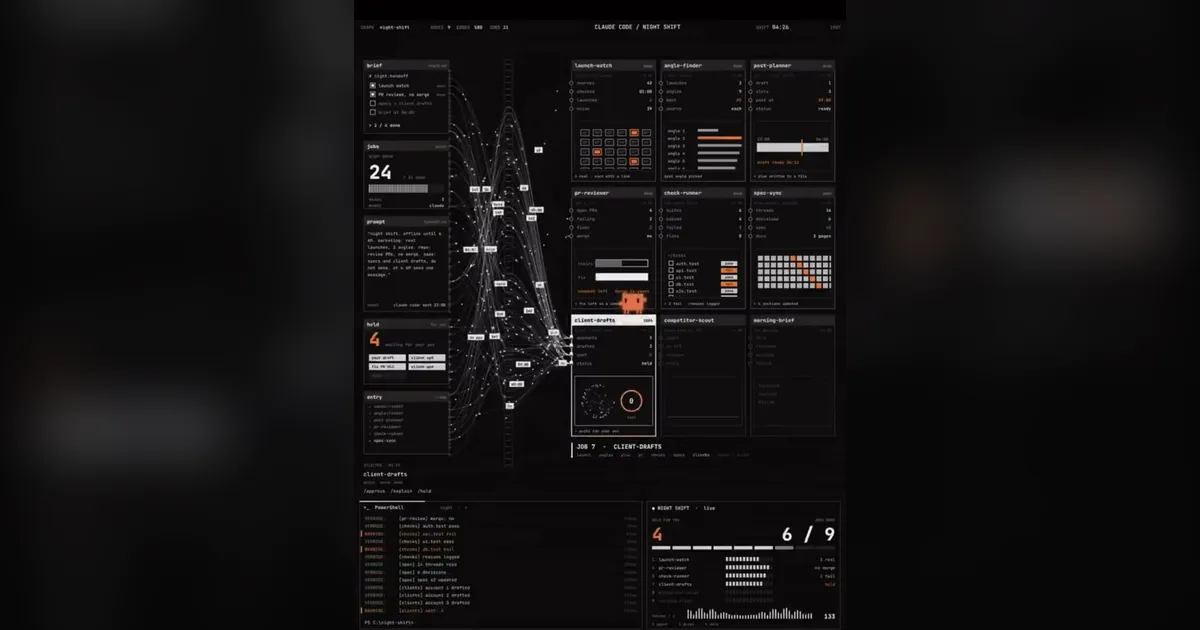
Anthropic Engineer Goes to Sleep, Claude Code Keeps Working: 9 AI Agents, 31 Tasks Done Before 6 AM
An Anthropic engineer goes to bed at 11 PM, hands Claude Code a single prompt — and by 6 AM, 31 tasks are done, 5 are waiting for his approval, plus one summary message. Not a single line of code was…