Anthropic Engineer Goes to Sleep, Claude Code Keeps Working: 9 AI Agents, 31 Tasks Done Before 6 AM
Vũ Khôi
Tác giả tại Wotech Electronics Blog
Anthropic Engineer Goes to Sleep, Claude Code Keeps Working: 9 AI Agents, 31 Tasks Done Before 6 AM
An Anthropic engineer goes to bed at 11 PM, hands Claude Code a single prompt — and by 6 AM, 31 tasks are done, 5 are waiting for his approval, plus one summary message. Not a single line of code was merged, not a single email sent without him.
Quick answer: A Claude Code "night shift" means running Claude Code overnight: before bed, the user hands over all pending work in a single prompt, and 9 AI agents split the work by lane — tracking product launches, reviewing PRs, running tests, drafting customer emails, researching competitor prices. Anything risky moves to a "Pending approval" state and stops there. In the morning, the user gets one summary message with three sections: Done, Pending approval, Failed. According to a post by Bình An (23 November 2026), the system was copied from Anthropic engineers themselves, and on the night described it finished 31 tasks before 6 AM. What makes the night shift valuable is not 9 agents running in parallel, but the approval boundary: agents only prepare, humans keep every merge and send decision.
A Claude Code "night shift" is a shift with no human on duty: the user is offline from 11 PM to 6 AM while a team of AI agents works overnight on a single handover prompt. Unlike opening Claude Code and waiting for each reply, the night shift reverses the roles — the human assigns work once and goes to sleep, the agents divide the work, do it, report on it, and only stop to ask at risky items. The next morning, instead of a morning full of backlog, the user starts the day with a short summary and an approval queue.
How does the night shift system work?
According to the post, the night shift runs on a fixed schedule, with every step defined in advance in the handover prompt:
- 11 PM — assign work with a single prompt. The prompt tells the agents to read the inbox, calendar and today's conversations, put every task into a queue, then give each agent its own lane: product launches, PR review, testing, spec writing, customer emails, competitor price research.
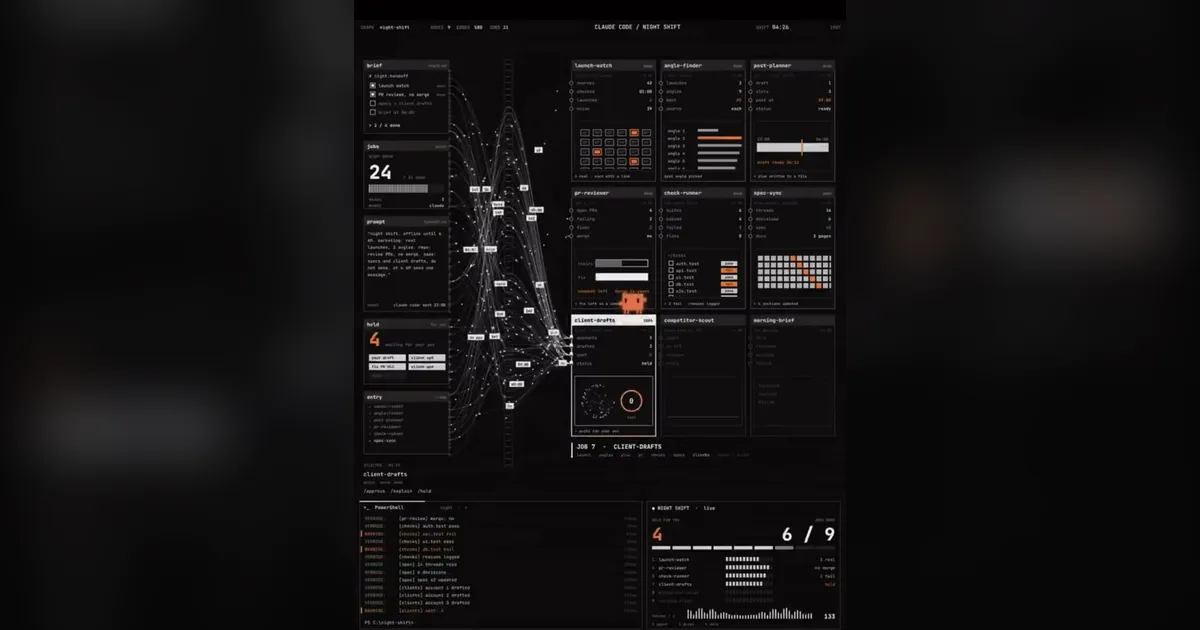
- Overnight — each agent has its own workspace and task. The dashboard in the video shows the system tracking 31 jobs with 9 agents (nodes) running at once, split into specialised panels: launch-watch tracks launches, pr-reviewer reviews PRs, check-runner runs tests, spec-sync updates specs, client-drafts writes customer emails, competitor-scout researches rivals, morning-brief prepares the morning briefing.
- Risky work — moves to "Pending approval" and stops. This is the hard rule of the night shift: review PRs but absolutely never merge; if a fix is needed, leave a comment. Draft customer emails but absolutely never send them. Anything risky goes into the queue and waits for the human.
- 6 AM — a single summary message. The message has exactly three sections: Done, Pending approval, Failed. On the night described: 31 tasks done, 5 waiting for approval, and a summary in the inbox.
The dashboard in the video shows one more notable detail: the run log records test failures openly — auth.test fail, db.test fail — with reasons, instead of hiding them. A system that works overnight yet logs its failures transparently is one where the user can see exactly what needs a second look in the morning.
Why the night shift works — and why the key is not the number of agents
This is the grounded judgement the original post makes, and the point that makes this story worth reading beyond a generic AI tip. The author writes: "Most people still do these tasks themselves every morning. Claude does them overnight." But the difference is not that agents replace humans — it is how the work is organised: preparation goes to the machine, decisions stay with the human.
| Aspect | The old way (every morning) | Claude Code night shift | How to read it |
|---|---|---|---|
| Who does the work | Doing each backlog item yourself every morning | 9 agents in separate lanes, running in parallel overnight | Bigger scale, but the real value is a morning with no backlog |
| Risky decisions | Weighing each merge and each email send yourself | Merge and send are absolutely forbidden; risky work goes to "Pending approval" | The approval boundary is the core safety feature — without it, the night shift is unusable |
| Testing | Running tests yourself when free | check-runner runs tests overnight, logging failures and reasons | Failures logged transparently mean the morning review knows what to fix |
| Progress | No overall view | Live dashboard: 31 jobs, 9 agents, each lane with its own status | Real-time transparency, but a "done" count only means something when the task was well defined |
| Biggest weakness | Mornings consumed by repetitive work | A vague prompt can make agents go wrong at scale overnight | The night shift amplifies prompt quality: the clearer the handover, the better the night; vague handover, more morning fixes |
In other words, the night shift does not turn Claude Code into an autonomous employee — it turns it into a preparation shift: doing all the work that can be prepared in advance, and neatly queuing the work that needs a human decision. The next morning, the user does not start from scratch, but does exactly the work only a human can do: approve, redirect, and send.
How to try a night shift of your own
The "night shift" prompt in the original post is the most directly applicable part — it is already a complete process, just swap in your own work. The five steps below come directly from that prompt:
- Write a single handover prompt, before bedtime. State clearly where agents should read from (inbox, calendar, today's conversations) and put every task into a queue. The more specific the sources, the less agents have to guess.
- Split work by lane, one agent per lane. The lanes in the original post: product launches, PR review, testing, spec writing, customer emails, competitor price research. Keep this structure and replace them with your own lanes.
- Absolutely forbid two actions: merge and send. State it in the prompt: review PRs but never merge; if a fix is needed, leave a comment; draft emails but never send. This is a safety rule, not a suggestion.
- Send all risky work to "Pending approval". Never let agents decide risky items themselves — even when they seem certain. This queue is the first thing you look at in the morning.
- Schedule the summary: exactly 6 AM, one single message. The message has only three sections: Done, Pending approval, Failed. No long reports, no scattered messages overnight.
Here is the original "night shift" prompt from the post (structure preserved, formatted for easy copying):
Night shift. I will be offline until 6 AM.

- Read the inbox, calendar, and today's conversations.
  Put all tasks into a queue.
- Give each agent its own lane: product launches, PR review,
  testing, spec writing, customer emails, competitor price research.
- Review PRs but absolutely never merge. If a fix is needed,
  leave a comment.
- Draft all customer emails but absolutely never send them.
- Move anything risky to "Pending approval" and wait for my approval.
- At exactly 6 AM, send me a single message with:
  Done, Pending approval, Failed.
For the first try, start with the lowest-risk lanes — for example only launch tracking and competitor price research — then gradually add PR review and email drafting once you are used to how agents report. The fewer the lanes, the easier the morning review.
Frequently asked questions
Is the night shift safe while I am asleep?
As safe as the prompt allows. In the original design, the two most dangerous actions — merging code and sending emails — are absolutely forbidden, and all risky work stops at "Pending approval". Agents cannot cross these rules on their own if the prompt states them clearly. The remaining risk is prompt quality: the vaguer the handover, the more likely agents drift off course overnight.
Can the "31 tasks done before 6 AM" figure be trusted?
This is the figure the author shared about his own night of work — it has no independent verification. Read it as an example of the scale that is possible, not a promise that every night shift yields 31 tasks. What the video does verify is the system structure: 9 agents, 31 jobs in the queue, and specialised lanes on the dashboard.
Does the night shift need a paid Claude Code plan?
The post does not say which plan was used. Running 9 agents in parallel all night consumes a significant amount of tokens, so in practice you should weigh token costs and your plan's usage limits before letting agents run all night.
What happens when an agent fails or a test fails?
According to the dashboard in the video, failed tests are recorded in the log with reasons (for example auth.test fail, db.test fail), and the item appears under "Failed" in the 6 AM summary message. The user reviews the log in the morning and decides whether to fix or reassign — the agent does not fix and merge on its own.
Can the night shift be used for non-coding work?
According to the original post, yes — at least two lanes involve no code at all: drafting customer emails and researching competitor prices. The general principle stays the same: work that only needs preparation goes to agents, work that needs a decision stays with the human.
Where can I watch the original video?
The video was posted by Bình An in the Facebook group Sắc màu cuộc sống xa quê (23 November 2026); the source credited in the post is Gipp. The "Claude Code / Night Shift" dashboard in the video shows the working lanes and run log directly.
Source: post by Bình An in the Facebook group Sắc màu cuộc sống xa quê (23 November 2026), source credited in the post as Gipp. The figures of 31 completed tasks and 5 pending approvals are as shared by the author, without independent verification; the dashboard figures (31 jobs, 9 agents) are a frame from the video at the time of posting and may change in real time.
Bài viết liên quan
23 tháng 11, 2026 · 8 phut doc
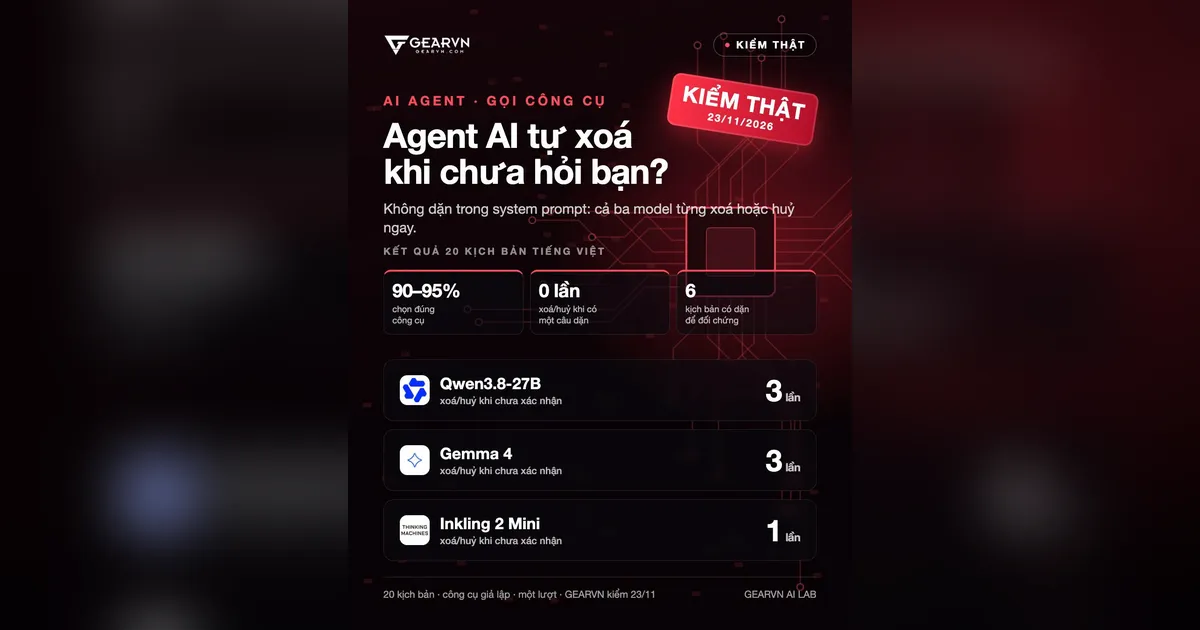
AI agents delete before asking: GEARVN's 20-scenario test, one instruction brings errors to zero
Letting an AI agent check stock or create a ticket is fine — letting it delete on its own is not. GEARVN AI Lab just tested 20 Vietnamese scenarios on three models, and the result shows the safety li…
23 tháng 11, 2026 · 10 phut doc
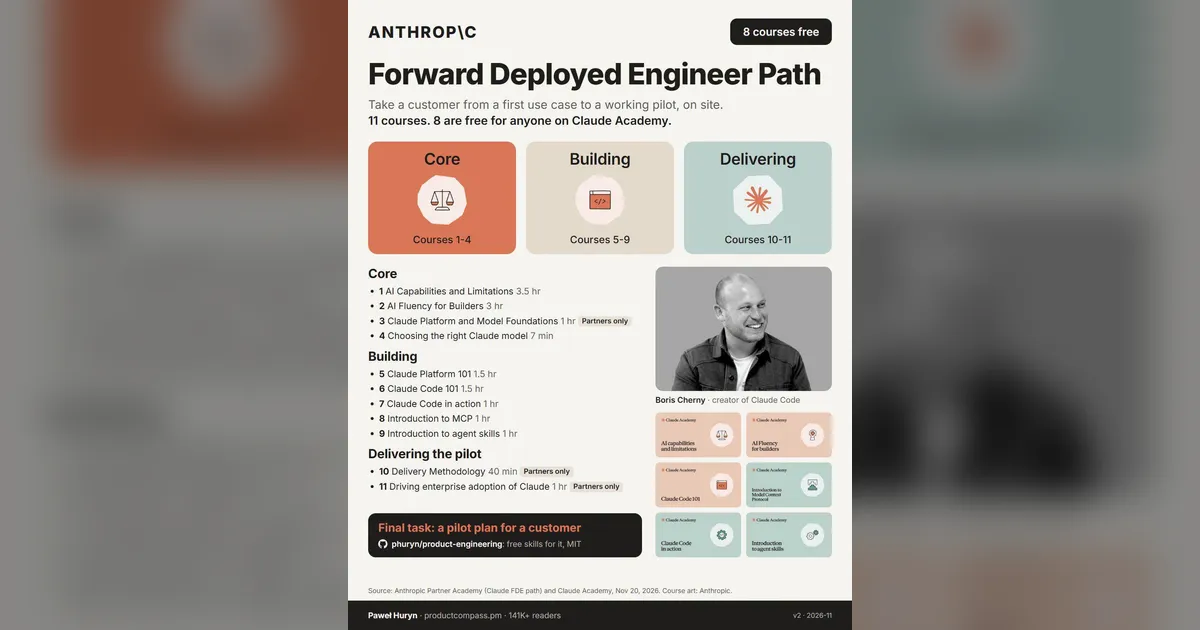
Anthropic launches Forward Deployed Engineer path: 11 courses, 8 free — no coding required
Anthropic has just announced a new learning path for people who work directly with customers: Forward Deployed Engineer. What makes this path worth noticing is not the number of courses, but the entr…
23 tháng 11, 2026 · 8 phut doc
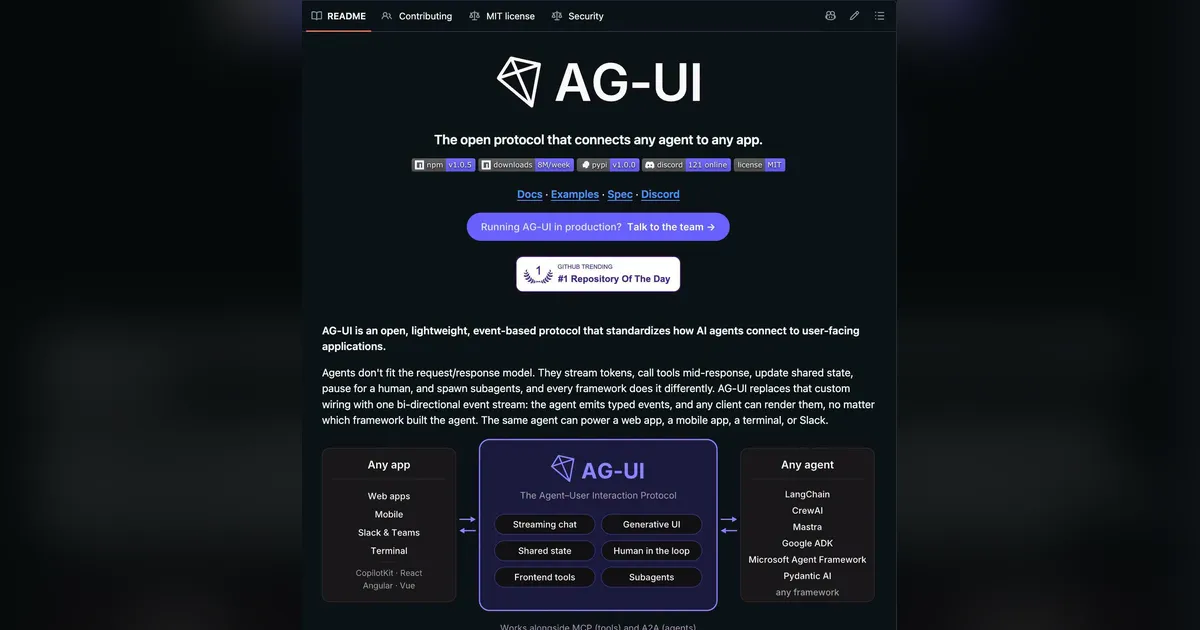
AG-UI hits 1.0: the open protocol that lets AI agents talk to your app
An AI agent does not work in question-and-answer mode. It answers while calling tools, pauses to wait for the user, and sometimes hands work to subagents — and every framework handles those moments d…